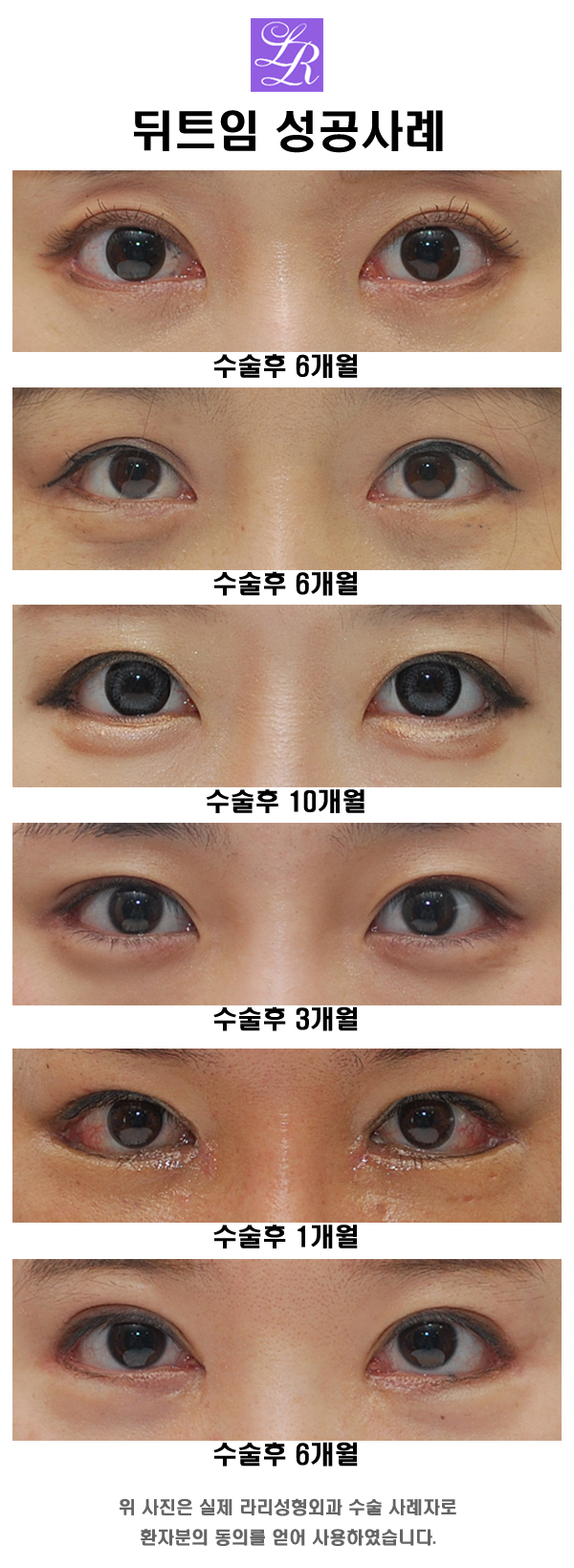
Is lateral canthoplasty a surgery that should absolutely never be performed?
No. If lateral canthoplasty were a plastic surgery procedure that should never be done under any circumstances, then double eyelid surgery and rhinoplasty would also be procedures that should never be done.
Not every plastic surgery procedure is satisfying, and problems can arise.
Among the posts circulating online, there are many people who have actually undergone lateral canthoplasty and complain that they were left with scars or that the corner of the eye became reattached. The reasons people think lateral canthoplasty should be avoided are:
-
I had lateral canthoplasty, but there was no effect and it reattached.
-
After lateral canthoplasty, only scars remained and the outer corner of the eye became deformed into a ㄷ shape.
-
Lateral canthoplasty requires cutting ligaments, so it is a surgery that should not be done.
-
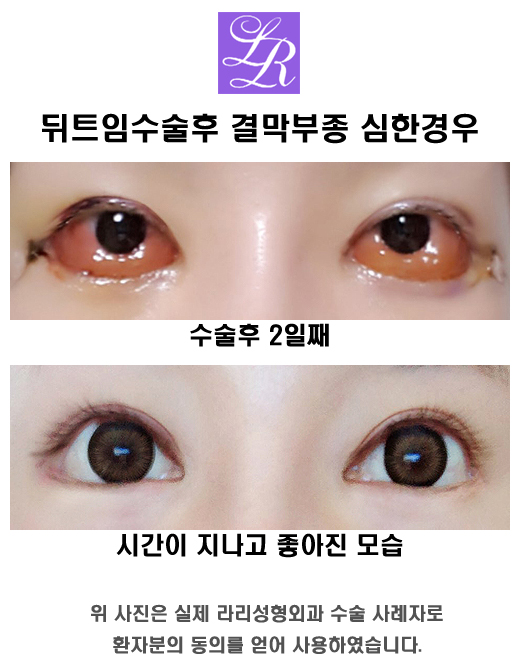
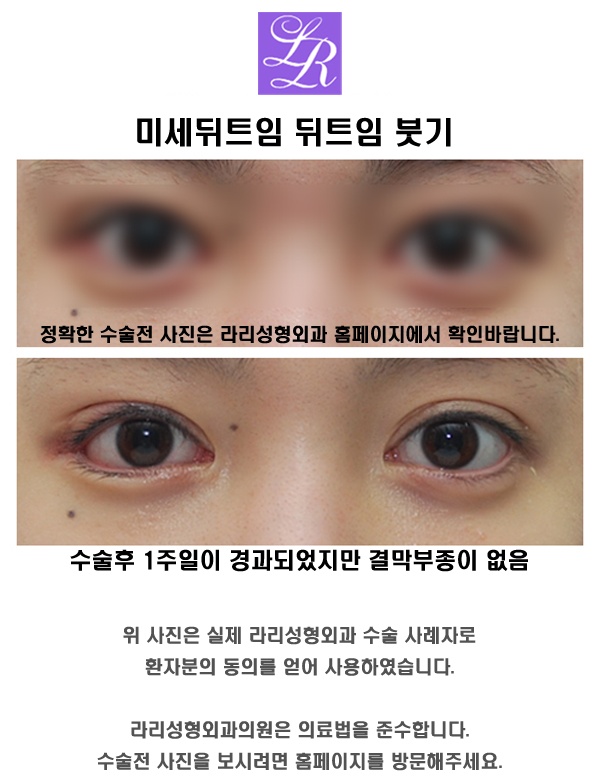
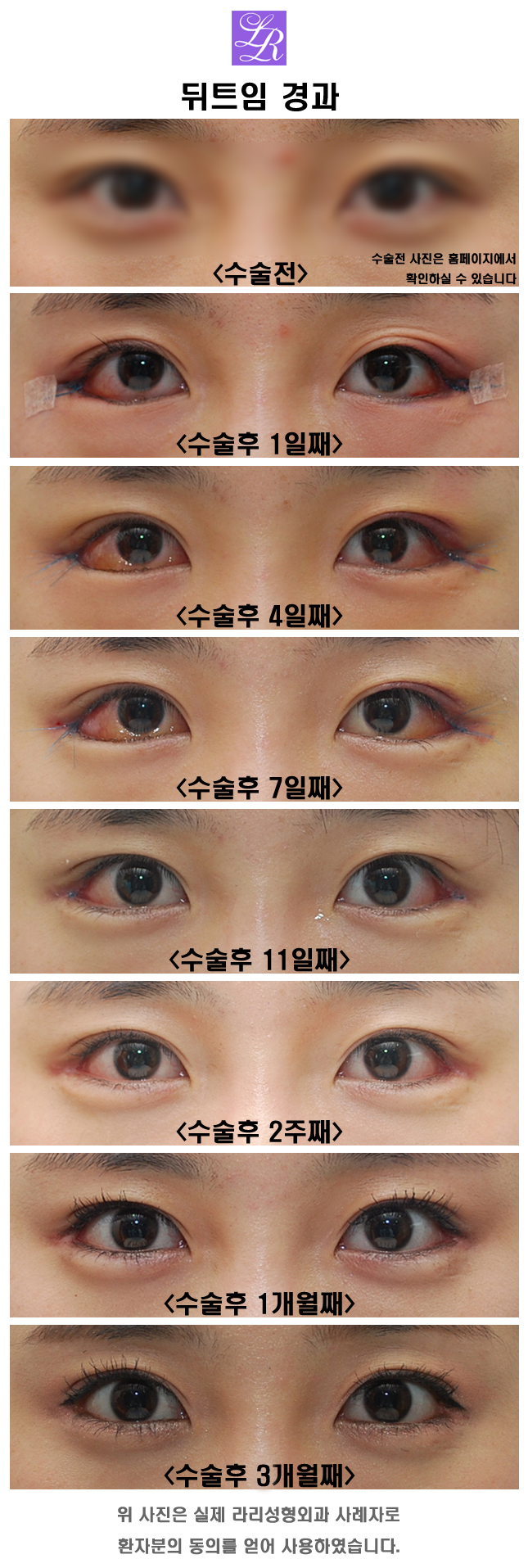
Lateral canthoplasty has many side effects, such as redness, conjunctival edema, and corneal indentation. And so on.
Let’s go over the above with objective medical data and examples from actual surgical cases.
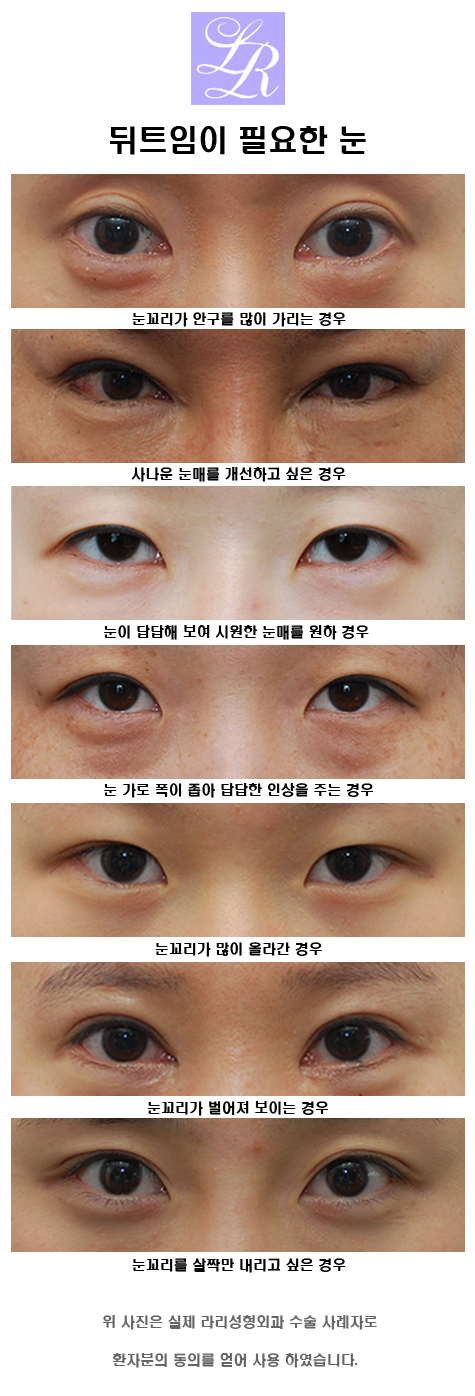
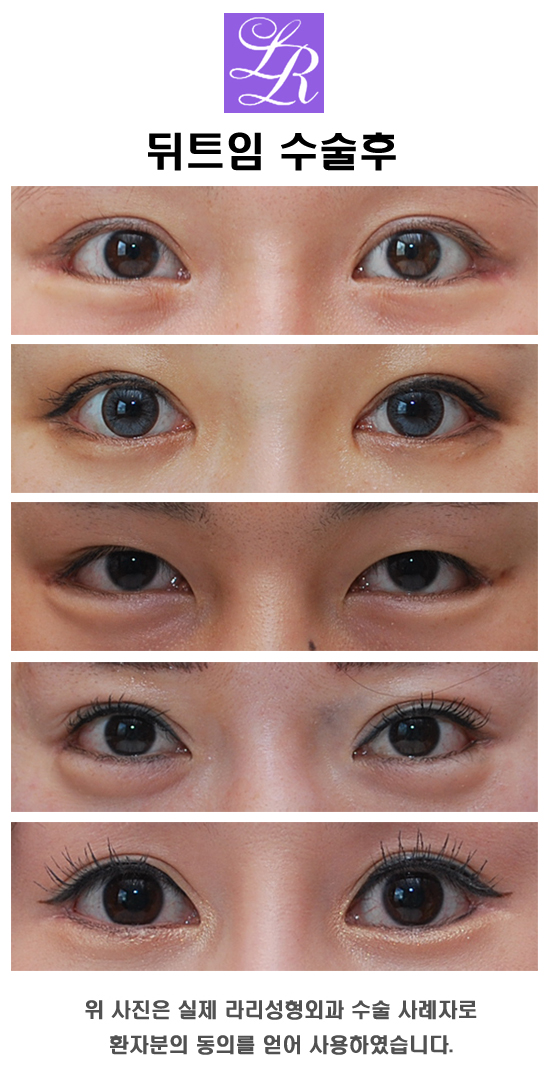
Does lateral canthoplasty reattach without any effect?
No. There are cases where it does not reattach.
People usually think that lateral canthoplasty often reattaches, but that is not necessarily true. Early lateral canthoplasty procedures brought the inner conjunctiva outward or cut the border line at the outer corner of the eye, called the gray line, in order to expand the white of the eye. As a result, the effect was minimal and there were many problems such as ectropion of the outer corner of the eye. This can be considered a limitation of simple lateral canthoplasty, which aimed only to widen the outer corner of the eye. To reduce these problems, the surgery had to be performed as conservatively as possible, and as a result, it reattached again.
Recognizing these limitations, surgeons began performing lateral canthoplasty that opens the outer corner of the eye not only horizontally but also vertically, and the culmination of that approach is downward lateral canthoplasty.
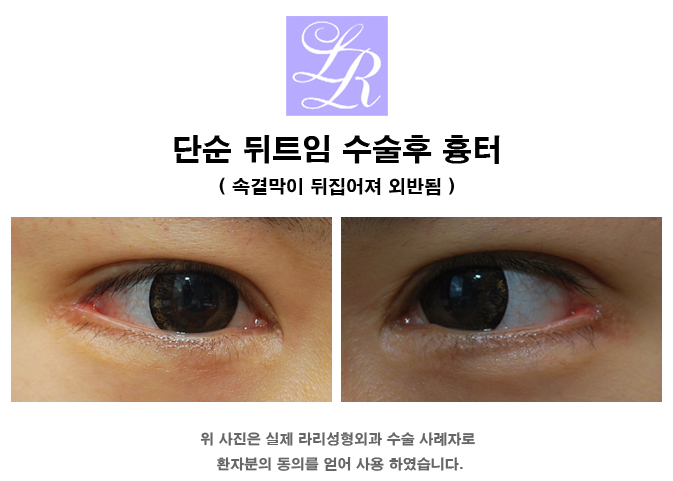


Does downward lateral canthoplasty leave a lot of scars and cause a ㄷ-shaped deformity?
Downward lateral canthoplasty does not necessarily leave a lot of scars or cause a ㄷ-shaped deformity.
To explain it in an easy-to-understand way, the claim that lateral canthoplasty should not be done because it has no effect and reattaches is the same as saying that buried double eyelid surgery should not be done because it will loosen over time. Likewise, saying that lateral canthoplasty should not be done because it leaves scars is the same as saying that incisional double eyelid surgery should not be done because it leaves scars.
Just as buried double eyelid surgery does not loosen when applied to the right eyes, and incisional surgery can, when performed properly, sometimes leave scars that are less visible than those from buried double eyelid surgery, downward lateral canthoplasty can also, when performed appropriately on the right eyes, leave almost no scars and often does not cause a ㄷ-shaped deformity.
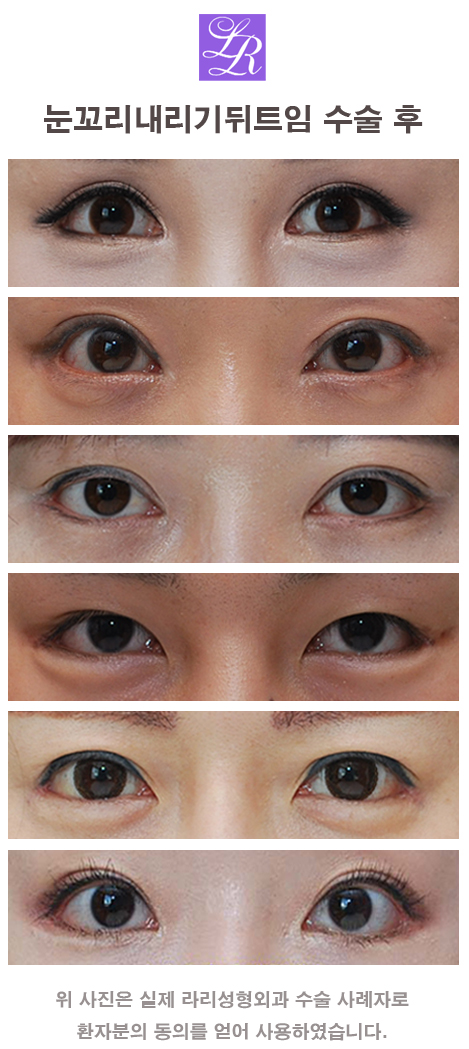
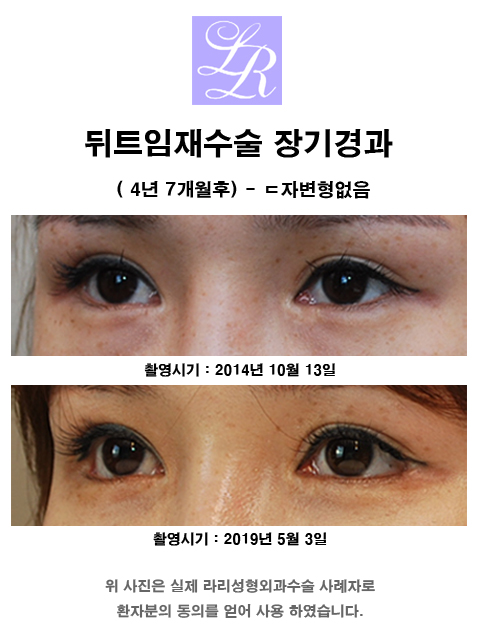
Does lateral canthoplasty cut the lateral canthal ligament, so it should never be done?
Lateral canthal surgery, which cuts the lateral canthal ligament, is a procedure learned from the United States, a medically advanced country.
Also, because the lateral canthal ligament is located deep inside where it cannot be seen, it is impossible to cut the entire ligament.
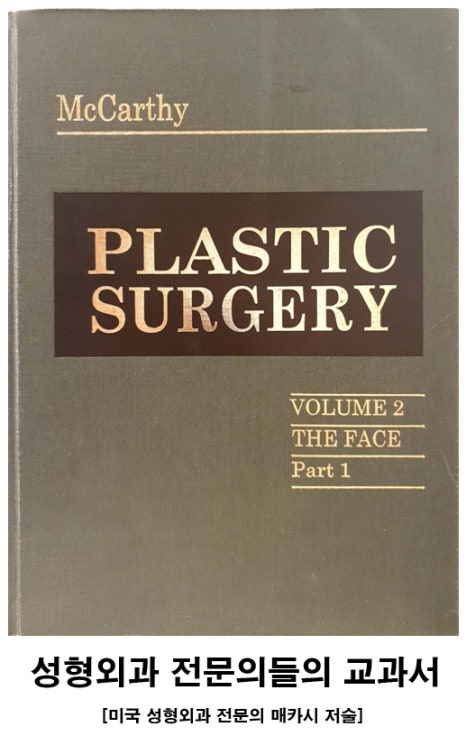
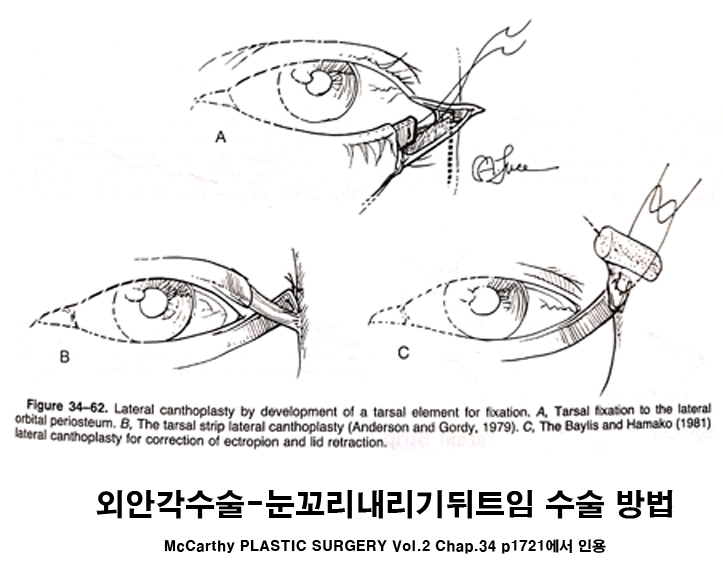
Downward lateral canthoplasty is a surgery that is almost identical to lateral canthoplasty described in Plastic Surgery, a plastic surgery textbook written by McCarthy, an American plastic surgery textbook author. The only difference is the surgical vector—whether the outer corner of the eye is moved downward or upward. If there is a plastic surgeon who says that lateral canthoplasty should never be done because it cuts the lateral canthal ligament and has no basis, it is highly likely that they either do not know because they have not even read a plastic surgery textbook, or that they are a revision specialist trying to encourage expensive lateral canthoplasty revision surgery.
Various methods of epicanthoplasty and epicanthoplasty revision surgery are also nearly identical procedures derived from a single operation. Only the vaguely named labels attached by each doctor differ. Just because the names are different does not mean they are different surgeries, and since they are all ultimately similar procedures, it is hard to say that one method is clearly superior. In fact, there are virtually no plastic surgery procedures that can be said to absolutely never be done.
I’ve heard lateral canthoplasty has many side effects: redness, conjunctival edema, corneal indentation...
It is not a side effect, just as bruising around the eyes after nose surgery is not considered a side effect!
Unlike double eyelid surgery or epicanthoplasty, lateral canthoplasty is a procedure that puts stress on the conjunctiva. This is the part commonly called the white of the eye. Unlike double eyelid surgery or epicanthoplasty, lateral canthoplasty involves incising not only the outer skin but also the inner conjunctiva of the white of the eye, which is why redness and conjunctival edema can occur.
Any surgery that involves incising the outer skin can cause swelling and bruising, and the bruising and swelling that appear in the white part of the eyeball are redness and conjunctival edema. Redness appears red because blood has broken and collected, showing through the transparent conjunctiva under the white background. Bruising also appears bluish through yellow skin because blood has collected under the skin. Likewise, if swelling is the accumulation of tissue exudate under thick skin, conjunctival edema is the accumulation of yellowish tissue exudate under the transparent ocular conjunctiva.
Corneal indentation refers to the phenomenon in which the cornea, the black part of the eye, appears sunken because severe dry eye develops due to conjunctival edema. Since this is a reversible drying of the cornea, it usually improves within a day or two if artificial tears are used properly.

So! Has some of the misunderstanding about lateral canthoplasty been cleared up now?
The important thing is that no matter what plastic surgery it is, not everyone can be satisfied. Also, do not get caught by brokers on plastic surgery apps or in plastic surgery communities. If you are even a little curious or notice anything strange, make the effort to visit in person and have a thorough consultation with a board-certified plastic surgeon who has a lot of experience with lateral canthoplasty. Please remember that this is the surest way not to end up writing a failed-surgery review later!