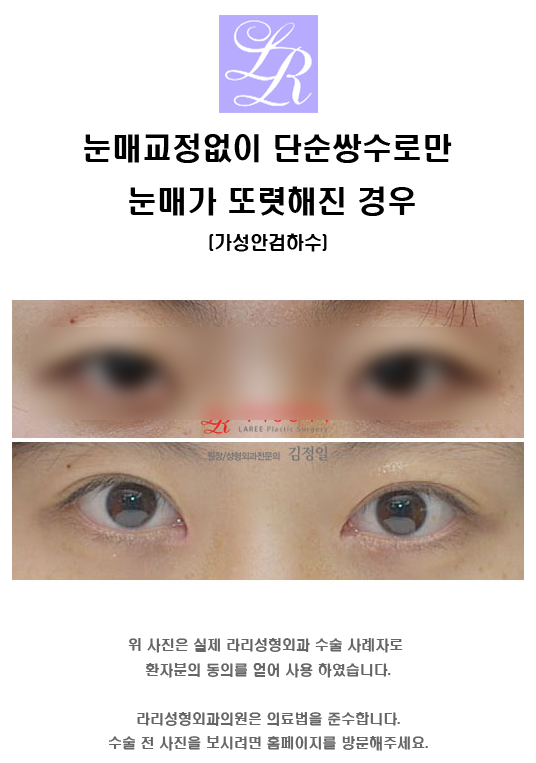
Double eyelid surgery is, quite literally, a surgery that creates a double eyelid crease, and ptosis correction is a surgery that makes the eyes open more clearly, regardless of whether a double eyelid is present.
Medically, ptosis correction can be considered the same as blepharoptosis correction, but ptosis refers to cases in which the eyes cannot be opened well at a pathological level. So, this is a term plastic surgeons created to distinguish between eyes that simply look sleepy within the normal range and eyes in a pathological state where they cannot open properly.
Double eyelid surgery
A surgery that creates a double eyelid crease; it has nothing to do with muscle surgery.
Ptosis correction surgery
A surgery that strengthens the muscles used to open sleepy eyes more clearly; it is unrelated to whether a double eyelid exists.
If you look at before-and-after photos of eye surgery circulating on the internet, it is common to see cases where people show before-and-after photos of double eyelid surgery and say that ptosis correction was performed. However, in fact, if the before-and-after photos show a change in the double eyelid line, it is more likely to be simple double eyelid surgery rather than ptosis correction.
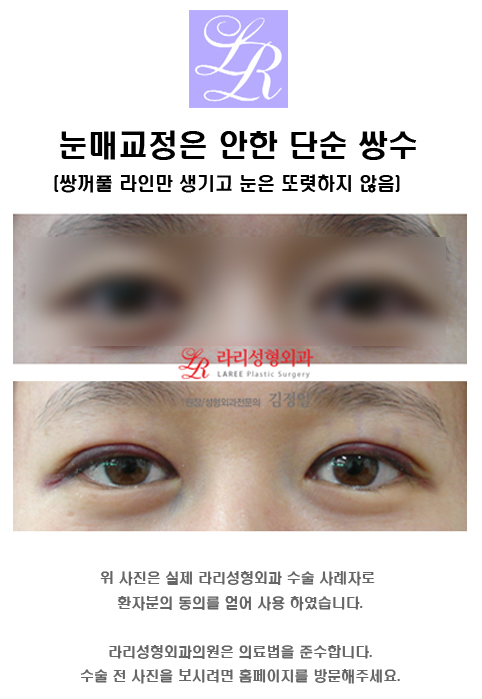
Of course, there are cases where muscle surgery is performed together with double eyelid surgery, but to accurately evaluate the degree of ptosis correction, you must judge only by how much of the eyeball is exposed, with no change in the double eyelid itself. If the before-and-after photos show double eyelid surgery and ptosis correction performed together, then the degree of eyeball exposure should increase along with the postoperative change in the double eyelid line.
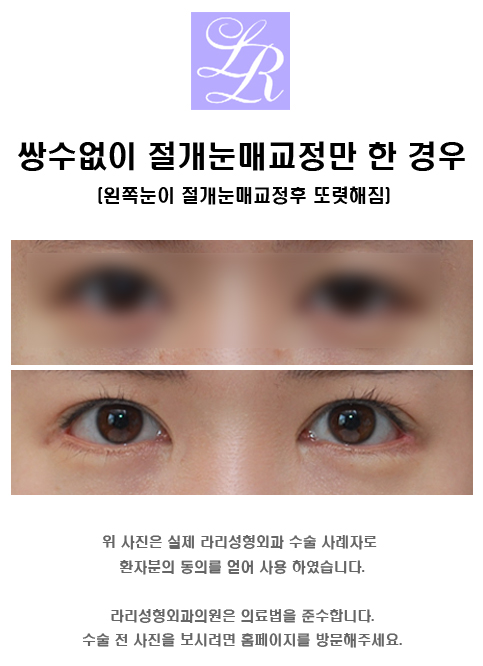
We have looked at the exact meanings of double eyelid surgery and ptosis correction, and now let’s compare incisional ptosis correction and incisional double eyelid surgery in terms of postoperative swelling.
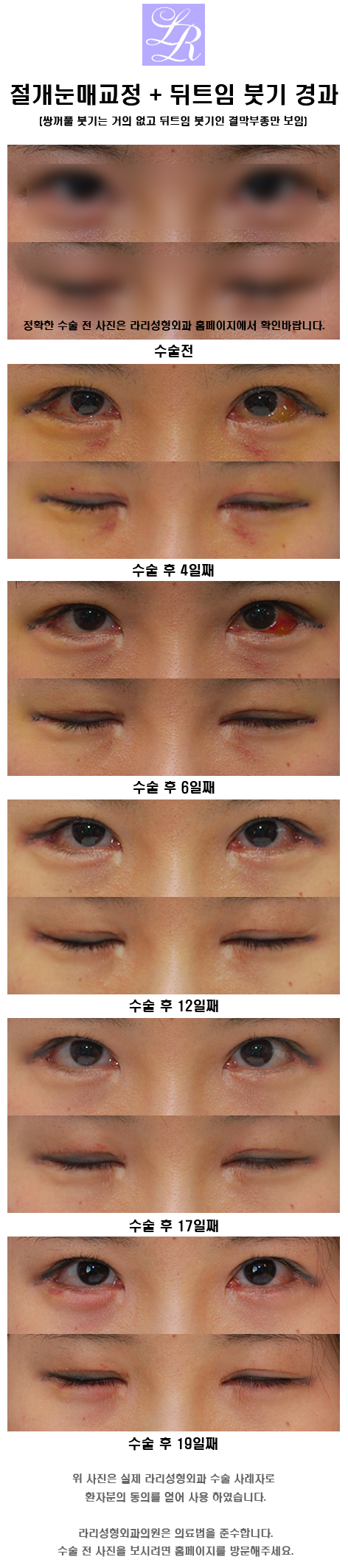 At first glance, one might think that ptosis correction would require dissection down to the deep area where the eye-opening muscles are located, so the swelling would be worse than with simple double eyelid surgery that only creates a crease. However, the result is the opposite. In fact, incisional ptosis correction, which involves deep dissection and pulling on the muscles, often causes less swelling than incisional double eyelid surgery.
With ptosis correction, there is direct swelling in the deep muscles, so the swelling visible from the outside is less. But with double eyelid surgery, the outer skin is pulled and fixed to the inner tarsal plate as the double eyelid line, so the swelling visible in the outer skin can be more pronounced.

There are also cases where the eyes become more defined even after only double eyelid surgery. In such cases, because there was no double eyelid and the skin covered the eyes so they were not visible, the skin folds upward during the surgery and the eyes appear more defined.
This is also called "pseudoptosis," and in fact, it is a case where the eyes become more defined through simple double eyelid surgery rather than through muscle strengthening with ptosis correction. Of course, in such cases, even if only simple double eyelid surgery was performed, there should never be any deception toward patients by claiming that ptosis correction was done.