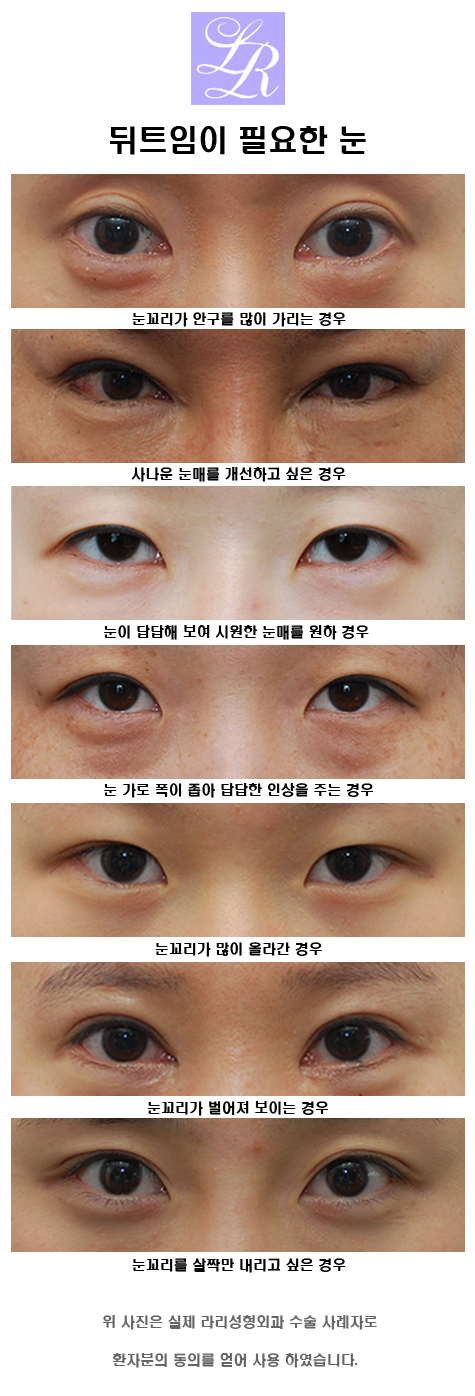
There are various surgeries performed around the eyes, and by location, they include the upper eyelid, lower eyelid, medial canthus, and lateral canthus. Surgeries performed on the upper eyelid include double eyelid surgery, ptosis correction, and upper blepharoplasty. Surgeries performed on the lower eyelid include lower blepharoplasty, aegyo-surgery, correction of ectropion and entropion, under-eye fat repositioning, and lower canthoplasty. The surgery performed on the medial canthus is epicanthoplasty, and finally, the surgery performed on the lateral canthus is lateral canthoplasty.
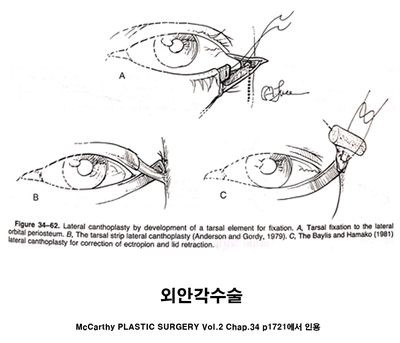
#Lateral canthopexy is, as the term suggests, a method of securing the lateral canthus, or the outer corner of the eye, to the periosteum with sutures when movement of the lateral canthus is needed. It is one of the surgical techniques that can be used in lower blepharoplasty, correction of ectropion, or lateral canthoplasty. Therefore, if you ask whether lateral canthopexy is the same as lateral canthoplasty, the answer is that when lateral canthopexy is performed in order to carry out lateral canthoplasty, it is considered a down-tilting lateral canthoplasty, while lateral canthoplasty performed without lateral canthopexy can be seen as a simple lateral canthoplasty or lower canthoplasty. The term #lateral canthal incision also refers to lateral canthoplasty performed on the lateral canthus.
Lateral canthopexy
Used as a method of lateral canthoplasty and also in lower blepharoplasty, etc.
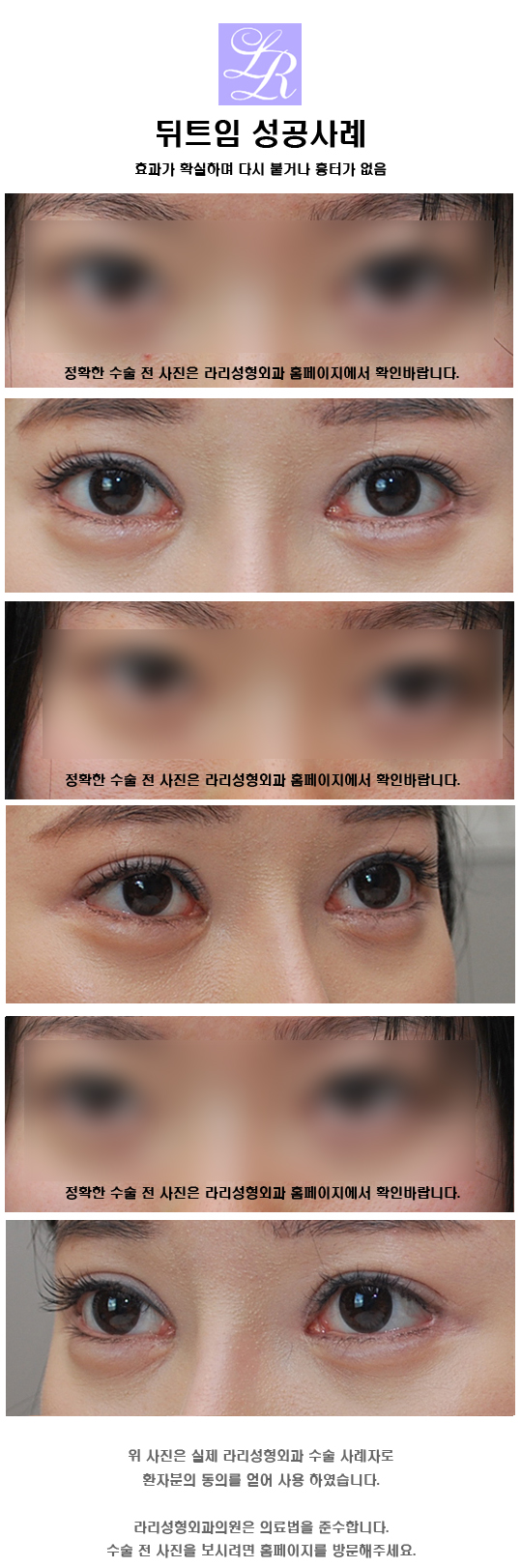
#Down-tilting lateral canthoplasty is a lateral canthoplasty that lowers the outer corner of the eye so that the eye looks softer or appears larger. Unlike simple lateral canthoplasty, the change in the eye shape can be seen even from the front, so its effect is clear. At this time, lateral canthopexy is performed to prevent the outer corner from reattaching or recurring after surgery and to lower the outer corner. This is the significance of lateral canthopexy in lateral canthoplasty.
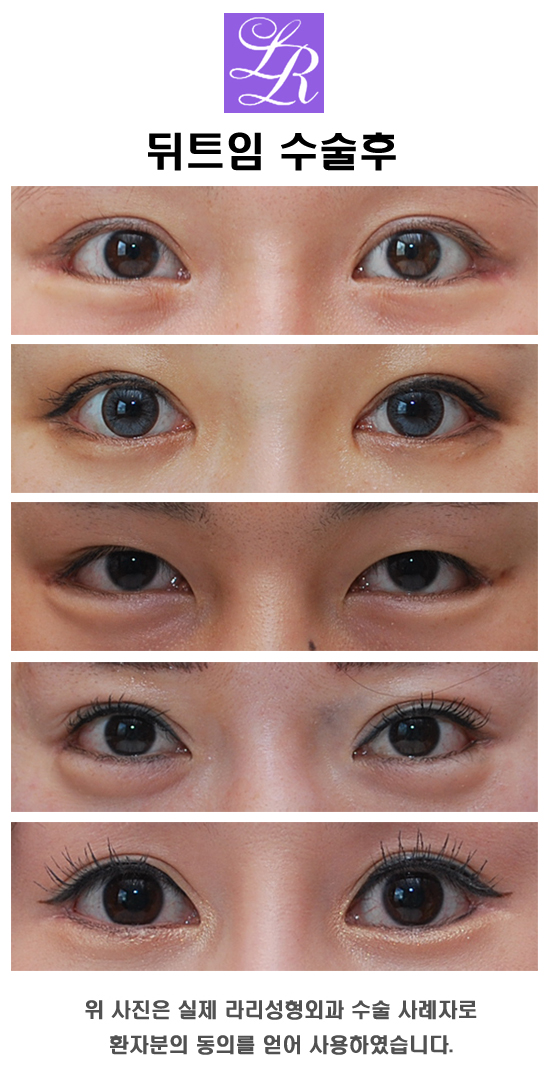
Down-tilting lateral canthoplasty, which uses lateral canthopexy, shows a clear effect in the short term from immediately after surgery up to 6 months, and even in the long term beyond 1 year, the outer corner does not reattach, so the effect can be considered semi-permanent. For those whose outer corners are significantly upturned and who want a softer downward tilt, it may be helpful to learn more about down-tilting lateral canthoplasty and #lower canthoplasty.