Rhinoplasty is broadly divided into bridge augmentation and tip surgery.
Until the early 2000s, bridge augmentation was the main option rather than tip surgery, so
the shape of the tip was not emphasized, and the focus was only on raising the low bridge typical of East Asian noses.
At that time, rhinoplasty was limited to simply placing thick silicone in the bridge.
Old-style rhinoplasty, or bridge augmentation, which did not consider the shape of the tip at all, emphasized the bridge and created the effect of making the facial features look more defined along with a large double-eyelid line.
Then, in the 2000s, plastic surgeons influenced by Dallas Rhinoplasty in the United States began performing tip surgery using the septum, and the lines of rhinoplasty started to become more refined.
However, among East Asians, including Koreans, there are not a few people with a thin or small septum.
In addition, once the septum has been removed, revision surgery becomes more difficult, so problems arose.
In the end, rib cartilage, which had previously been used only for the bridge, began to be used for the tip as well.
Accordingly, from 2010 onward, autologous rib cartilage and homologous rib cartilage such as donor rib cartilage were actively used in plastic surgery.
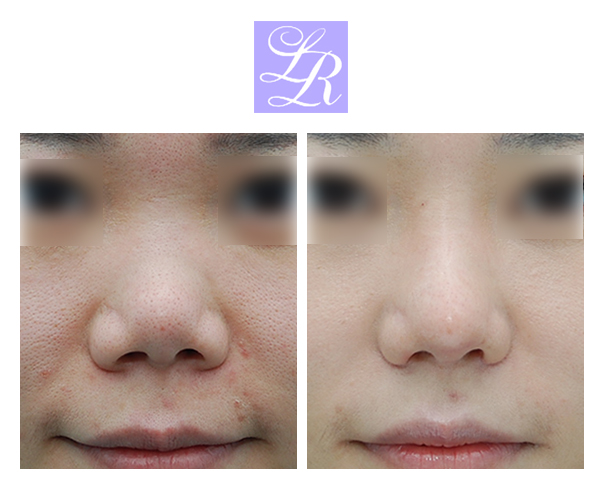
The most common use of rib cartilage in tip surgery is when the tip has shortened due to contracture caused by inflammation.
When inflammation occurred after a previous nose surgery and the tip tissue became shortened, it is important to release the shortened contractured tissue, but the strong tissue that can maintain the length and height of the released and lengthened tip is rib cartilage.
Using rib cartilage makes it possible to sufficiently extend a shortened, contracted tip.
It also reduces the appearance of upturned nostrils and can restore the nose length to a normal length.
From the side view, the nasolabial angle that looked upturned becomes smaller, and the upturned tip becomes longer.
Does the nose look longer overall?
This patient had surgery with autologous rib cartilage, not donor rib cartilage.
Rib cartilage is usually taken from the right side, and the harvest site or scar looks about like this, so it may be helpful to keep that in mind.
The clothing shown above is probably a bra.
The harvested autologous rib cartilage is used after being lightly soaked in water and carved into an appropriate shape.
If you often wear bikinis in the summer, then no matter how nicely the nose turns out, after autologous rib cartilage harvest,
the scar left under the bra line can naturally be a concern..
An alternative that can be used in such cases is homologous rib cartilage, that is, donor rib cartilage.
If you are concerned about the scar from autologous rib cartilage,
it is also possible with donor rib cartilage!
In fact, in the early days, rib cartilage was sometimes used for the bridge rather than the tip,
but more recently it is mainly used to correct tip deformities.
East Asians in particular often need to raise a low tip or increase its length, and in such cases the strong tissue that can withstand the pressure when the tip is raised is rib cartilage.
It can support the pillar that bears all the pressure placed on the tip when extending the length or height of a short or low nose.
When the tip is upturned and shortened, rib cartilage can be used to extend the length of the tip and raise it.
Rather than simply raising the bridge and making the tip look upturned, making the subnasal columella area clearly defined and slightly lengthening the tip makes the nose look more attractive overall.
Before surgery, when no pillar was placed in the columella, only silicone was inserted, so the nostrils did not become longer and the skin above the nostrils stretched, meaning only the tip skin was lengthened.
However, if the columellar pillar is firmly established using rib cartilage, the length of the nostrils increases and the tip naturally becomes more refined.
Instead of using ear cartilage on the tip or tying the tip cartilages together with sutures to force the tip to look refined, the nose is built up from the foundation by placing a pillar in the columella, so you can see that the tip does not look pinched.
It is said that donor rib cartilage is all American-made products approved by the U.S. FDA and, of course, also approved by the Korean KFDA.
The drawback is the cost, since a 2 cm piece costs over 1 million won.
Also,
in the paper titled Choosing Between Autologous Rib Cartilage and Homologous Rib Cartilage (Donor Rib Cartilage) written by Dr. Toriumi,
published in JAMA Facial Plast Surg. 2017 May 1;19(3):188-189. (JAMA is the American Medical Association),
it explains that there is no evidence that homologous rib cartilage (donor rib cartilage) is more absorbed than autologous rib cartilage,
but because donor rib cartilage is not living tissue after implantation and is similar to an implant, it may be absorbed.
In actual clinical practice, when going back in for revision surgery on a nose that used donor rib cartilage,
there are cases where it has not been completely absorbed but feels slightly eroded.
Even so, compared with ear cartilage or septal cartilage, donor rib cartilage is considered strong enough to serve as a columellar pillar.
Rib cartilage not only supports the columellar nasal pillar, but also sufficiently increases the nasolabial angle, which is the angle formed by the nose and upper lip in the profile view,
so it can have an effect similar to an augmentation procedure.
It changes the overall shape of the nose tip into a more refined appearance not only from the side but also from the front.
To make the tip look clearly refined, rather than simply making the tip pointy, a pillar needs to be built from the base of the nasolabial angle,
and there must be a sufficient change in volume, meaning increased volume, from the center of the maxilla.
By placing a columellar pillar with rib cartilage, this increase in volume becomes clear.
The photos above show well how the side profile of the face changes as volume increases from the base of the columellar pillar.
Properly supporting the columellar pillar also increases the length of the nostrils in relation to the overall height of the tip,
making the tip appear harmoniously and overall more refined.
In other words, if the columellar pillar is not established, even if the tip becomes longer, the tip may appear more blunt if the nostril length remains the same.
Today, we looked at revision rhinoplasty using rib cartilage.
Although nose surgery using rib cartilage has become more common than before,
there are still aspects that are unfamiliar to the general public, so I wrote this post to share a bit of information.
I hope it was helpful.