I watched a video on YouTube uploaded by a plastic surgery specialist, and he said that for pseudoptosis, where there is no double eyelid and the skin covers the pupil, making it look like ptosis,
there is no need for ptosis correction surgery that pulls the muscle, and that simple buried suture double eyelid surgery is enough.
To put it simply, that is half right and half wrong.
In fact, when the skin and the epicanthal fold sag and cover the eye so that it looks like ptosis, there are cases where simple double eyelid surgery can improve pseudoptosis caused only by drooping skin, like folding up blinds that are covering a window.
But in more complex cases where the skin is sagging and the muscle that opens the eyes is also weak, ptosis may not improve with simple double eyelid surgery alone.
Pseudoptosis or true ptosis
Simple buried suture double eyelid surgery or non-incisional ptosis correction
In cases like the photo below, where there is a double eyelid but the pupil is still not about 80% visible, ptosis has not been improved by double eyelid surgery.
For eyes like this, ptosis correction must be done separately in addition to double eyelid surgery to make the eyes look clearer.
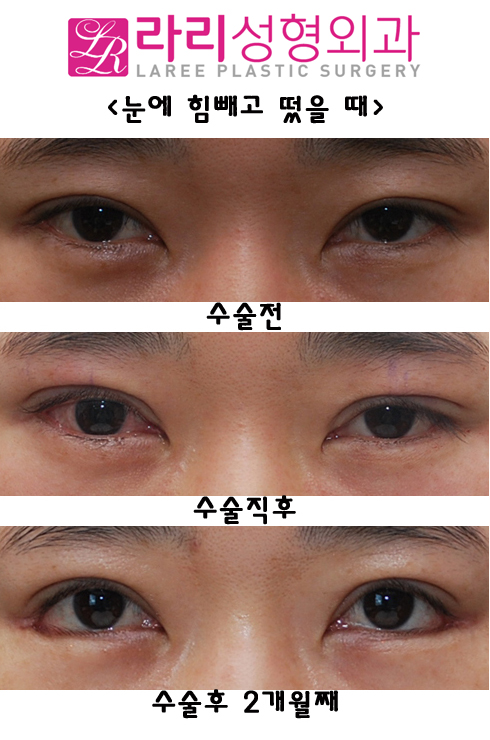
What is also unique about cases like this is that it is not true ptosis.
Normally, the person is not putting much effort into opening the eyes, so it looks like ptosis, but if they intentionally use force to open them, they can open them widely.
Some people may ask, if you can open your eyes widely by using force, why not just do that instead of having surgery?
As everyone knows, if you keep forcing your eyes open to make them look bigger, you will get tired in less than a minute.
That is exactly when ptosis correction surgery is needed.
When you want to improve only the muscle without changing the double eyelid line, a non-incisional ptosis correction method that does not involve cutting is useful.
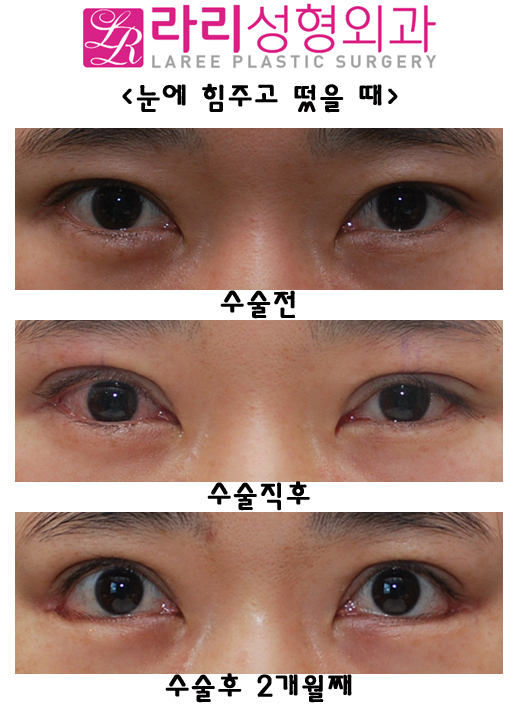
After non-incisional ptosis correction, you can see that the eyes look clearer than before surgery both when opening them with the eyes relaxed and when opening them with force.
Because non-incisional ptosis correction does not directly pull the muscle like an incisional method, it can produce a more natural ptosis correction effect.
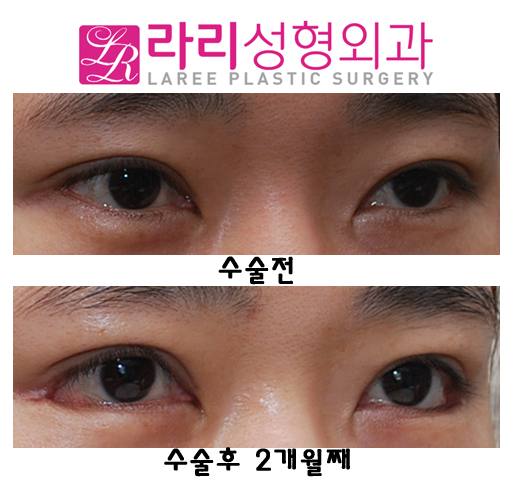
Because the correction is natural, after ptosis correction the eyes do not look over-opened or excessively raised, but instead only appear clearer.
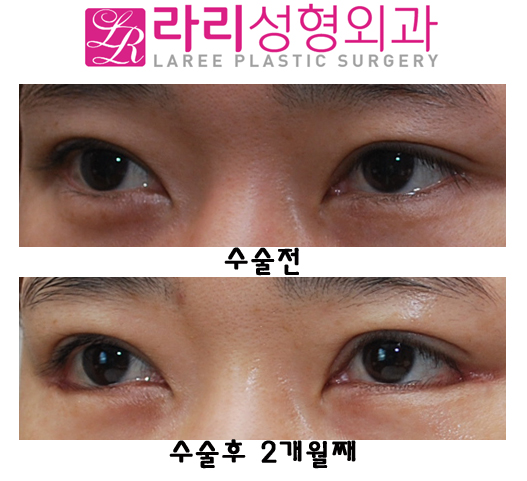
The previous lateral canthoplasty had also fully reattached, so revision lateral canthoplasty was performed together with non-incisional ptosis correction,
which created an even clearer eye appearance and shows a definite before-and-after difference.
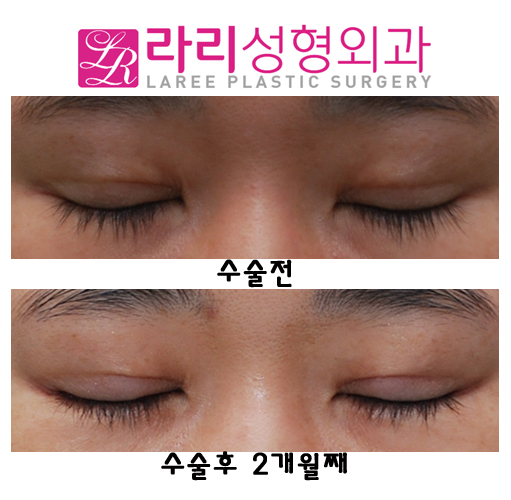
After revision lateral canthoplasty, when the eyes are open, the change in the outer corners of the eyes is clearly visible,
and when the eyes are closed, it also shows that the eyes close well.
In fact, many people are suspicious that both ptosis correction surgery and lateral canthoplasty will make it hard to close the eyes properly.
But as shown in the photos above, even after revision lateral canthoplasty and ptosis correction were performed together, the eyes still close well.
Also, the double eyelid scar remaining unchanged before and after surgery is evidence that the ptosis correction was performed non-incisionally.