Hello.
This is Oks Dental Clinic.
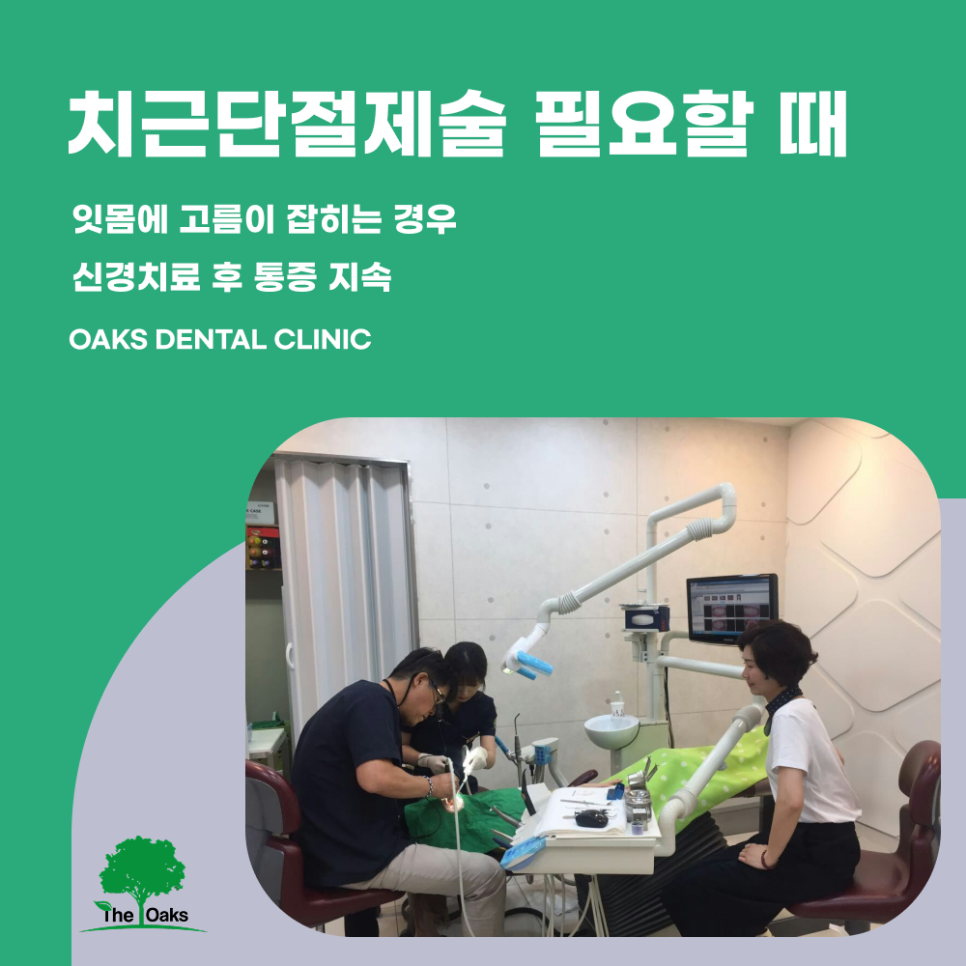
“Even after root canal treatment, my gums
still hurt and are swollen...”
If you have already had root canal treatment but continue to experience pain or develop pus, there is a treatment method that can most effectively help preserve your natural tooth.
That method is apicoectomy.
Today, we’ll explain when apicoectomy should be considered as the last option for saving a tooth without extracting it, and how the procedure is performed.
When is apicoectomy needed?
▶ If you previously had root canal treatment, but the pain has returned or a pus pocket has formed in the gums
▶ If symptoms continue even after attempting retreatment of the root canal
▶ If retreatment is not possible because of prosthetics such as a crown or bridge
▶ If the root tip structure is complex and difficult to reach with root canal treatment, or if inflammation remains
In these cases, apicoectomy can be the final treatment method that directly removes inflamed tissue at the root tip, cuts off the root tip, and eliminates the source of inflammation.
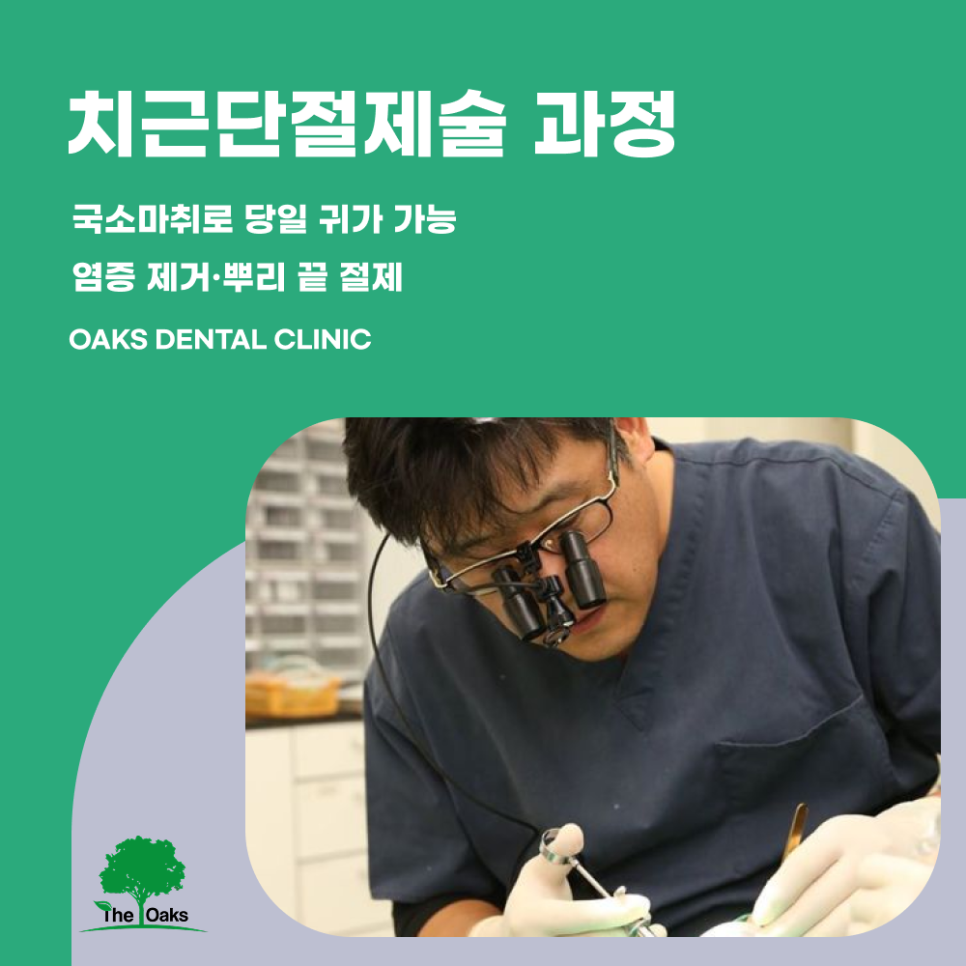
Apicoectomy: What is the process?
▶ Precise diagnosis and preparation
X-rays and CT scans are used to accurately determine whether there is inflammation at the root tip and assess the structural condition.
▶ Surgery begins after local anesthesia
A small incision is made in the gum to expose the alveolar bone, and then the root tip is exposed.
▶ Removal of inflamed tissue and root tip resection
The last 2–3 mm of the tooth root is horizontally resected, and the surrounding inflamed tissue is removed.
▶ Disinfection and retrograde filling
After thoroughly disinfecting the root tip area, filling material (sealant) is placed in a retrograde direction to seal it.
▶ Suturing and recovery
After suturing the gum, the recovery process begins so that the bone around the root and the gum tissue can heal.
What are the benefits of this surgery?
▶ The last way to preserve a natural tooth
▶ Because the periodontal ligament can be maintained, shock absorption and sensation can be preserved.
▶ It can be performed relatively simply under local anesthesia
▶ It is not a major surgery, and same-day discharge may be possible.
▶ Performed precisely with a microscope
▶ Even tiny inflamed areas that cannot be seen with the naked eye can be removed, resulting in a high success rate.
Important precautions to remember
If the inflammation is not completely removed or the filling is inadequate, treatment failure may occur.
After surgery, there may be pain, swelling, or slight loss of sensation, and to support recovery, you must follow the prescribed instructions such as taking the medication, applying cold compresses, and eating soft foods.
If the periodontal condition is healthy, the prognosis is good, but if there is severe bone loss, the success rate may be lower.
To conclude...
Apicoectomy is a treatment with significant value because it opens the possibility of living with your natural tooth.
It helps you preserve as much of your own tooth structure as possible without extraction.
However, it also requires precise diagnosis, advanced technique, and microsurgical equipment.
It is important to go through consultation and preparation with experienced medical staff.
If you are worried because your gums continue to hurt and swell even after root canal treatment, please do not keep putting it off on your own—feel free to consult us anytime.