Hello.
This is Oks Dental Clinic.
When you come to the dentist,
and hear,
“Extraction may need to be considered,”
anyone’s heart can sink.
“Do I really have to have it removed?”,
“Can’t I still bear it for now?”,
“Will it hurt a lot if I get it pulled?”
These worries are completely natural reactions.
But in fact, an extraction is less about “removing a tooth”
and more like a last protective measure to prevent greater pain and problems.
Today, we’ll explain extractions, which many patients are curious about,
at Gangnam Dental Clinic.
Why do teeth have to be removed at all?
Many people ask,
“Teeth should always be saved, so why are you saying to remove it?”
That makes sense.
As a rule, teeth should be preserved as long as possible.
However, sometimes leaving a tooth in place can create even bigger problems.
For example…
✓ When decay is so deep that only the root area is left
✓ When periodontal disease is severe enough that the tooth moves even with a finger
✓ When a tooth breaks and the bone inside the gum is damaged as well
✓ When a wisdom tooth presses on the adjacent tooth and pain keeps recurring
✓ When space must be secured for orthodontic treatment
In these cases, rather than trying to forcefully save the tooth, it is safer for your overall health and oral health to choose extraction.

What happens if you delay an extraction?
In truth, many people put off extraction because
“it doesn’t hurt yet,”
or “I’m scared and it’s inconvenient.”
But if a diagnosis has already determined that an extraction is needed, the situation only gets worse over time.
• Inflammation spreads to the bone and surrounding tissues, and the face may swell
• Sharp, stabbing pain may suddenly become severe
• Pus can form, making it hard to open your mouth and even to eat properly
• Decay can spread to nearby teeth, causing multiple teeth to become a problem at once
When this happens, a more difficult procedure than a simple extraction is needed,
and the pain, cost, and recovery time all increase.
That is why the choice made when the problem first appears is very important.
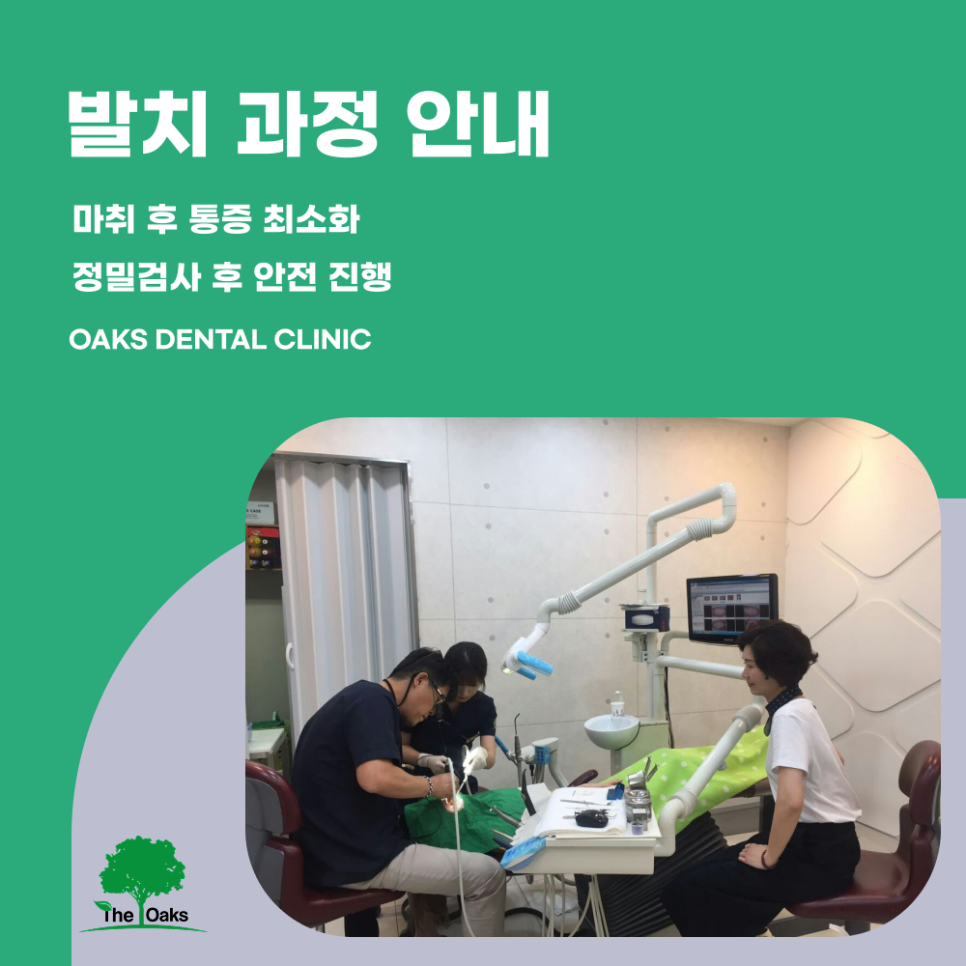
The extraction process is not as complicated as you might think
When people hear “extraction,” many imagine a scene where a tooth is forcibly grabbed and pulled out.
But in reality, it is carried out much more delicately and safely.
It starts with a careful diagnosis
An X-ray or CT scan is taken to check
• how many roots there are
• how deeply it is positioned in the bone
• how close it is to the nerve
All of these factors are checked.
The anesthesia is sufficient, so there is no pain
Modern anesthesia is administered very precisely,
so many patients say,
“Huh? It’s already out?”
The tooth is carefully separated and removed
For a standard extraction, the tooth is loosened to help it come out naturally.
If, like a wisdom tooth, the root is twisted or the tooth is buried in the bone,
the tooth is divided into several pieces and safely removed.
Finally, the area is cleaned and sutured
Inflamed tissue is cleaned out and the area is sutured to help recovery.
Most extractions are completed within 10 to 20 minutes, and even difficult wisdom tooth cases can be handled quickly by experienced medical staff.
Please don’t worry too much about pain or swelling after extraction
After an extraction, some pain and swelling for 2 to 3 days is a natural part of recovery.
These symptoms are controlled with painkillers and can also be eased quickly with cold compresses.
However, if the following occur, you should definitely come in for a visit.
• The pain gradually gets worse
• A strong bad smell comes from the mouth
• Pus comes out
• The extraction site keeps throbbing
These may be complications such as dry socket,
so they need to be checked right away.
What you must keep in mind after extraction
The most important thing for recovery is protecting the blood clot.
That blood clot becomes the foundation for the bone and gums to heal again.
Things to be careful about
• Do not use a straw
• No spitting or gargling
• Smoking is strictly forbidden for at least 1 week
• Avoid hot and hard foods
✔ Things that are good to do
• Apply firm pressure with gauze for 1 to 2 hours
• Use cold compresses for 48 hours
• Take prescribed medication on time
• Brush lightly starting the next day
If you follow just these basics, recovery will be much faster and safer.
How do you fill the empty space after extraction?
Whether it is a front tooth or a molar, once a tooth is missing, the surrounding teeth begin to tilt toward the empty space.
When this happens, the bite becomes unbalanced,
chewing force becomes concentrated on one side,
and problems can even arise in the jaw joint.
That is why after extraction, restoration is considered using the methods below.
• Implant
Function closest to a natural tooth
• Bridge
Can restore function quickly
• Partial denture
Chosen when several teeth are missing
We will guide you to the most suitable option depending on your situation, so there is no need to worry.
In closing…
An extraction is never a treatment to be decided lightly.
That is why it must be judged carefully and accurately, and the experience of skilled medical staff is very important in this field.
But one thing is clear:
if an extraction is needed and performed at the right time, pain is reduced and recovery becomes much easier.
If your tooth hurts, feels loose, or you keep having discomfort because of a wisdom tooth, don’t 고민 on your own—please consult Gangnam Dental Clinic.