Dogok-dong Dental Clinic: How long does the implant period take? A guide from step-by-step process to recovery!
Hello.
This is Oaks Dental Clinic.
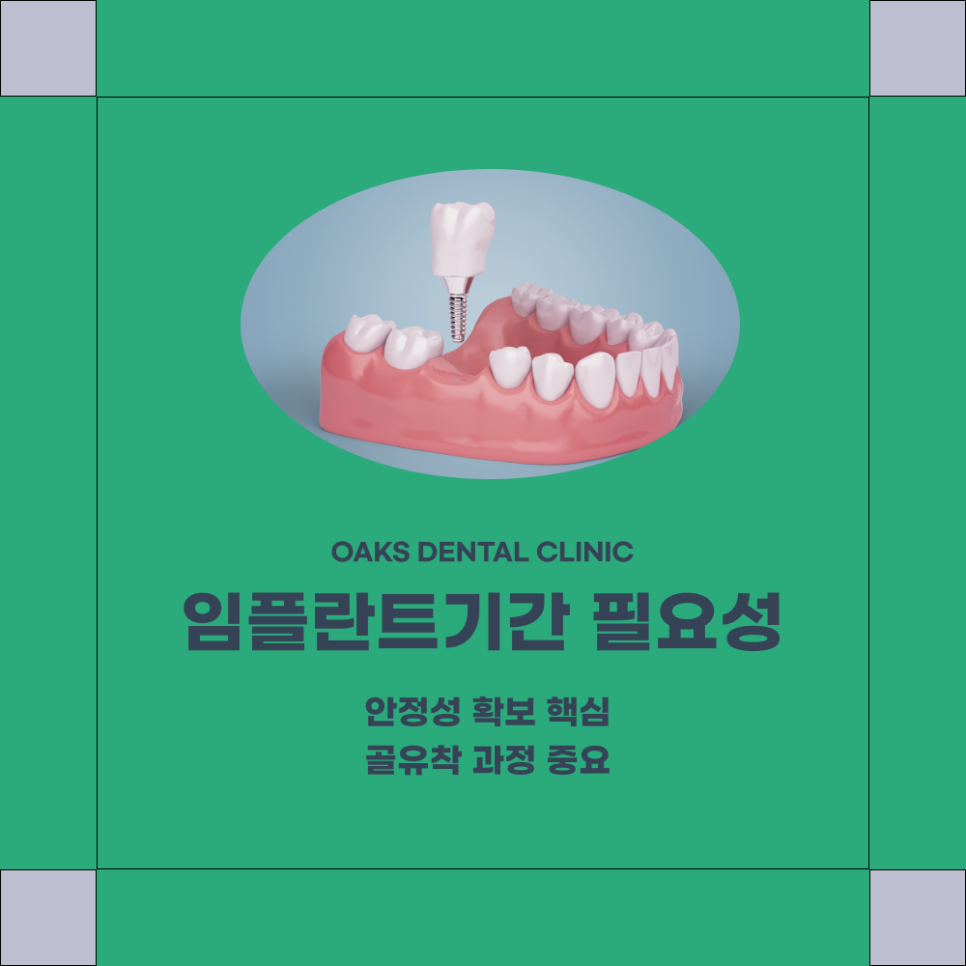
One of the things people considering implants
are most curious about
is the treatment period.
“How long will it take?”
,
“Won’t it take longer than expected?”
and similar questions are often asked.
An implant is not simply a treatment that
places an artificial tooth. Because it also
includes the process in which the jawbone and
artificial root are stably integrated,
it requires a certain amount of time.
Today, we will explain why the implant period is necessary,
how long each stage takes, and
ways to shorten the period,
at Dogok-dong Dental Clinic.
Why the implant period is necessary
Implant treatment is a process for restoring
functions similar to those of natural teeth.
It is not simply about inserting an artificial tooth;
the implant placed into the jawbone must
undergo the essential process of firmly bonding
with the bone, called “osseointegration.”
If this process does not occur sufficiently,
the implant may loosen or fall out,
so an appropriate recovery period is
essential for stable results.
Therefore, the implant period is not just about
taking a long time; it can be seen as
an important process for successful treatment.

How long does the entire implant treatment take?
The implant period varies depending on
the individual’s oral condition, but in general
it takes about 3 to 6 months.
If the jawbone condition is good,
the process can progress relatively quickly,
but if there is insufficient bone or additional
treatment is needed, the period may be longer.
In particular, if extraction is necessary,
the recovery period after extraction must also
be considered, which can extend the overall period.

Step-by-step look at the implant period
Detailed examination and treatment planning
The start of implant treatment is an accurate diagnosis.
Through X-ray and 3D CT imaging,
the condition of the jawbone and the position of
nerves are checked, and a treatment plan tailored
to the individual is created.
This process takes relatively little time,
but it is an important stage that determines
the overall direction of treatment.
Implant placement process
This is the stage where the artificial root is
placed into the jawbone.
It is performed under local anesthesia,
and is usually completed in about an hour.
Although the procedure itself is short,
the recovery process afterward is important.
Osseointegration period (the most important stage)
This is the stage that takes up the largest portion
of the implant period.
It is the process by which the placed implant
firmly bonds with the jawbone,
and it usually takes about 2 to 3 months on average.
In the upper jaw, the bone density is lower,
so it may take a bit more time,
while the lower jaw tends to progress
relatively faster.
Prosthesis placement
Once osseointegration is complete, the artificial tooth
(prosthesis) is placed.
This process is completed in a relatively short period,
and ultimately restores a form and function
similar to those of a natural tooth.
Cases where the implant period becomes longer
Not all patients proceed within the same timeframe.
In the following cases, the implant period may be longer.
When there is insufficient jawbone (bone graft required)
When periodontal disease is present
When recovery is needed after extraction
When recovery is slower due to a systemic condition
Because these factors are directly related to treatment safety,
it is important to proceed with sufficient time.

Care after implants is just as important as the treatment period.
Implant treatment is not over just because the procedure is finished.
The lifespan of an implant can vary greatly depending on
how it is managed after placement.
Along with proper tooth brushing, the area should be kept clean
by using floss and interdental brushes,
and it is important to check the condition through
regular dental checkups.
In particular, good early care is necessary
for stable long-term use.
In conclusion...
The implant period is not simply waiting time;
it is an essential process for stable results.
Although it varies depending on the individual’s oral condition,
proceeding with sufficient time plays an important role in
increasing long-term success rates.
If you are planning an implant, it is important to understand
the period involved and create a treatment plan that is suitable
for you through an accurate diagnosis.
For safer and more satisfactory results,
we hope you proceed with implants through a systematic process.