
Molars: The Key Teeth Responsible for Chewing Force
Molars are the teeth that crush and chew food into smaller pieces, and they play a key role in how we eat. While the front teeth mainly perform the cutting function, molars are at the center of mastication, grinding and crushing hard foods.
Therefore, if a molar is lost, chewing ability is significantly reduced, even ordinary meals become inconvenient, and over time excessive stress may be transferred to the opposite molar or adjacent teeth, causing secondary problems.
In particular, because the molar area bears very strong chewing forces, implant treatment with durability and stability is often recommended rather than conventional prosthetic methods.
🔍 Why Molar Implants Are Important
- Restoring chewing ability
If a molar is lost, you will not be able to chew food properly, and digestive function may also be affected.
Through molar implants, it is possible to restore chewing ability close to that of natural teeth, improving satisfaction with meals and daily life.
- Preventing strain on adjacent teeth
If the empty space left by a missing molar is left untreated, the adjacent teeth on both sides may tilt or move downward, causing the alignment to shift and the bite to become unbalanced.
By filling the space with an implant, the balance of the entire dentition can be maintained.
- Protecting the jaw joint and facial shape
Changes in the bite caused by molar loss can lead to jaw joint pain or jaw asymmetry, and over the long term may even affect facial appearance.
Therefore, molars are areas that must be treated, with the focus on restoring function rather than aesthetics.
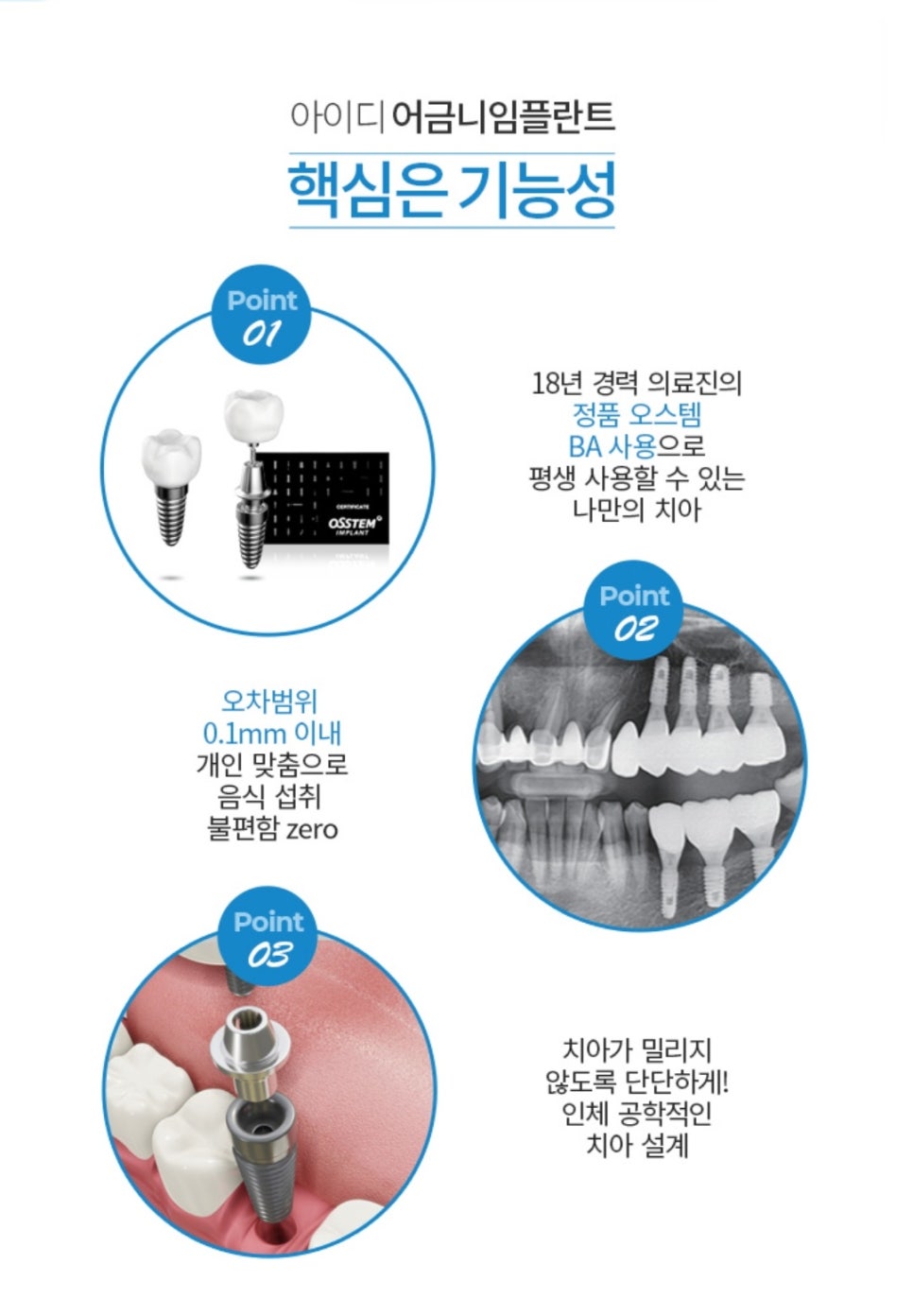
🦷 Molar Implants and How They Differ from Front Teeth Implants
| Category | Front Teeth Implant | Molar Implant |
|---|
| Chewing force | Relatively low | Receives the greatest force |
| Aesthetics | Emphasized | Function is important |
| Bone condition | Generally thin | Relatively wide |
| Surgical difficulty | Moderate | Often high |
Because molars are subjected to strong chewing forces, a thicker and stronger implant fixture is needed, and depending on the condition and amount of jawbone, bone grafting or sinus lift surgery may also be performed. In addition, the inferior alveolar nerve is close to the lower molar area, so accurate location assessment and skilled surgical technique are important during surgery.
🏥 Treatment Process for Molar Implants
- Detailed diagnosis and consultation
Through CT scans and oral examinations, the height, width, and density of the jawbone, as well as the location of the inferior alveolar nerve, are checked, and the patient’s overall health, oral hygiene, and bite condition are comprehensively analyzed.
- Establishing the implant plan
Since molars are areas that receive a lot of force, a precise plan is made for the implant angle, depth, bone density, and prosthetic design, and the appropriate implant type is selected for each site.
- Implant placement surgery
The procedure is performed under local anesthesia or, if necessary, under conscious sedation. In the posterior upper jaw, sinus lift surgery may be applied, and in the posterior lower jaw, guided surgery to prevent injury to the inferior alveolar nerve may be used.
- Osseointegration and recovery
Osseointegration is allowed to proceed for about 2 to 4 months, and during this period, temporary prosthetics are worn to partially compensate for chewing function.
- Placement of the final prosthesis
After taking dental impressions, the fabricated prosthesis is placed, and precise bite adjustment and usage instructions are provided.
Because the molar area bears a heavy chewing load, the height of the prosthesis and the occlusal relationship must be adjusted carefully.

Considerations for Molar Implants
- Bone grafting is often needed
Because molars have thick roots and bone loss is often significant, if a tooth has been missing for a long time, the bone may have resorbed considerably, making bone grafting necessary in many cases.
- Position of the maxillary sinus
In the upper molar area, there is an air cavity called the maxillary sinus above it, so if there is insufficient bone, a sinus lift (maxillary sinus lifting) must be performed together to place the implant stably.
- Risk of injury to the inferior alveolar nerve
Because the inferior alveolar nerve canal runs through the lower molar area, accurately identifying its location and controlling the implant depth are essential to avoid nerve damage.
- Thorough aftercare is necessary
Because molar implants bear a lot of force, aftercare is extremely important. Regular dental visits, scaling, bite adjustment, and hygiene management are needed to maintain an environment where the implant can be used for a long time.

Why People Hesitate About Molar Implants
Because molars are not very visible, many people think that if one is missing, it might be okay to just leave it alone. However, since they are functionally important, leaving them untreated can harm the health of the entire mouth.
There are also many cases where treatment is delayed for the following reasons.
• Cost burden
• Fear of surgery
• Length of treatment period
• Concerns about pain
If you are 고민 중이라면 because of these reasons, the burden can be reduced through various methods such as painless implant procedures using conscious sedation, consultation about insurance coverage, and creating a customized treatment plan.

How Can Molar Implants Last a Long Time?
Once an implant is placed in a molar, ideally it should be used for as long as possible.
To do so, care such as the following is important.
- Regular checkups – Visit every 3 to 6 months to check the condition of the prosthesis and gum health
- Precise bite adjustment – Check the occlusion frequently
- Use of interdental brushes and oral irrigators – Remove bacteria around the implant
- Avoid smoking – It interferes with bone integration and recovery
- Avoid excessive force – Be careful when eating hard foods

Molar Implant FAQ
Q. How long can a molar implant be used?
→ It varies depending on the individual’s oral hygiene, eating habits, and prosthesis management, but many people use them for more than 10 years, and with proper care they can be used semi-permanently.
Q. Which is better, dentures or molar implants?
→ For a single missing tooth or a partial gap in the dentition, implants are functionally superior. However, in cases of extensive edentulism, dentures or implant-supported dentures may be alternatives.
Q. I heard treatment takes a long time. How long does it take?
→ It usually takes about 2 to 4 months after surgery for osseointegration, and if bone grafting or sinus lift surgery is needed, it may take more than 6 months.
Molar implants are not a 'choice' but a 'necessity'
Many people pay attention to front teeth because of their aesthetics and appearance, but in fact molars are the key area that determines the function of the teeth.
If a lost molar is left untreated, it can negatively affect not only the chain of damage to other teeth but also overall health.
Therefore, it is most important to restore function and maintain a healthy oral structure through early, precise diagnosis and treatment planning.