Hello. I’m Dr. Jo Hyun-woo of 입체성형외과.
This is the first post since starting this blog.
Going forward, I will do my best to present the myths and truths about facial contouring surgery, as well as questions people often have,
in an honest and straightforward way so that many people
can obtain accurate information.
Today, I’d like to talk about chin surgery,
which many patients are curious about.
There are many different types of chin surgery.
For patients with a recessed chin, there is chin bone advancement surgery, which moves the chin forward.
For people whose chin protrudes significantly, there is chin bone setback surgery.
For people whose chin appears too long, there is chin bone length reduction surgery.
There are many different surgical methods.
Recently, as more patients want a V-line, there are the T osteotomy, which makes the chin pointier, and its variations, the S osteotomy and Y osteotomy. There is also the lower border osteotomy of the chin, commonly called contouring shaving.
Among these, what many people are curious about is the difference between the T osteotomy and contouring shaving.
To give the conclusion first, several studies have reported that there is no difference in the results.
Let’s take a closer look at each procedure.
First, let’s look at the T osteotomy.
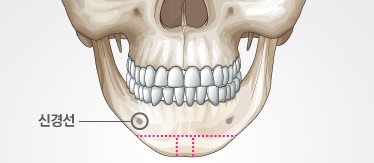
- The chin area is cut in a T shape while avoiding the nerve line.
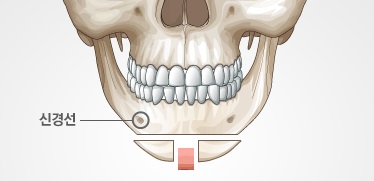
- After removing the middle bone fragment,
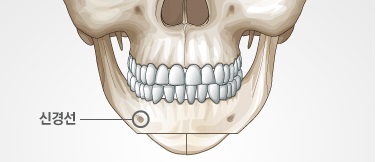
- The two trimmed chin bones are brought together.
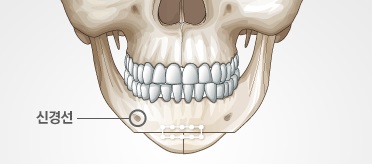
- The bones are brought together and fixed with fixation pins.
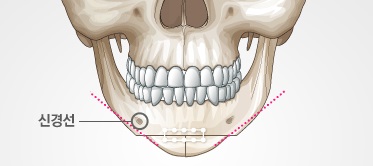
- The remaining portions of both jawbones are cut.
The T osteotomy is performed through the process above.
The advantages of the T osteotomy are
that it allows both advancement and setback of the chin at the same time,
and it can safely protect the nerve line.
In addition, for patients who are not having angle jaw surgery,
it is a surgical method that can be performed as a standalone procedure.
Next is the lower border osteotomy of the chin, or contouring shaving surgery.
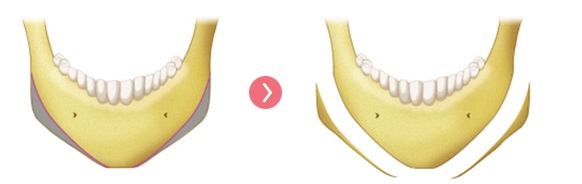
As shown in the figure, this is a surgery that removes the jaw from the angle of the jaw to the chin as one piece.
It can be performed when a patient does not need chin advancement or setback,
and because fixation pins are not used, it can be an option for those who feel uncomfortable with fixation plates.
These two surgeries ultimately produce the same V-line,
and, as mentioned earlier, there is no particular difference in appearance.
In terms of surgical technique, contouring shaving is a somewhat more difficult procedure,
but an experienced surgeon can perform both procedures safely.
Rather than choosing a particular method, when chin advancement or setback is needed, performing a T osteotomy
can be said to be more appropriate for creating a more beautiful shape.
This has been plastic surgery specialist Dr. Jo Hyun-woo.