Hello. I’m Dr. Jo Hyun-woo of 입체성형외과.
When patients come in for a consultation about chin surgery, one of the things they often wonder about is, “Why is it called one type of surgery at one hospital, but a different name here?” I get this question a lot.
In fact, the most commonly known surgical method is the T-osteotomy technique.
But chin surgery is extremely varied, with more than 10 commonly used surgical methods.
Today, I’ll talk about the different types of chin surgery.
Before discussing the types of chin surgery, if you think about why there are so many kinds, it’s because each patient has a very different chin shape. There are truly many different cases, such as underbite, receding chin, short chin, and wide chin.
So, depending on the case, the appropriate surgical method is chosen.
T-osteotomy Surgery
I’ve written about T-osteotomy many times in previous columns, so it may be best to refer to those articles for more details.
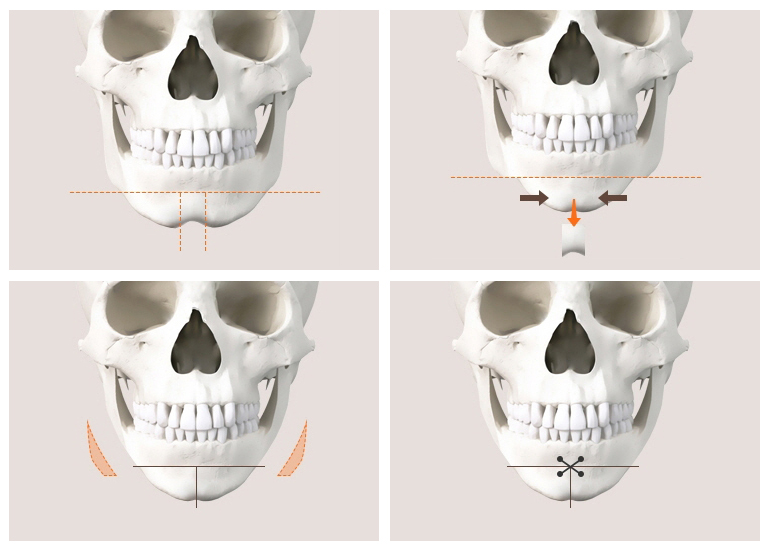
T-osteotomy surgery
In general, this is a surgery that can be approached easily and conveniently.
It can narrow the width of the chin while also allowing advancement and setback.
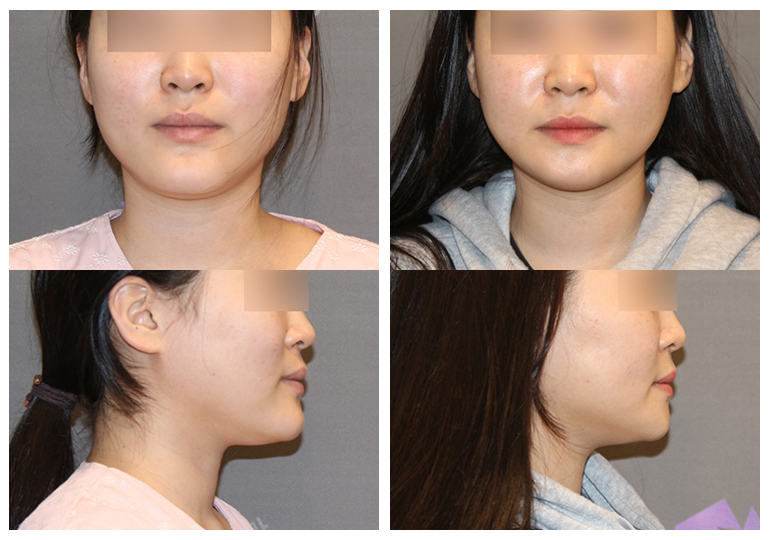
Correction of an underbite through T-osteotomy
V-osteotomy Surgery (Lower Chin Edge Resection)
This is a surgery that trims all the way to the tip of the chin while performing square jaw surgery, without needing chin advancement or setback.
In fact, if chin advancement or setback is not needed, the result is essentially the same as T-osteotomy surgery.
It is suitable for people who do not want fixation pins.
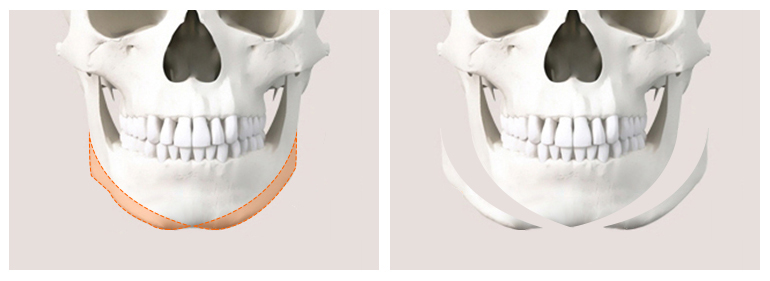
V-osteotomy surgery
This is generally the surgery commonly referred to as “shaving from the square jaw down in a long line.”
The drawback is that because dissection extends below the chin, a double chin can form. However, if the periosteum is firmly returned to its proper position during surgery, there is little difference from T-osteotomy.
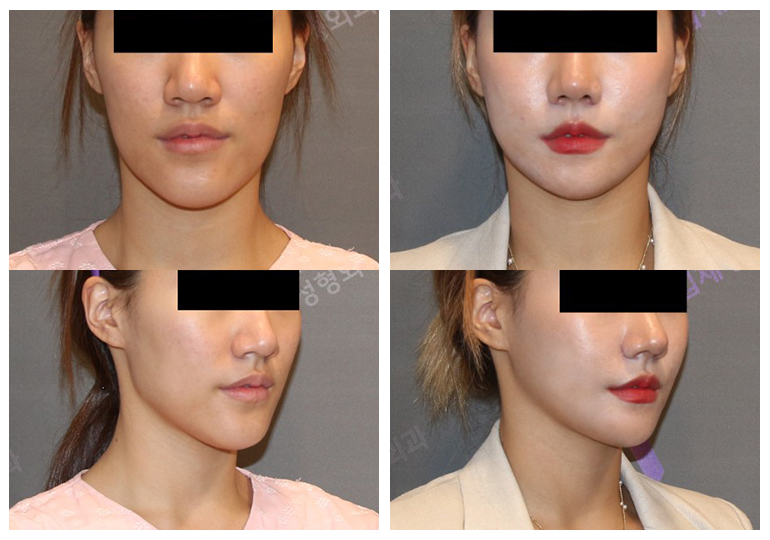
Long-chin correction through V-osteotomy
I think the first two surgeries are already familiar to you, since I’ve mentioned them often in columns and on YouTube.
Chin Advancement and Setback Surgery
This is a procedure that was performed before T-osteotomy surgery became widely used.
It is suitable for patients with underbite or a receding chin, and when there is no need to reduce the width of the chin.
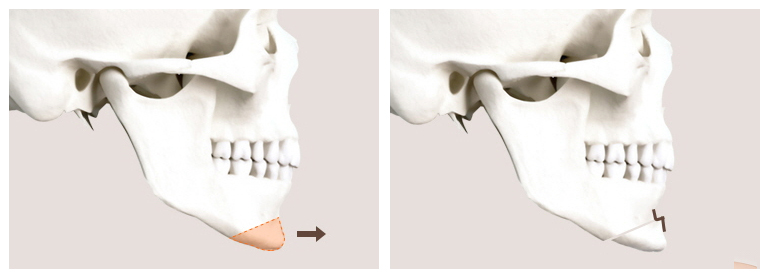
Chin advancement
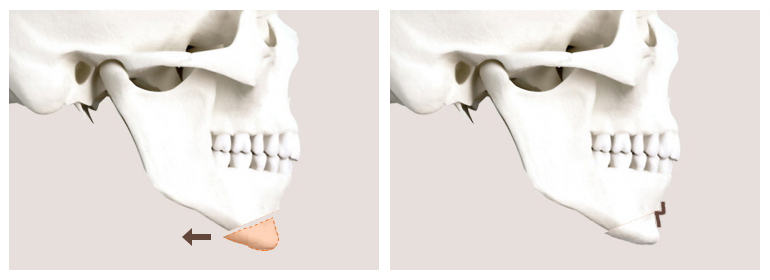
Chin setback
As shown in the illustration, the bone is cut in an I-shape, T-shape, or zigzag shape, then moved forward or backward as needed and fixed in place with fixation pins.
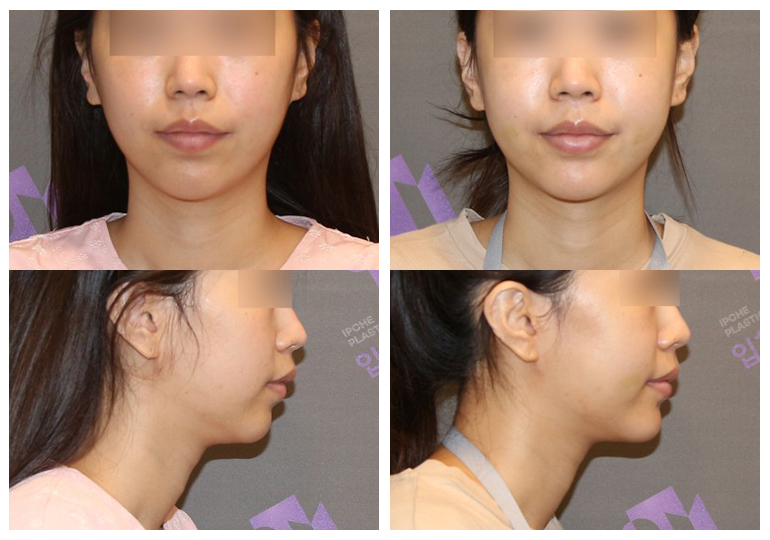
Correction of a receding chin
Chin Lengthening Surgery
When the chin appears too short, this is a surgery that lengthens it through bone grafting.
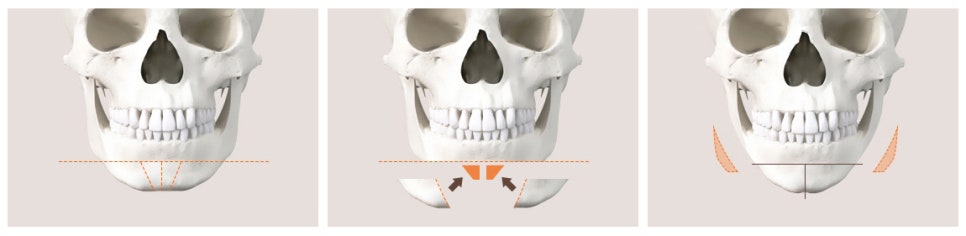
Lengthening through bone grafting with T-osteotomy
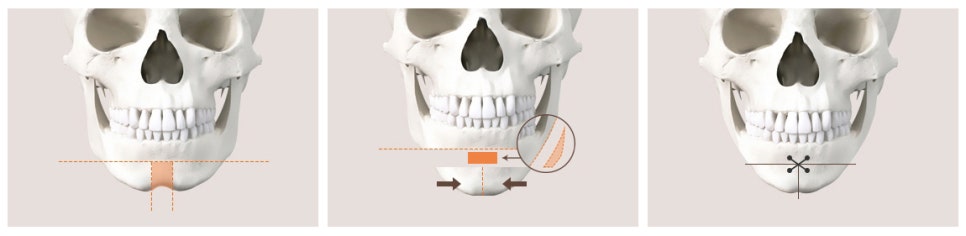
Lengthening through bone grafting with square jaw bone
The bone removed during T-osteotomy may be grafted, or square jaw bone may be resected and used as a graft.
Because no other foreign material is used, this is a procedure that can produce good results.
So far, I have explained chin surgery methods. In fact, there are many more surgical methods besides these.
However, those methods are also derived from these techniques, so it is fair to think of them as procedures with slightly different names.
Among the many chin surgery methods, there is no single method that is the best.
It is important to choose the surgical method that best suits you, so please consult an experienced specialist to achieve good results.
Thank you.