Hello, I’m Director Hyun-woo Cho of 입체성형외과.
If you’re reading this, I think you’re someone who is preparing for zygoma surgery and looking into its side effects.
These days, it seems I receive more inquiries about revision surgery than about zygoma surgery itself.
I think this is because, over the past few years, a procedure called "quick zygoma surgery" has become popular, and the number of related side-effect cases has increased as a result.
You need to know the side effects of zygoma surgery in advance in order to avoid them.
Today, I’ve organized all the possible side effects of zygoma surgery together with real cases, so I recommend reading this post to the end for a decision that won’t require revision surgery.

If you have zygoma surgery, won’t your cheeks sag?
I’ve heard the face collapses as you get older...
First, let me give you the conclusion.
Yes. Any surgery that involves shaving bone will be accompanied by some degree of sagging.
However,
if the surgery is performed properly, the sagging is at a level that is not visible to the naked eye.
When bone is shaved, a natural empty space is created where the bone used to be. Then the remaining soft tissue in that area will sag downward due to gravity.
But the sagging that occurs at this stage is very slight, and in fact, it is difficult to confirm visually.
"Then why do people say they developed cheek sagging after zygoma surgery or facial contouring surgery?"
In all cases where people feel that cheek sagging occurred after zygoma surgery, it is because the surgery was not performed accurately.
By "not performed accurately," I mean:
- the cut bone was not properly fixed, or
- the bone was dissected more than necessary.
I will show you a CT scan of a patient who came to us with a cheek sagging problem after zygoma surgery at another hospital.
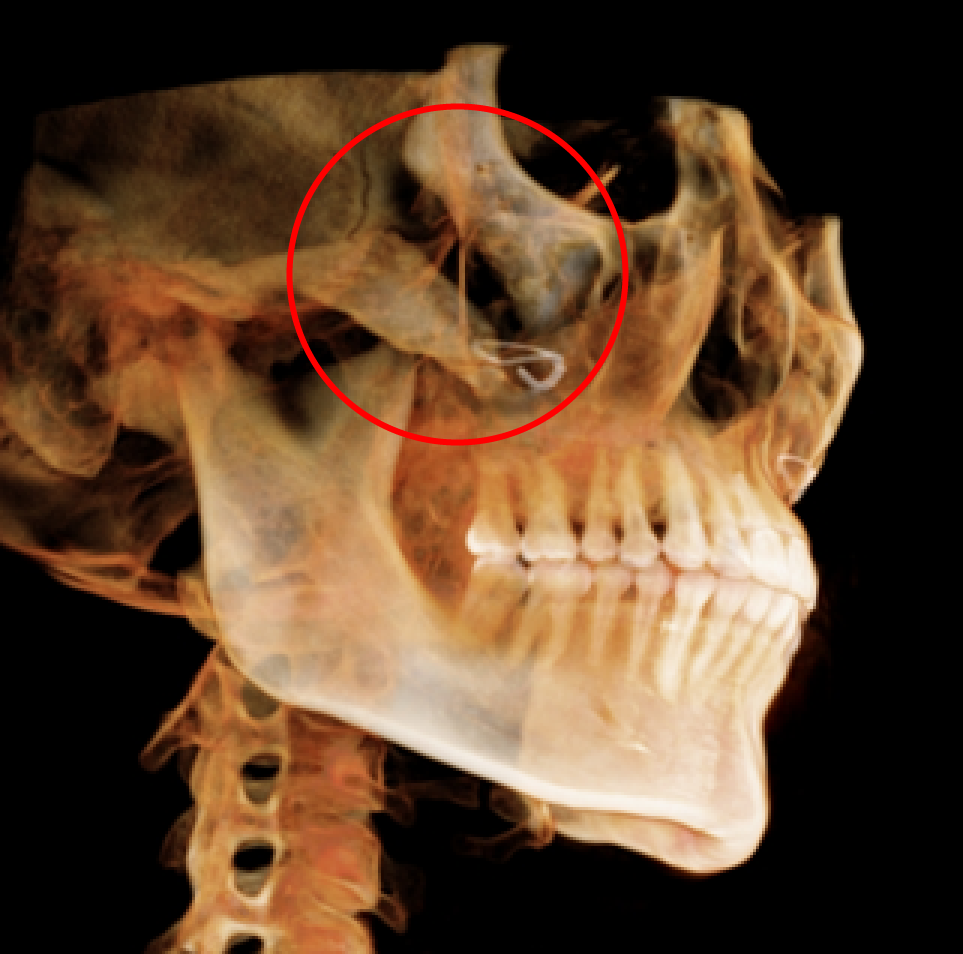
[입체성형외과] Side effects of zygoma surgery, cheek sagging
If you look at the marked area, you can see at a glance, even if you are not a specialist, that the gap between the cut zygoma bones has opened widely, which means the surgery was done incorrectly.
In this patient’s case, it was because the bone was not properly fixed during surgery. If proper fixation is not done like this, it may look as though the bones were fixed at the time of surgery...
As time passes, the gap between the cut bones widens, and the zygoma moves out of its original position.
As you can see, when the cheekbone moves downward, the skin and muscles attached to the zygoma naturally move downward as well, making the skin look saggy. Dissection beyond what is necessary is also a major problem. The retaining ligaments that support the skin of our face can be cut, and the periosteum can also be torn, leading to skin sagging.
In cases like this, you may not notice the problem immediately after surgery, but side effects begin to appear gradually after 1 to 2 years, and this is when you feel that you have developed "cheek sagging due to zygoma surgery."
Saying that the cheeks sagged because of zygoma surgery is the result of an incorrect operation, and if the bones are fixed correctly in the proper position, there is no need to worry.
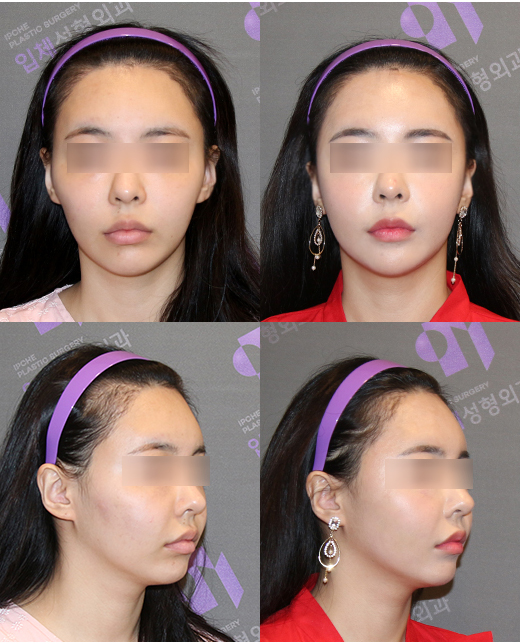
2 years and 6 months after zygoma surgery
What is nonunion?
In zygoma reduction surgery, nonunion means that the cut zygoma bone does not join back together, as in the CT image you saw earlier.
What you may be overlooking is that a more serious side effect than cheek sagging is "nonunion."
When nonunion occurs, cheek sagging naturally follows.
Recently, many clinics have been performing non-fixation surgery. The so-called "non-fixation zygoma surgery" requires more advanced technique than fixation surgery. If the bone is simply cut without the special know-how that only a specialist has, nonunion can occur, in which the bones do not join and instead separate further.
As a result of nonunion, the patient not only experiences cheek sagging, but also pain at the site where the bones have not joined and a feeling that the bones move when chewing.
"Then would fixation zygoma surgery be fine?"
Even when fixation is used, there are cases where the fixation pin breaks and nonunion develops.
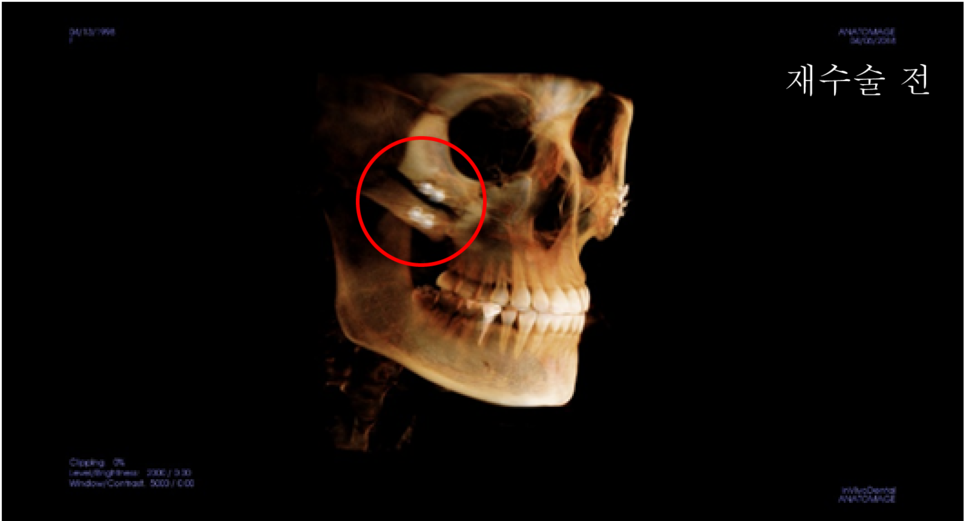
[입체성형외과] Side effects of zygoma surgery, nonunion
The patient above had zygoma surgery with fixation at the first hospital, but came to us with nonunion after the fixation pin broke.
In such cases, you must visit the hospital as soon as possible and have the fixation redone so that the bones can join again.
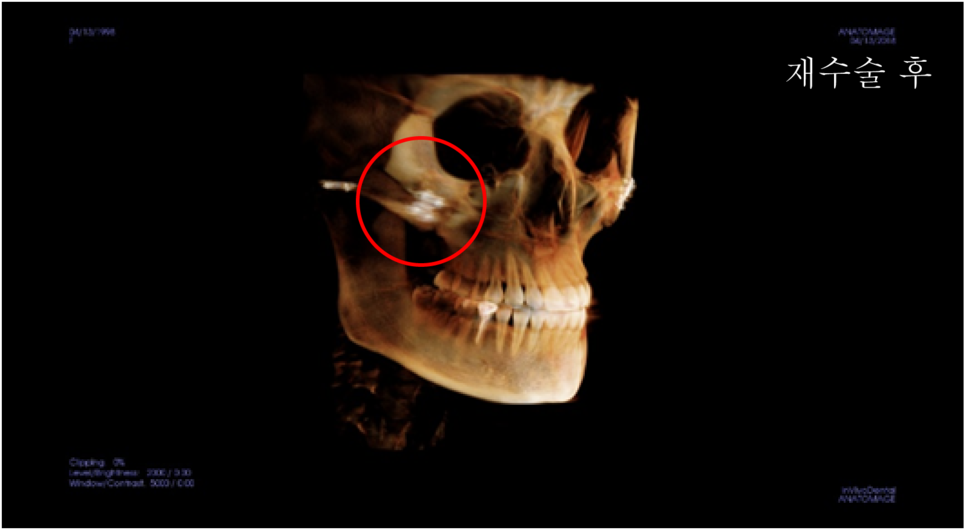
[입체성형외과] Side effects of zygoma surgery, nonunion
These problems can occur regardless of whether fixation is used if the surgeon lacks experience. Therefore, the most important thing is to understand bone movement accurately and perform proper fixation so that nonunion does not occur in the first place, using the specialist’s own know-how.
I’ve heard the bone can return to its original position after zygoma surgery...
This is also one of the questions I get very often during consultations. There are cases where recurrence happens depending on the osteotomy status, but in fact, the recurrence rate is low with standard fixation zygoma surgery.
Most patients who come in because of recurrence had "quick zygoma reduction surgery" 1 to 2 years earlier.
As mentioned earlier, I think this is because quick zygoma reduction surgery is a "non-fixation" procedure that requires advanced skill, and I can also say that this is the result of improper fixation.
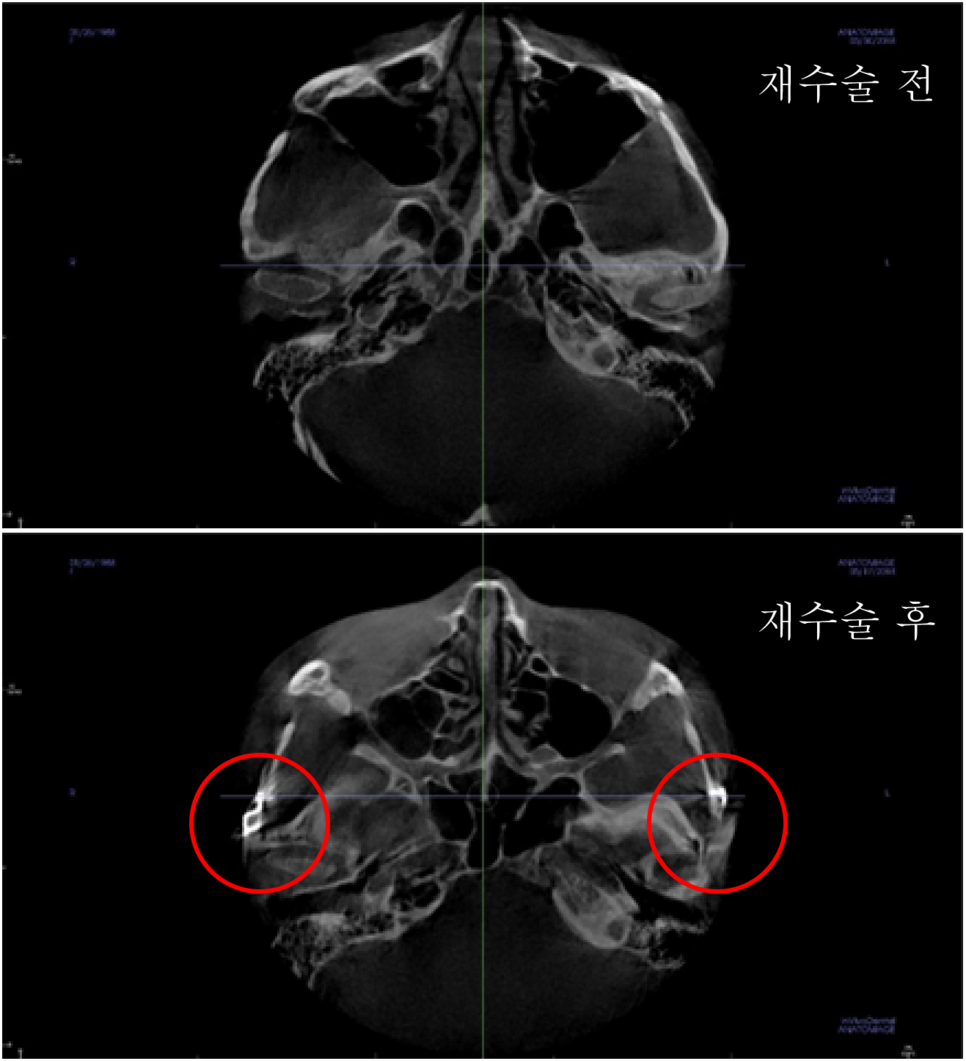
[입체성형외과] Side effects of zygoma surgery, recurrence of zygoma surgery
These are photos of a patient who had zygoma reduction surgery at another hospital two years ago and recently came in saying it seemed like the zygoma had grown larger again.
After checking with CT, we could see that the zygoma had returned to its original position.
As you can see, if the zygoma recurs like this, pushing the widened posterior zygoma back in and securing it again makes the chance of it returning to its original position close to 0%.
However, this too would all be unnecessary if proper fixation had been done from the beginning.
Again, if only "proper fixation in the proper position" is maintained, zygoma surgery should not be a problem at all.
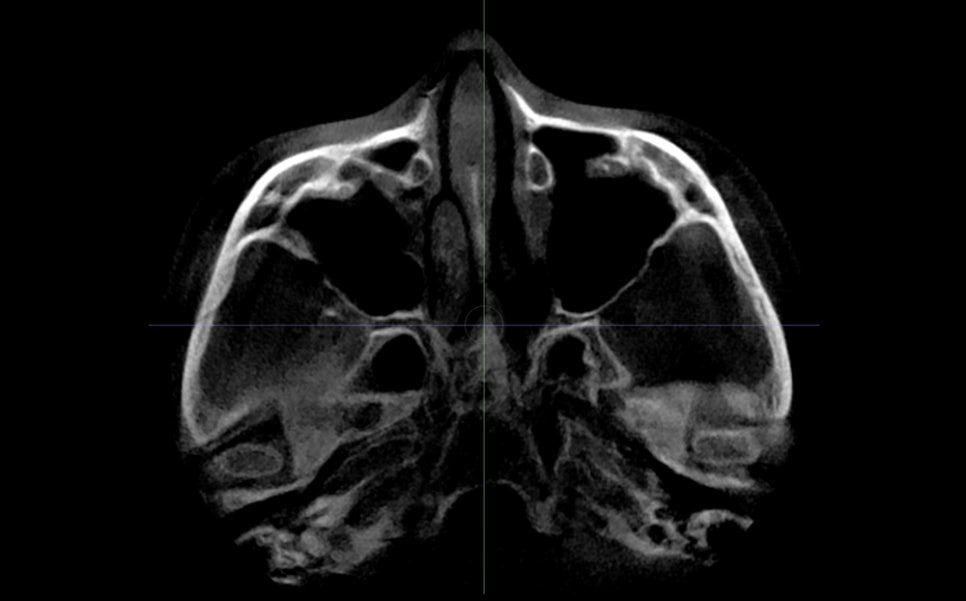
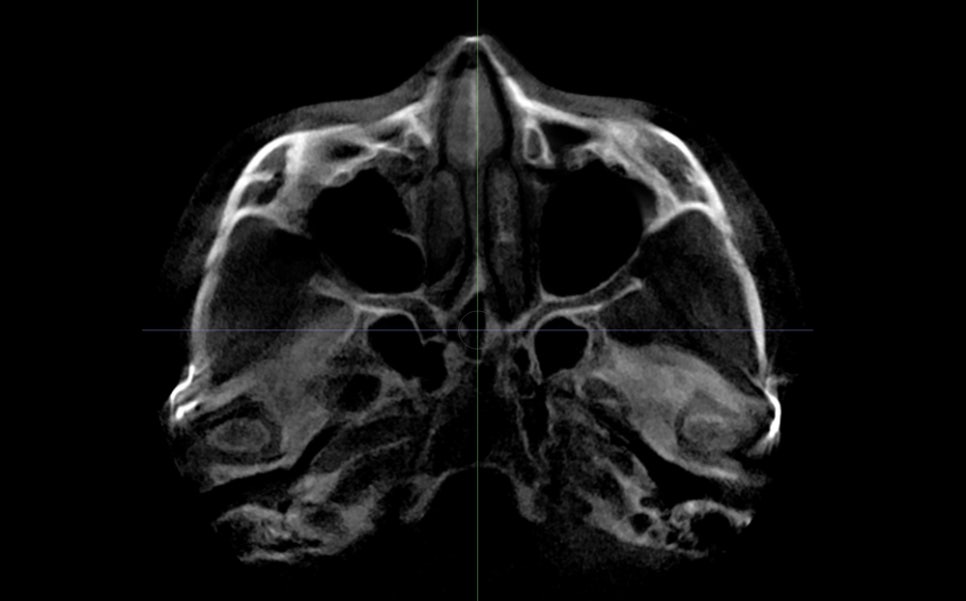
Before and after 230-degree zygoma surgery
Can zygoma surgery improve hollow cheeks?
There is something many people misunderstand. They think that if they have zygoma surgery, hollow cheeks will be resolved.
Let me be clear: hollow cheeks and zygoma surgery are separate issues.
In general, people think that if the protruding zygoma is moved inward, hollow cheeks will look less noticeable. But when the cheekbone is moved inward after surgery, the original cheek hollow can actually appear deeper, making it look even more severe.
Therefore, this is something that must be addressed before surgery, and during consultations I check the extent of each patient’s hollow cheeks in advance and explain it to them.
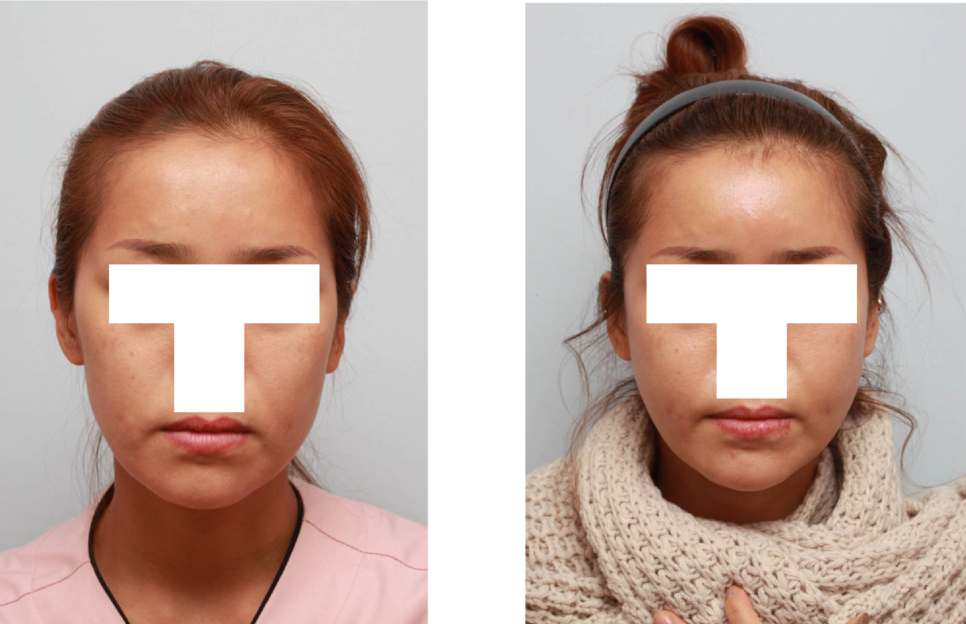
[입체성형외과] Side effects of zygoma surgery, improvement of hollow cheeks
The photo above is of a patient who underwent zygoma surgery together with fat grafting. You can see that the uneven area below the zygoma was also improved through fat grafting.
Can nerves be damaged after zygoma surgery?
I’ve heard paralysis can happen...
Simply put, the area where zygoma surgery is performed is not a site where important nerves pass through.
The nerve that can be affected during zygoma surgery is the "zygomaticofacial nerve."
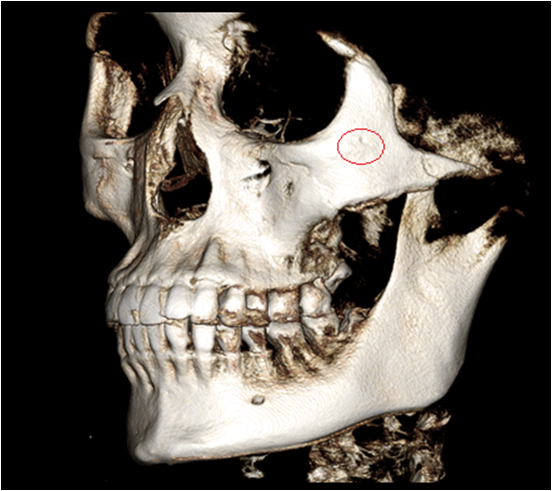
[입체성형외과] Side effects of zygoma surgery, nerve damage in facial contouring
Do you see the small tiny hole in the zygoma area in the CT image above? Because of its location, the zygomaticofacial nerve can potentially be damaged during surgery.
Since the position where the nerve emerges differs from patient to patient, if the surgeon lacks experience, the nerve may sometimes be stretched or injured.
But even if it is injured, there is no need to panic too much.
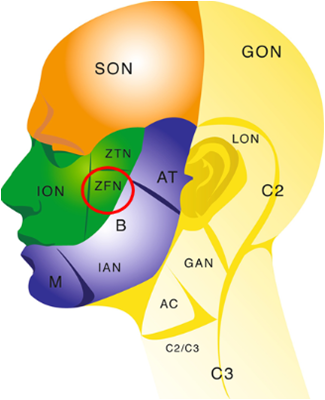
[입체성형외과] Side effects of zygoma surgery, nerve damage in facial contouring
As mentioned earlier, this nerve is responsible for sensation in a very small area, as shown above. Even if it is damaged, nearby nerves usually take over, and sensation returns soon after.
Therefore, the chance of nerve damage from zygoma surgery is low, and even if damage occurs, normal sensation naturally returns after a certain recovery period. So there is no need to worry too much about nerve damage.
What is sinusitis?
This is the last possible side effect of zygoma surgery. "Sinusitis" means inflammation occurs in the sinus area during surgery.
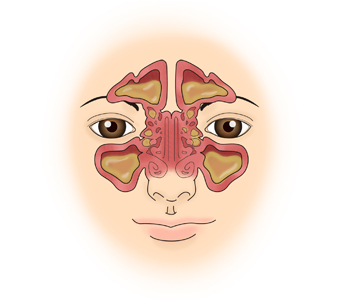
[입체성형외과] Side effects of zygoma surgery, sinusitis
The sinus can be thought of as an air-filled cavity inside the nose. If this sinus is opened too much during zygoma bone cutting, the likelihood of inflammation increases significantly.
If this condition continues, the fixed bone may dissolve and chronic inflammatory reactions may continue.
If a patient has significant facial swelling after zygoma surgery or pus coming out through the nose, they must undergo another surgery to wash out the sinus with antibiotics.
This is a very rare case, but I am sharing it because knowing about it may help with prompt treatment if the symptoms appear.
Finally, I would like to say that there is no surgery in the world that has no side effects.
But this is true not only for plastic surgery, but also for procedures many people commonly undergo, such as LASIK, and even general surgery performed because the body is in pain.
Even so, the reason surgery is performed is because
with a properly done operation, the side effects are so minimal that they are hard to even call side effects, and the results obtained through surgery are absolutely significant.
In reality, the side effects that become a problem can be described as a kind of "accident" that is not due to the surgery itself but to the surgeon.
Therefore, it is most important to meet a board-certified specialist with a long career and proven skill in a specific field.
Before surgery, I recommend visiting at least 2 to 3 hospitals and making the right decision after 충분한 consultation.
Thank you for reading this long post.