Hello, I’m Dr. Jo Hyun-woo of 입체성형외과.
Today, I’d like to talk about one of the popular surgeries many people are choosing these days: forehead lift surgery.
Forehead lifting has been performed for a long time.
In the past, forehead lifting was done by making a full incision across the forehead and lifting it.
However, as endoscopy developed, forehead lift surgery using an endoscope began to be performed.
Also, while it used to be a surgery to smooth wrinkles in older patients, it has now become a good surgical option that can also be applied to people in their 20s.
So today, I’ll explain the fixation methods patients often ask about when having forehead lift surgery.
Endotine vs. bone tunneling
There are two main methods used to fixate the tissue during forehead lift surgery.
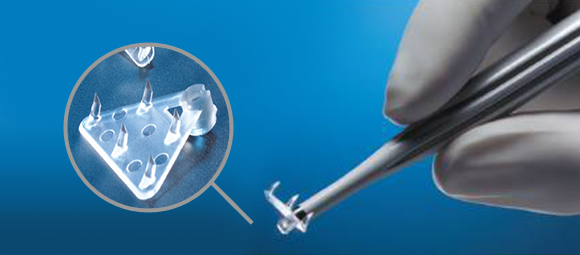
Endotine
Endotine is a dissolvable pin made for fixation after a forehead lift.
As shown in the image above, it is a triangular fixation plate made of PLA (polylactide), and it is said to be absorbed by the body after about 8 months.
After the forehead lift, a small hole is made in the bone, and fixation is done with five spike-shaped pins, usually in two pairs, one on each side.
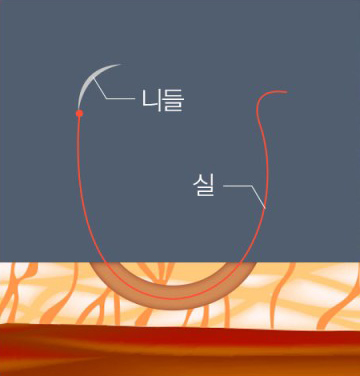
Bone tunneling
Bone tunneling was widely used to fix the flap even before Endotine became available. In this method, tunnel-shaped holes are made in the bone, and fixation thread is passed through the periosteal tissue to secure it.
Endotine and bone tunneling each have their own advantages and disadvantages.

In the case of Endotine, the advantage is that it provides strong fixation and places less tension on the tissue.
However, it is expensive, and in patients with thin scalps, the fixation pins can sometimes be felt in the early stage after surgery.
For patients with thin scalps, bone tunneling may be recommended.
In the case of bone tunneling, the advantages are that it is not felt or visible and can reduce costs.
However, bone tunneling requires a certain level of skill and has the disadvantage of taking longer during surgery.
Sometimes, it is said that hair loss occurs at the area where Endotine is fixed, but with bone tunneling, temporary hair loss may also occur.
This does not seem to be due to a difference in the fixation method itself.
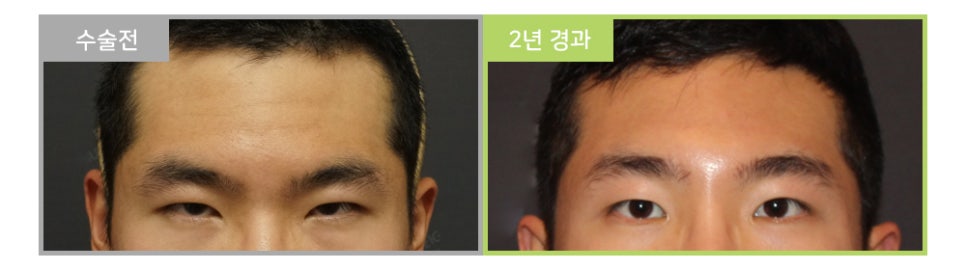
In conclusion, it is difficult to say which fixation method is better because each has its own pros and cons.
In practice, the surgeon’s skill and design choices—such as the extent of dissection and how fixation is performed—seem to be important.
So far, we have looked at the fixation methods used in forehead lift surgery.
In fact, the fixation method can vary depending on the surgeon’s preference, so if patients decide through thorough consultation before surgery, they will be able to achieve good results.
Thank you.