Hello, I am Dr. Joonhyun Jo of Interface Plastic Surgery.
The long winter has already ended, and March has arrived with spring.
Please take care of your health during this seasonal transition.
Today, I will talk about the concern of people whose facial bones have become smaller after contouring surgery, but whose foreheads still look wide and make their faces appear larger: the methods for reducing a wide forehead.
I once talked about facial proportions in a previous column.
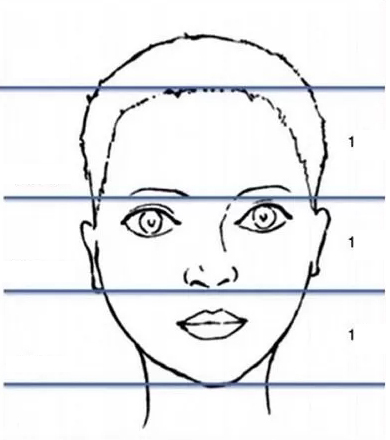
In the past, the ideal facial proportion was said to be 1:1:1, but recently, as youthful-looking faces have become popular, a ratio of around 1:1:0.8 is considered ideal.
When contouring surgery or double jaw surgery is performed, the lower part of the face becomes shorter, but for people with a wide forehead, the face may still appear long or large.
The surgeries that such people often choose are hair transplantation and forehead reduction surgery.
Hair Transplantation
First, let me talk about hair transplantation.
These days, hair transplantation is so widely performed that many people are probably already familiar with it.
Hair transplantation is a method that removes hair follicles from the back of the head and transplants them after separating them into follicular units, allowing for natural-looking results.
The number of grafts needed varies depending on how much correction is required, but roughly speaking, if we assume lowering the hairline by 1 cm, about 2,000 to 2,500 hairs are needed, and for 2 cm, about 3,000 to 4,000 hairs are needed.
Depending on how the hair is harvested from the back of the head, transplantation is divided into strip and non-shaven methods.
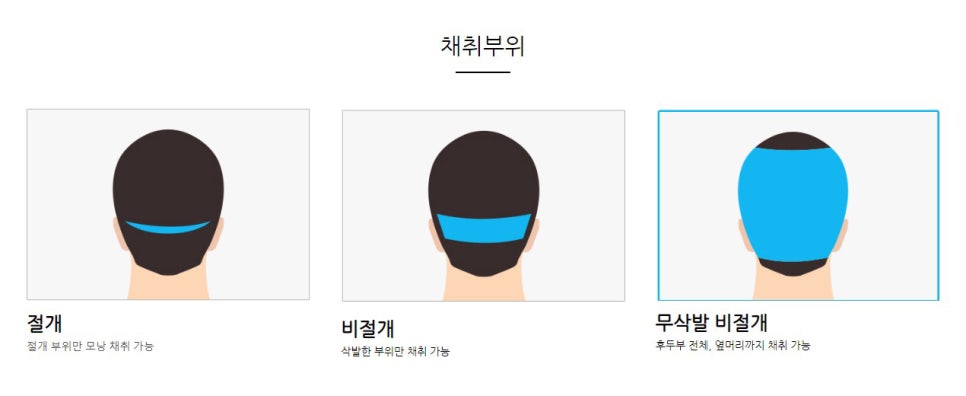
Excerpt from New Hair Hair Transplant Plastic Surgery Clinic
Originally, when the non-shaven method was used, the head had to be shaved, but these days hair transplantation has advanced, and there is reportedly a non-shaven non-shaving method that does not require shaving the head.
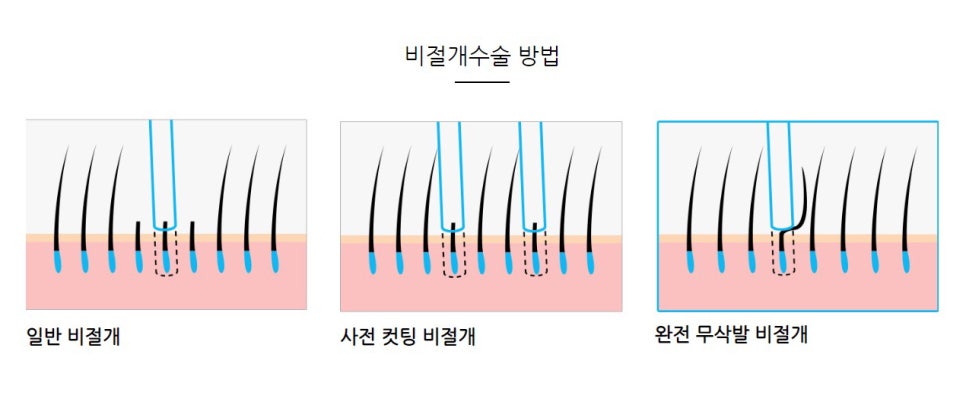
Excerpt from New Hair Hair Transplant Plastic Surgery Clinic
With the surgical method above, it is said that hair follicles can be harvested without shaving the head.
Hair transplantation allows the hairline to be corrected naturally without leaving any scar at the forehead area.
However, because the hair is taken from the back of the head, the corrected area may look a little unnatural, and if the graft survival rate is low, another revision surgery may be needed.
Forehead Reduction Surgery
In the case of hair transplantation, because the surgery takes a long time and is expensive, another option patients choose is forehead reduction surgery.
It seems that forehead reduction surgery has been actively and widely performed for less than 10 years.
In the beginning, many people avoided it because the scar was too visible.
These days, the surgeons’ techniques are excellent, so in many cases the scar is hardly visible.
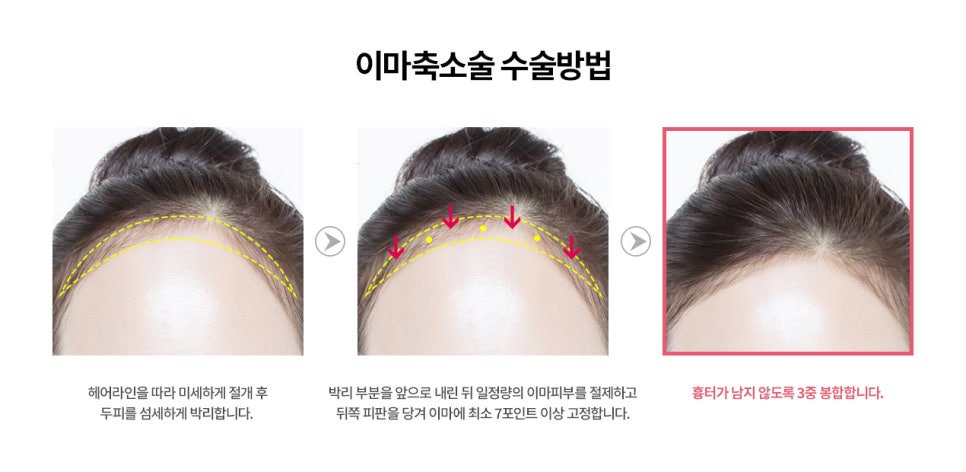
Forehead reduction surgery is performed in the way shown above.
It is said that the forehead can be reduced by up to about 3 cm.
With hair transplantation, a 3 cm reduction would require a large number of grafts, so this can be an effective method for people with a very wide forehead.
The biggest drawback of forehead reduction surgery is, as mentioned earlier, the scar.
In the case of scars, surgical techniques have advanced, and by using triple-layer closure and laser treatment, they can be made into scars that are manageable enough.
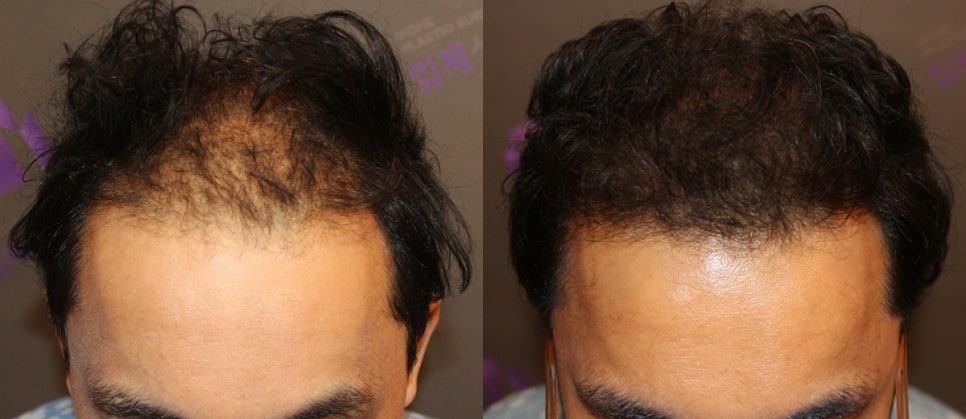
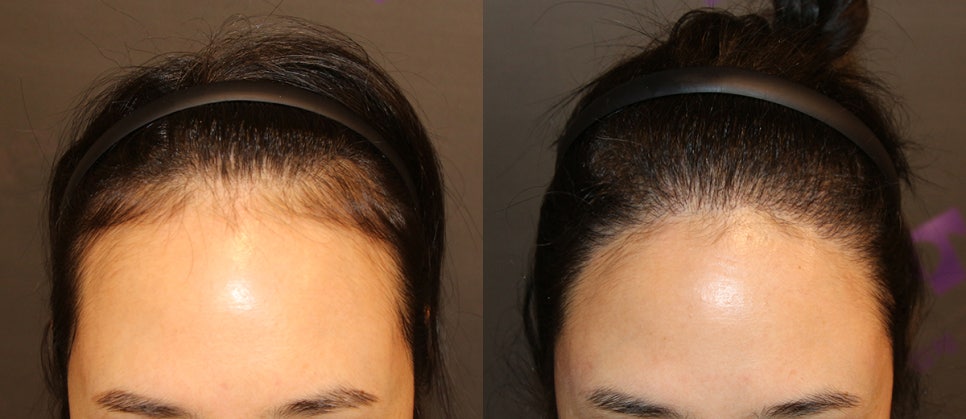
Recently, in order to reduce the forehead as much as possible and make the scar less visible, forehead reduction surgery and hair transplantation are often performed at the same time.
For those who are worried about scars, it may be worth considering simultaneous surgery as well.
Today, I talked about hair transplantation and forehead reduction surgery, which are solutions for people who are concerned that their forehead looks wide after contouring surgery.
Neither of these surgeries is my specialty, so the discussion may not be very detailed, but I hope it helps you get a general idea that these are some of the ways to reduce the forehead.
Thank you.