Hello, this is Dr. Jo Hyun-woo of 3D Plastic Surgery.
The thing people who come in for contouring surgery are probably most curious about is how long the swelling lasts after surgery.
Some people have jobs, some go to school, and in situations where they need to meet many different people, how much time has to pass before they can resume going out? Today, I’ll explain this while looking at several cases.
I previously mentioned the recovery period after contouring surgery in an earlier column.
In general, swelling increases until 72 hours after surgery and then begins to go down after that point.
However, it seems that swelling varies greatly from patient to patient.
Even when the same surgery is performed in the same amount of time in exactly the same way, the amount of bleeding and the amount of soft tissue a patient has can cause the initial swelling to differ, so the amount of swelling that goes down also seems different. I’ll explain while showing actual patient photos.
First are patients who underwent 230-degree 3D zygoma reduction.
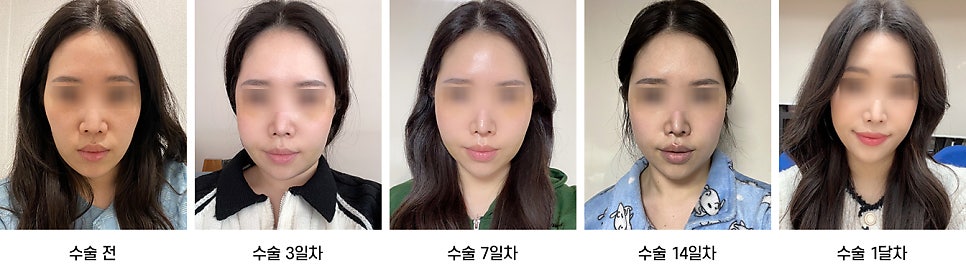
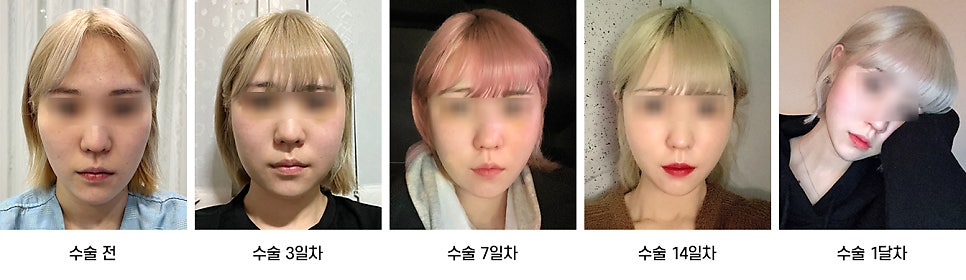
These two patients had typical swelling.
Swelling peaks on day 3, and you can see that much of the major swelling goes down between days 7 and 14.
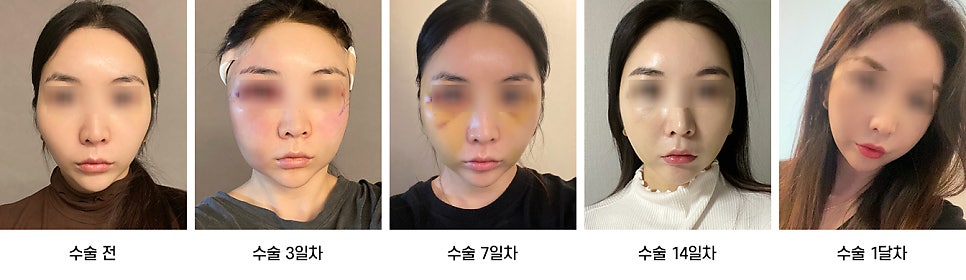
Sometimes, as in this patient, swelling rises a lot around the eyes on day 3. In such cases, one side may still remain swollen even after a week.
However, even this kind of swelling can be seen to go down a lot after about a month.
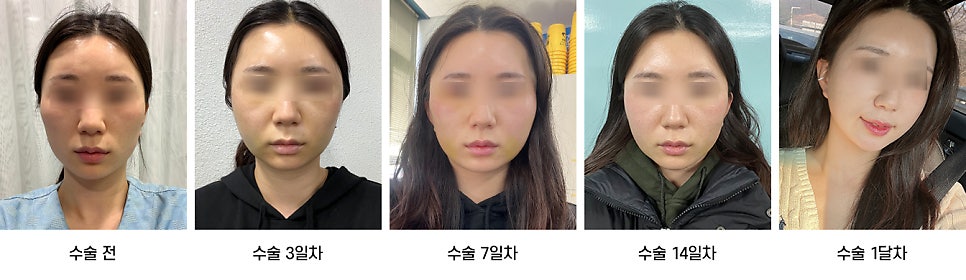
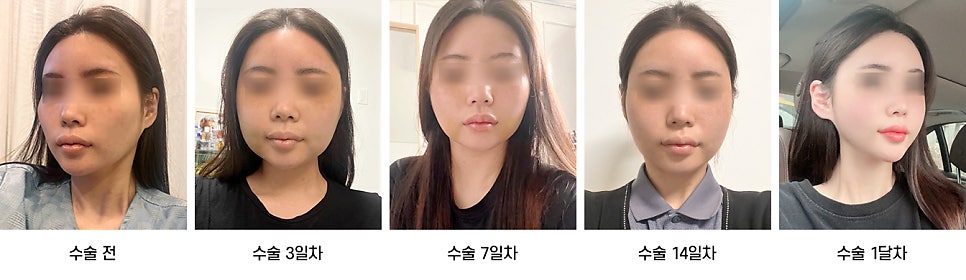
People who do not have much facial fat can be seen to have less swelling.
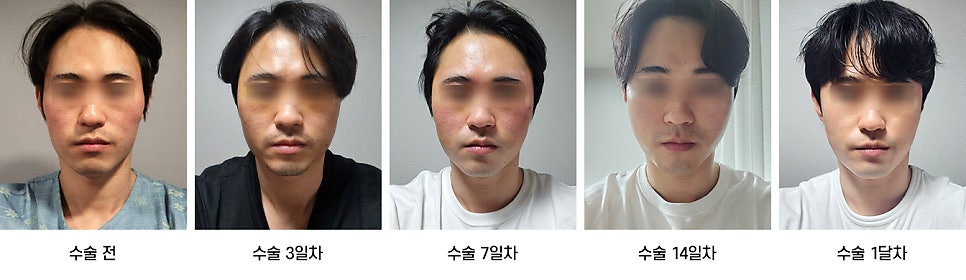
In particular, men seem to have less severe swelling because they do not have much facial fat.
One week after surgery, you can see that the face is only slightly puffy.
Next, I’ll show photos of patients who underwent three-type contouring surgery.
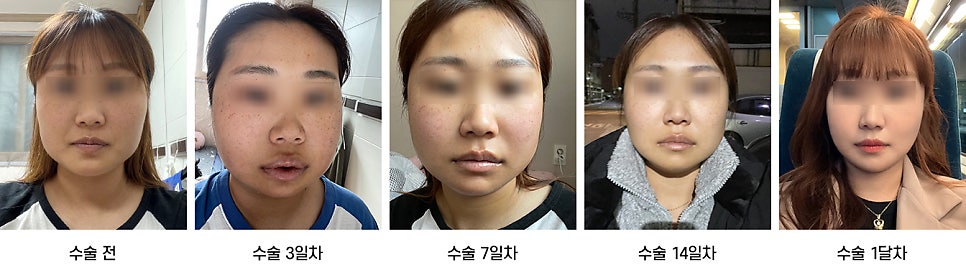
Because three-type contouring surgery involves the lower jaw area, the area around the lips tends to swell the most, and the swelling on day 3 can look severe.
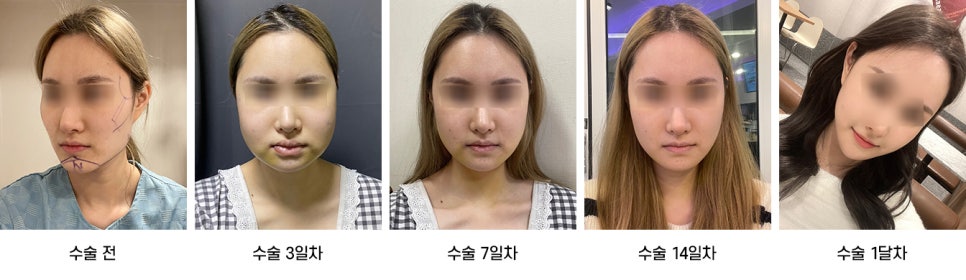
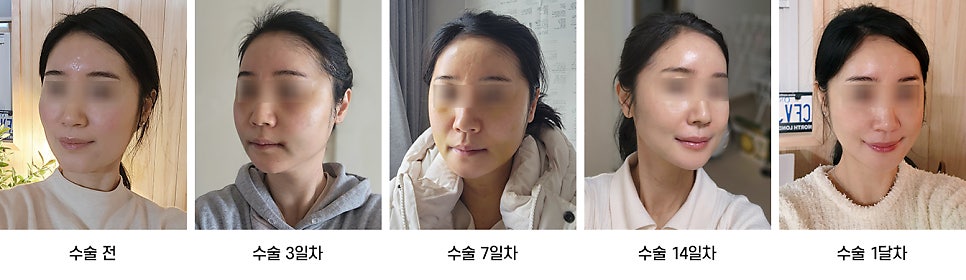
However, since 3D zygoma reduction uses an intraoral incision, the eye area does not swell, so some people feel that the swelling is actually less than with 230-degree 3D zygoma reduction. You can see that the two patients above do not have severe swelling around the eyes.
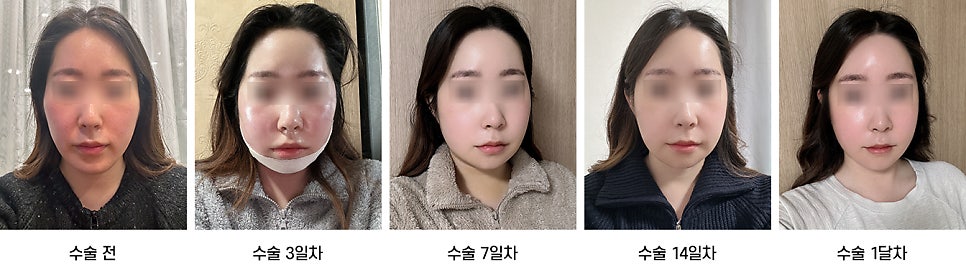
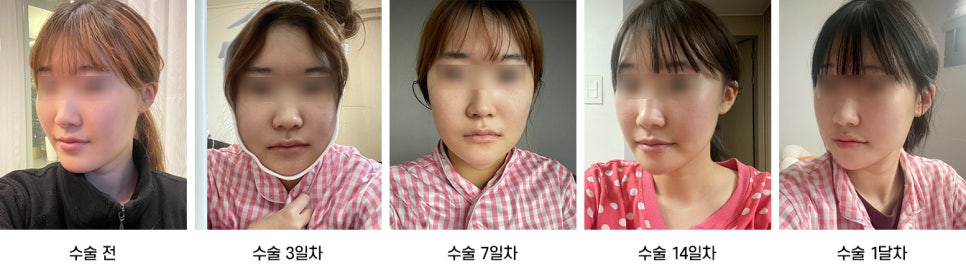
The two patients above are photos of patients who had a lot of swelling after three-type contouring surgery.
As you can see in the photos, even a lot of swelling has calmed down significantly after a week.
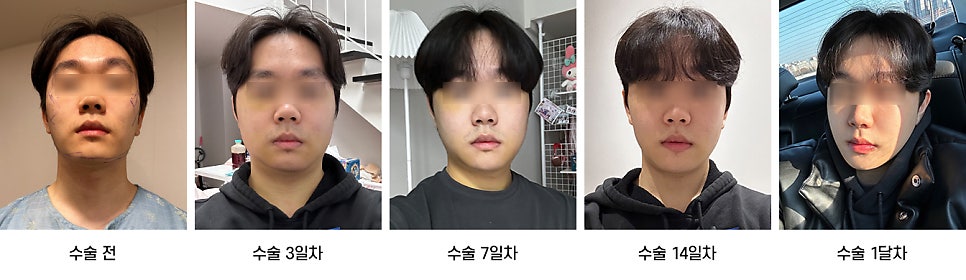
Lastly, here is a male patient who underwent three-type contouring surgery.
As with other surgeries, men tend not to swell much because they do not have much facial fat, so even with three-type contouring, the swelling is not severe.
As you have seen so far, swelling differs from patient to patient, and the amount of swelling that goes down also differs.
However, even looking at the patients above, it seems that major swelling subsides within 7 to 10 days.
After about a month, only about 20% of residual swelling remains, and the rest seems to go down over about 6 months.
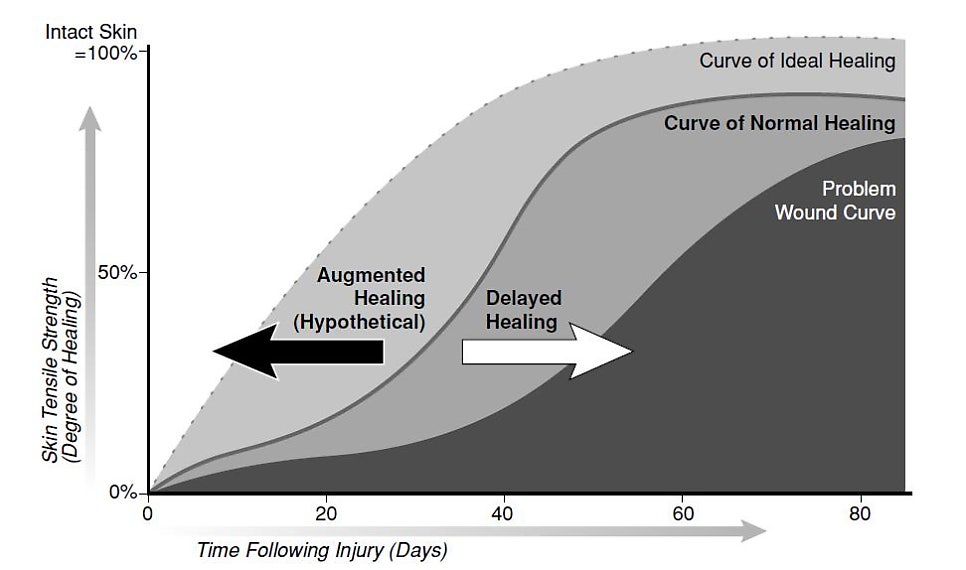
This graph shows how long it takes for a wound in our body to return to its original state after it is injured.
It is a complicated graph, but in general, it says that wounds like surgical wounds are almost completely healed between 40 and 60 days.
The swelling in our face follows this wound-healing process as well, and you can think of it as much of the swelling going down after about two months.
However, as I keep seeing patients, I feel that it is only after 6 months that I can say, “Ah, it has gone down a lot,” and patients who have passed about a year seem to settle in even more.
From the patient’s perspective, that may feel like a very long time and be hard to wait through, but our bodies seem to need that amount of time.
To perform surgery that minimizes swelling, we do not try to make the operation time unnecessarily long, and we also control bleeding as much as possible during surgery.
In addition, many doctors are making efforts to minimize the dissection area so that the swelling range is reduced as well.
However, postoperative swelling from surgery inevitably takes time.
Finally, I’ll talk about when daily life becomes possible.
In fact, each patient has different work and responsibilities, and what counts as “daily life” can also vary.
Some people who need to meet others stay at home for about a month.
From my perspective, I think there should be no major issue with going out or working starting from day 4, when the swelling begins to go down.
Today, I explained postoperative swelling by looking at patient cases.
Because the degree of swelling differs so much from patient to patient, it is not possible to say exactly how much swelling there will be, but if you look at the recovery progress of the patients above and make a rough prediction, it likely won’t be far off.
Thank you.