Hello, this is Director Jo Hyun-woo of Iptae Plastic Surgery.
Today, I’d like to talk about swelling after facial contouring surgery.
I think all patients considering facial contouring surgery share the same concern, but one of the most common questions is how quickly they can return to daily life after surgery.
When talking about recovery after facial contouring surgery, there are things like bruising, inside-the-mouth wounds, and discomfort when opening the mouth. But the most important factor in determining when you can return to daily life is swelling.
So I’ll explain the process of swelling going down after facial contouring surgery with day-by-day photos.
The photos below show a patient who underwent zygoma reduction, square jaw surgery, and chin surgery—a three-part facial contouring procedure.
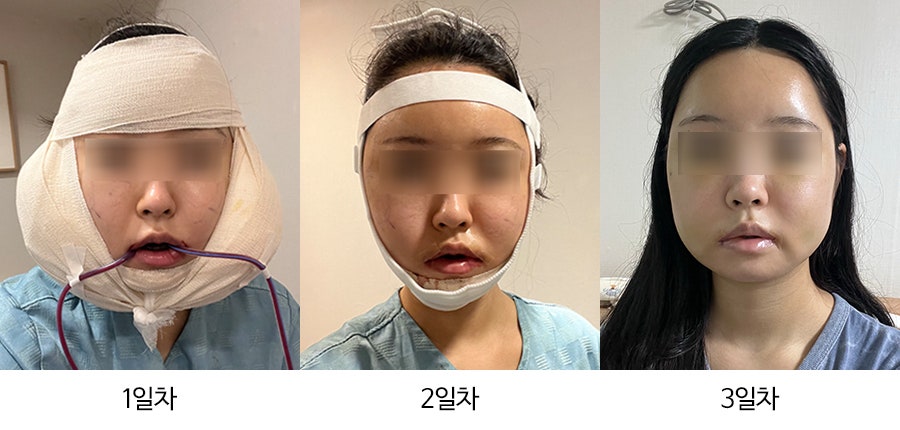
When people generally think about swelling after facial contouring surgery, they assume the face will be the most swollen immediately after surgery. But in fact, if you look at the day of surgery or the next day, you may feel that it is “less swollen than expected.”
Swelling after facial contouring surgery reaches its peak at 72 hours after surgery, and it becomes most pronounced on days 2 to 3 rather than immediately after surgery.
At this time, patients often worry that their face is becoming more and more swollen, but it is normal for swelling to continue increasing until day 3. After day 3, the swelling gradually begins to subside.
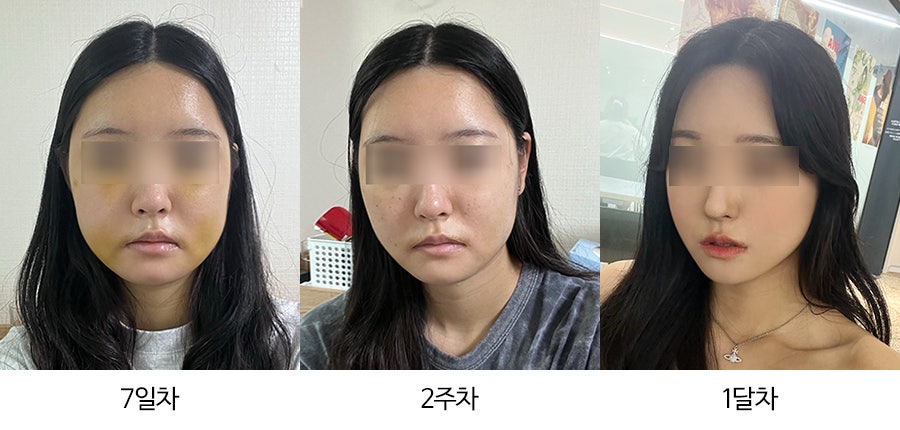
By day 7 after surgery, the major swelling will have gone down.
However, some patients often become worried after a week has passed.
“Why does my face look uneven after surgery? Did something go wrong?”
They say this with concern because the major swelling has subsided, so it feels like all the swelling is gone, but the face still appears to have contours and unevenness.
However, one month after surgery is still not complete recovery, and you can think of the swelling as gradually subsiding and the wounds healing over 3 months, or up to 6 months in some cases.
The reason the face may look uneven during recovery is that after facial contouring surgery, the face swells significantly overall, and as the swelling goes down, it subsides in different areas at different times.
Since some unevenness is unavoidable as swelling decreases, this is a natural process, and you do not need to worry too much if you think of it as part of recovery.
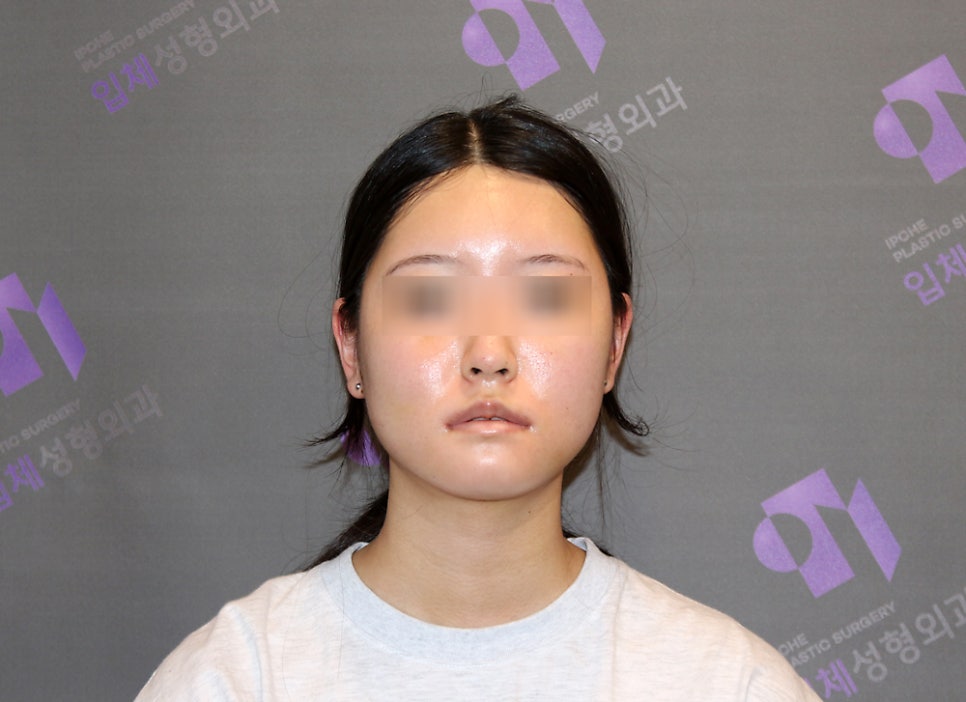
Check-up on day 10 after zygoma reduction, square jaw surgery, and chin surgery
If you want to hide the fact that you had surgery from people around you, I would say you should plan for at least 2 weeks.
By 2 weeks after surgery, the swelling has gone down a lot, so it should be at a level where you can casually say, “I just had my wisdom teeth removed~” or “I fell asleep after eating ramen last night~”.
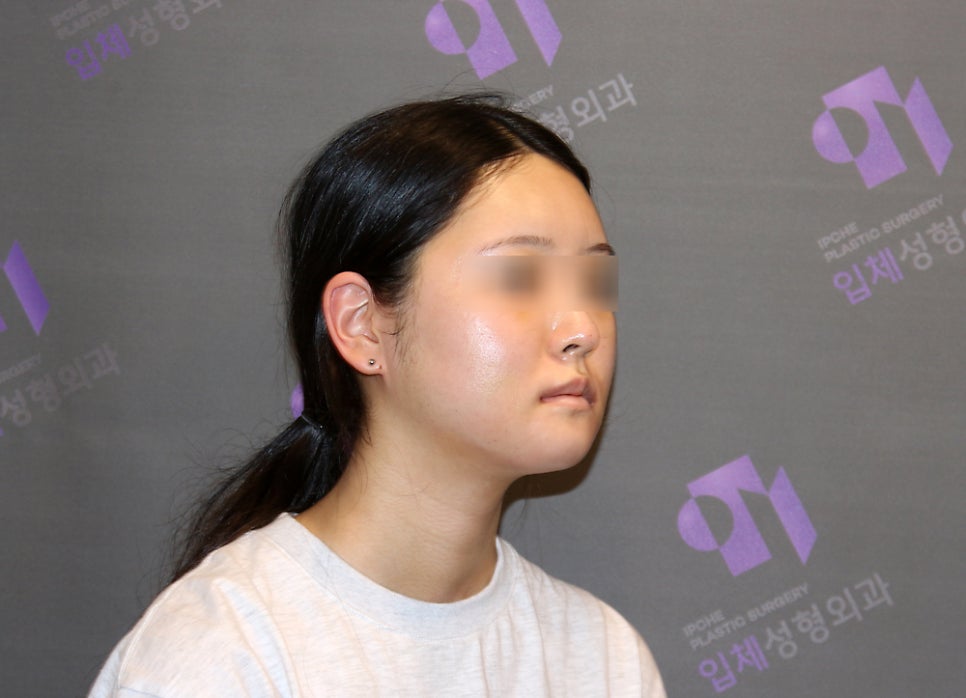
Check-up on day 10 after zygoma reduction, square jaw surgery, and chin surgery
Sometimes, even after some time has passed after surgery, there are people who say, “My face keeps getting smaller~”
In general, by one month, 90% of the swelling has gone down, so it may look like everything has settled. But as the residual swelling and scar tissue remaining over 3 to 6 months gradually subside, the face becomes a little slimmer little by little.
However, swelling varies depending on the patient’s constitution, so for some people it may last longer, while for others there may be almost no swelling even on day 7.
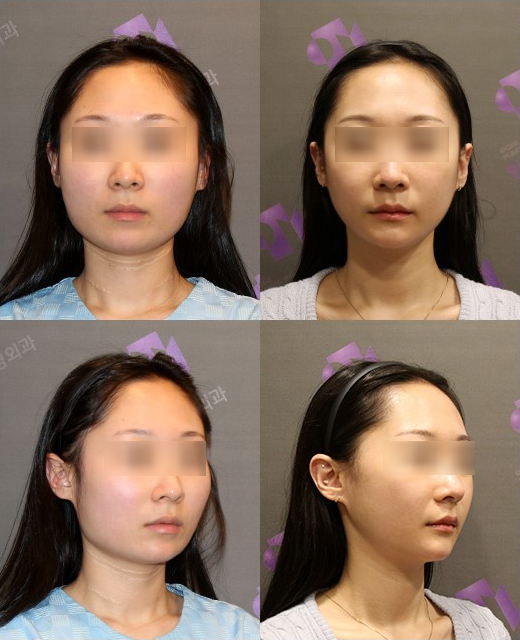
Check-up at 6 weeks after zygoma reduction, square jaw surgery, and chin surgery
“Then, is there a way to reduce swelling after surgery?”
Aside from the patient’s constitution, the factors that affect swelling after surgery are the surgical method and the length of the operation.
Swelling after facial contouring surgery is proportional to the amount of bleeding during surgery, as well as the duration of the surgery.
Therefore, surgery that reduces swelling means reducing bleeding, in other words, minimizing unnecessary injury, and shortening the operation time through a smooth and efficient procedure without delay.
For example, if something that could be cut once is cut 3 to 4 times, or if it is handled repeatedly, the surrounding soft tissue will naturally be injured. That means there will also be more bleeding.
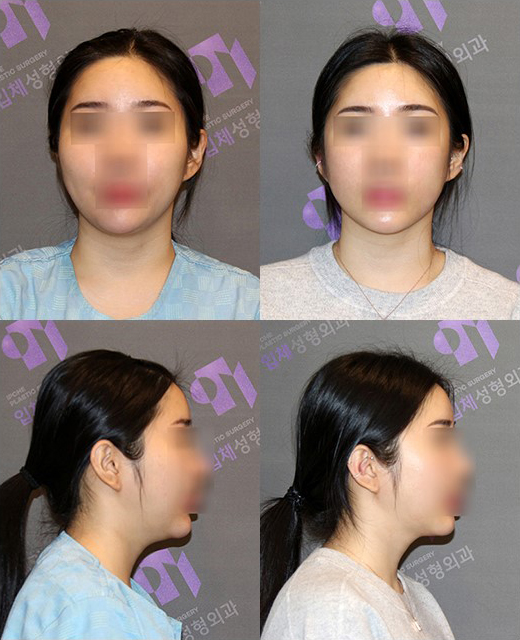
Check-up at 6 weeks after 230-degree three-dimensional zygoma surgery, chin surgery, and facial fat suction
In the case of 230-degree three-dimensional zygoma reduction surgery, the procedure is simple for a faster recovery, and the surgery time is about 20 minutes.
Facial contouring surgery is performed through the narrow space inside the mouth, so if the surgeon lacks experience, damage to the surrounding tissue is inevitable.
If there is too much unnecessary dissection, bleeding increases and the operation time becomes longer as a result.
Therefore, if you do not want to struggle with swelling that lasts longer than average, the best approach is to finish the surgery neatly and without delay.
That concludes our look at swelling and recovery time after facial contouring surgery.
Thank you.