Hello.
I am Jeon Hae-won, a board-certified plastic surgeon at 3D Plastic Surgery, where I perform rejuvenation surgery.
�Recently, while writing posts related to forehead lifts, I experienced an unexpected response.
"Does an endoscopic forehead lift make the forehead even wider?"
"My forehead is already wide. Is there a way to reduce it entirely, instead of lifting it?"
I received this second question very often, especially from younger patients in their 20s and 30s.
�So today, I’d like to talk about forehead reduction surgery, which is a completely different approach from a forehead lift.
In the past, people with a wide forehead were called Wong Fei-hung, and even now there are still many people concerned about the width of their forehead.
 Many people simply think of forehead reduction surgery as a surgery that makes the forehead narrower.
But if you look at the history of this surgery, you can see that it has gone through a truly interesting and complex development process.
To begin with the definition of forehead reduction, it is a surgery that brings the hairline forward to reduce the vertical length of a wide forehead.
It is also called "hairline lowering" or "surgical hairline advancement (SHA)."
But has a surgery like this always looked the way it does now? Not at all.
The 고민 about hair is a story as old as humanity itself
In fact, concerns about hair seem to be as old as human history.
From ancient Egypt, Rome, and Greece, people used various herbs and animal-based products to try to address hair loss.
It took a very long development process before forehead reduction surgery emerged in its modern sense.
To understand where it began, we first need to look at the history of hair transplantation and scalp reconstruction surgery.
�In 1897, Dr. Menachem Hodara in Turkey attempted a scalp transplant,
and in the 1930s and 1940s, Dr. Shoji Okuda of Japan developed punch grafting techniques for burn patients.
In the 1950s, Dr. Norman Orentreich discovered the concept of "donor dominance," the key principle of hair transplantation that hair from the occipital and temporal regions is resistant to balding.
If these efforts were the starting point of hair transplantation, which moved individual hairs to narrow the forehead...
A shift in perspective: moving the scalp
Scalp reduction surgery, which appeared in the 1960s, was a completely different approach.
It involved cutting away the scalp in the balding area entirely and stretching the hair-bearing scalp to cover it.
"Wait, isn’t that similar to forehead reduction?" It may look similar, but the purpose was different.
The goal of scalp reduction surgery was to eliminate the balding area itself, while the goal of forehead reduction surgery was to reduce the height of a wide forehead.
That is because hair loss is not limited to the hairline alone.
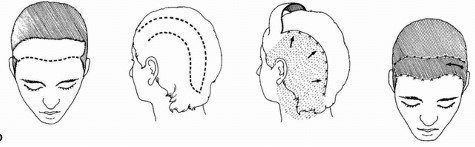 In 1969, Dr. Jose Uri’s temporoparietal-occipital flap procedure, Dr. Sheldon Kabaker’s various attempts...
These were mainly used at the time for scalp reconstruction after trauma or skin cancer removal. For cosmetic purposes, they were still too aggressive.
But as these experiences accumulated, scalp-handling techniques continued to advance, and that ultimately became the foundation of today’s forehead reduction surgery.
One of the important moments in the history of modern forehead reduction surgery was in 1985.
It was the paper published by Dr. Toby Mayer and Dr. Richard Fleming.
 In this paper, "Hairline Aesthetics and Styling in Hair Transplantation Surgery," they stated:
"The position and shape of the hairline are among the most important elements in overall facial aesthetics."
At that time, most doctors tended to focus simply on treating hair loss.
The idea of paying attention to the aesthetic importance of the hairline itself was innovative at the time.
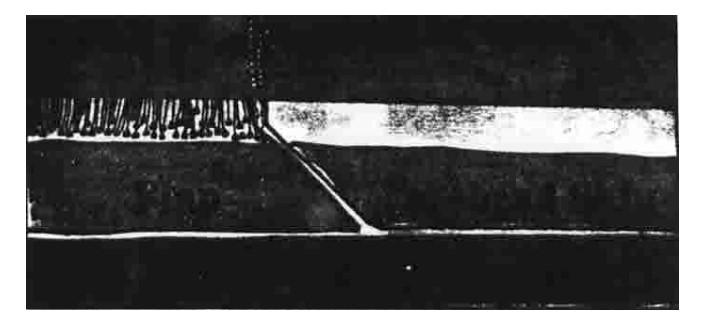 More importantly, they introduced a new technique called the "trichophytic incision method."
It is a technique in which the hair follicles are cut at an angle so that hair can grow through the scar area, and it is still used even now, 40 years later.
In 1999, the finished form finally appeared
True innovation came in 1999 from Dr. Timothy Martin. It was the paper titled "Lowering the Hairline in Forehead Contouring."
The reason this paper is important is that it was one of the first records to explicitly define hairline lowering as an independent area within forehead contouring surgery.
Dr. Martin’s approach was highly innovative. After making an incision at the hairline, he advanced the scalp forward and removed excess forehead skin.
He reported 27 procedures over five years, with significant improvement and high satisfaction in all cases.
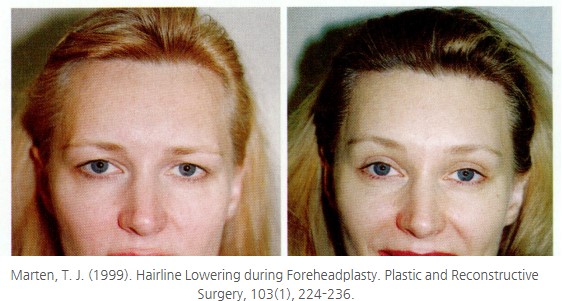 The results were remarkably excellent for outcomes from 25 years ago.
This was the birth of modern forehead reduction surgery.
In 2013, it became complete
Dr. Sheldon Kabaker took Dr. Martin’s technique one step further.
In particular, he developed a technique to make the lateral hairline appear more naturally rounded.
His 2013 paper on "Hairline Lowering" was truly comprehensive.
It included everything from patient selection to incision design and suturing methods... everything about modern forehead reduction surgery.
The most impressive part was this:
"In patients without progressive hair loss and with appropriate scalp elasticity, the hairline can be lowered by up to 10 cm using a tissue expander."
Of course, this is a special case, and in ordinary cosmetic surgery, about 1.5–2 cm per procedure is considered a safe and natural range.
Why did these developments concentrate around this period in particular? There is a very interesting sociocultural background.
The 1980s and 1990s were a time when media influence increased rapidly.
TV, movies, and fashion magazines spread the standards of "ideal beauty" worldwide.
And at that time, what began to attract attention was the "golden ratio of the face."
As the ideal forehead height came to be viewed as about one-third of the total facial length, interest in surgical approaches for a more balanced face increased significantly.
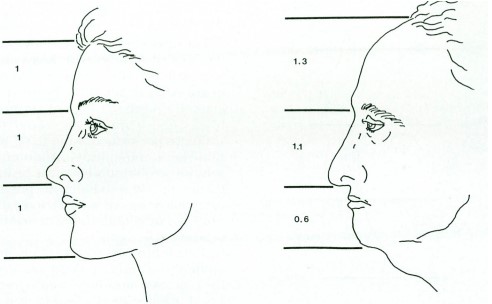 Trends and fashions, like in the clothing industry, also exist in plastic surgery.
Forehead reduction surgery is the same; it has developed alongside changes in social aesthetic standards.
To summarize the 40-year journey, here is the development history of forehead reduction surgery in chronological order:
1897–1960s: Development of foundational techniques for hair transplantation and scalp reconstruction surgery
1985: Introduction of the concept of hairline aesthetics by Toby Mayer and Richard Fleming
1999: Establishment of modern forehead reduction surgery by Timothy Martin
2013: Refinement and systematization of the technique by Sheldon Kabaker
What is interesting is that forehead reduction surgery also began to develop in earnest in the 1990s, when the revolution in facial rejuvenation surgery was taking place.
So far, we have looked at the fact that forehead reduction surgery is not simply a "surgery to make the forehead narrower," but a sophisticated procedure created through the research and innovation of many medical professionals. Next time, I’ll talk about the latest techniques and future directions of this surgery.
From the role of periosteal incision, to the development of fixation devices, to the introduction of endoscopic techniques...
We will look at how modern forehead reduction surgery is evolving to become safer and more effective.
If you would like more detailed information, please also visit the link below.
If you have any questions, please leave them in the comments at any time.
Thank you.