Hello.
I am Heo Jae-won, a board-certified plastic surgeon at 3D Plastic Surgery, where I perform facial rejuvenation surgery.
In the previous post, we looked at the historical development of forehead reduction surgery.
Today, I will go into detail about the technical innovations that have been made in the operating room and the core techniques currently in use.
Technical Differences Between the Past and Present
What would it have been like to undergo forehead surgery in the 1980s and 1990s?
At that time, the coronal incision was mainly the standard procedure.
It was a method that involved a large scalp incision extending up toward the crown of the head.
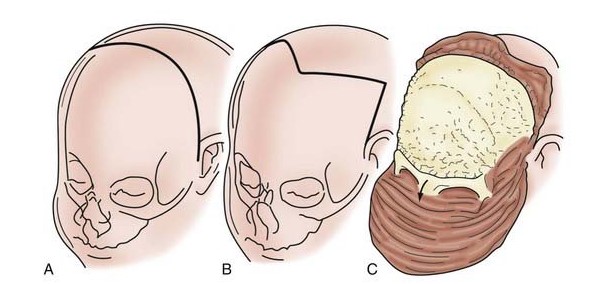
Coronal incision
The problem with this method was clear.
Not only was the surgical area extensive, but it also had the side effect of pushing the hairline farther back.
With the development of endoscopic brow lift surgery, this approach gradually disappeared, but there was still an unresolved issue.
What should be done in cases where the forehead is too wide to apply endoscopic techniques?
Among the patients I meet in clinical practice, some are extremely sensitive about their hairline.
They may not be able to accept even a slight widening of the forehead.
To meet these needs, hairline incision methods began to be preferred starting in the mid-1990s.
This involved making an incision directly along the hairline to preserve the hairline.
However, a new problem emerged: visible scarring.
Two Innovative Solutions to the Scar Problem
To solve this problem, two key techniques were introduced.
The trichophytic incision and the zigzag design (W-plasty).
This incision method is applied in the same way not only to brow lift surgery but also to forehead reduction surgery, and it is still used today.
The most important technical element in scar management in forehead surgery is the trichophytic incision.
This technique was first introduced in 1985 by Drs. Meyer and Fleming as an innovative incision method.
The key to the trichophytic incision is preserving the hair follicles while allowing hair to grow through the scar.
Unlike a typical vertical incision, this technique cuts the skin at a special angle.
Specifically, it makes an oblique cut at an angle of about 10-45 degrees rather than perpendicular to the hair follicles.
What effect does this angled incision have?
The magic of the angled incision lies in partial transection of the hair follicles.
When the scalp area where hair grows is cut at an angle, part of the severed follicle (the hair bulb) is preserved.
During the recovery process after surgery, new hair grows from this preserved bulb and passes through the scar.
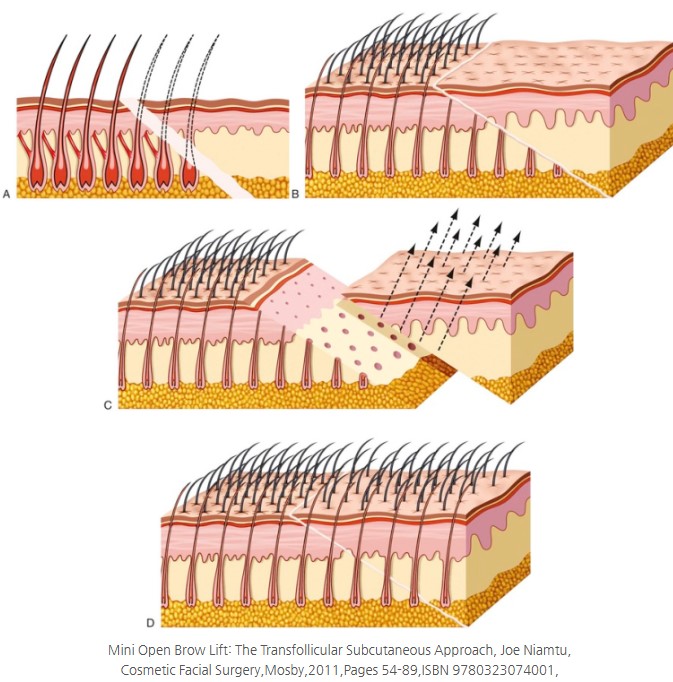
Trichophytic incision
Because the newly grown hair naturally covers the scar, the surgical mark becomes almost invisible.
This is not simply a technique for hiding a scar; it is a technique that allows hair to grow from the scar itself.
Application in Forehead Reduction Surgery
Because forehead reduction surgery involves an incision along the hairline, scar management is especially important.
This is because the scar may be exposed when the hair is tied up or when the wind blows.
The trichophytic incision method I use is as follows:
-
Hairline design: The design is customized to the hairline with an irregular pattern based on a zigzag shape.
-
Angle adjustment: The follicles are cut obliquely at an angle of about 30-45 degrees.
-
Depth adjustment: Only the hair shaft is cut while preserving the hair bulb.
This meticulous method takes more time, but the results are highly satisfying.
About 3-6 months after surgery, hair begins to grow through the scar, and after one year, the scar is barely visible in most patients.
Continuous Development of the Technique
In the early days, only simple angled beveling was used, but more sophisticated techniques have since been developed.
The double beveling technique angles both the front and back skin flaps to promote more natural hair growth.
In addition, the irregular zigzag-pattern trichophytic incision is less noticeable than a straight scar and creates a more natural hairline.
In forehead reduction surgery, incision design is a key factor that determines the outcome.
In particular, the method of making a zigzag incision along the hairline is the most widely used, but why choose a zigzag shape instead of a straight line?
The three key reasons for a zigzag incision are:
-
Natural hairline: A hairline is not originally straight, but has subtle irregularities.
-
Scar-concealing effect: A zigzag shape makes the scar less noticeable than a straight line.
-
Tension dispersion: It prevents the tension created when the scalp is pulled from concentrating in one area.
The zigzag incision follows the same principle as the W-plasty technique used in scar revision surgery in plastic surgery.
W-plasty is a technique developed to improve straight scars by creating a series of small triangular incisions on both sides of the scar so that they interlock.
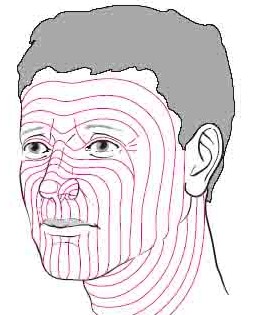
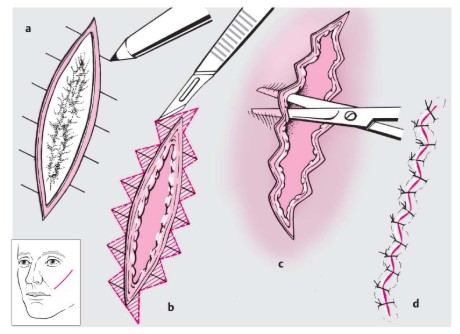
The reason W-plasty is effective is the dispersion of force.
A straight scar tends to widen under forces that act perpendicular to the skin’s tension lines (RSTL: Relaxed Skin Tension Lines).
But W-plasty disperses this force in multiple directions.
According to interesting research findings, when the angle of the triangle apex is 45 degrees, tension decreases by 29%, and when it is 60 degrees, it decreases by up to 50%.
It works like an accordion expanding and dispersing tension effectively.
Preventive Application in Forehead Reduction Surgery
In forehead reduction surgery, W-plasty is applied preventively.
In other words, it is used in advance to minimize scarring from the beginning, rather than correcting it after a scar has formed.
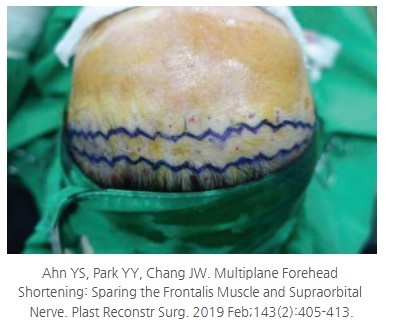
The forehead is a curved area of the face, and scars tend to remain easily, especially when the incision is made along the hairline.
If a straight incision is made, there is a risk that the scar will widen over time after surgery.
When W-plasty is applied preventively in forehead reduction surgery, the following effects can be achieved:
-
Scar prevention: From the outset, the scar is made less noticeable, reducing the need for later scar revision surgery.
-
Natural hairline: The zigzag pattern resembles a natural hairline.
-
Tension dispersion: It disperses the tension created when the scalp is pulled forward in multiple directions.
Because these incision methods require more time and care, not every doctor uses them.
Also, some people are constitutionally less likely to form noticeable scars.
However, in facial surgery, if even a small amount of additional scar concealment is possible, I believe it is right to use every possible technique, even if it takes more time.
That is because a well-executed trichophytic incision and W-plasty design are key factors that greatly increase patient satisfaction.
In the next post, I will explain in detail another key technique in forehead reduction surgery: the aponeurosis incision.
We will look at how this technique improves both the safety and effectiveness of surgery at the same time.
The technical details may have been somewhat complex, but I hope you understand that these finer techniques make a difference in surgical outcomes.
If you would like to know more, please refer to my blog below.
Thank you.