Hello. I’m Dr. Jo Hyun-woo of 입체성형외과.
In general, people with prominent cheekbones often undergo cheekbone reduction surgery through an intraoral incision, commonly called 3D cheekbone surgery.
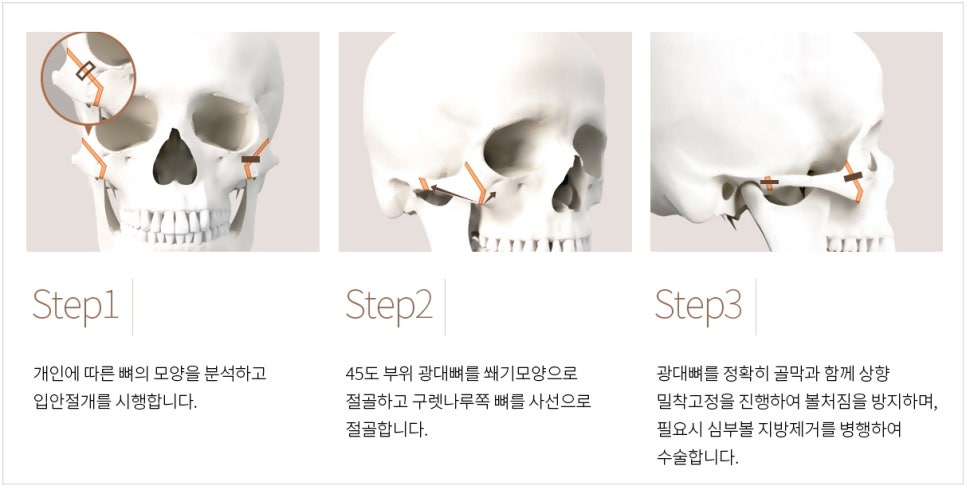
3D cheekbone reduction surgery
This is the most common method: part of the cheekbone at the 45-degree area is removed, and the cheekbone at the arch is cut and rotated inward.
At present, it is the method that most effectively rotates the bone inward and reduces volume significantly.
At 입체성형외과, we perform not only this 3D cheekbone surgery but also a procedure called 230-degree three-dimensional cheekbone reduction surgery.
Today, let’s look at what makes the 230-degree three-dimensional cheekbone surgery better than the existing 3D cheekbone surgery.
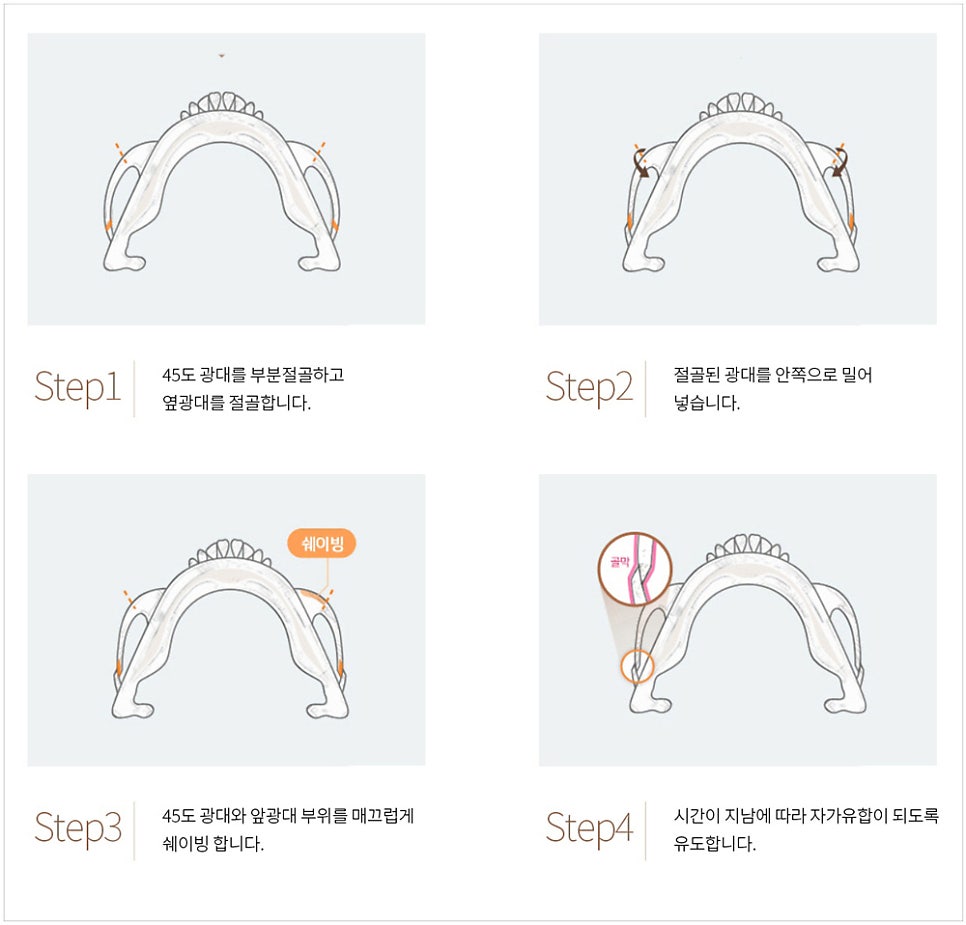
230-degree three-dimensional cheekbone reduction surgery
230-degree three-dimensional cheekbone reduction surgery is a method in which the 45-degree cheekbone is partially cut through a scalp incision instead of an intraoral incision, and the bone at the arch is completely cut and moved inward.
So, what are the advantages of this surgical method compared with 3D cheekbone reduction surgery?
- Surgery is possible under sedation anesthesia.
Because the surgery is not performed through an intraoral incision, general anesthesia is not necessary, and the procedure can also be done under sedation anesthesia.
General anesthesia is generally used for facial contouring surgery because it secures the airway and helps prevent irrigation fluid or blood from entering the mouth.
Since 230-degree three-dimensional cheekbone reduction surgery uses a scalp incision, there is no need to secure the airway separately, so the surgery can be performed safely even under sedation anesthesia.
- The operation time is faster.
In general, a shorter operation time can lead to faster recovery.
Even for the same surgery, if it progresses more quickly, there may be less swelling afterward, and less swelling naturally allows for faster recovery.
I do not think that a faster surgery is always better, but if it is performed accurately, then of course a surgery that finishes sooner is preferable to one that takes longer.
- The dissection range is smaller.
230-degree three-dimensional cheekbone reduction surgery involves a smaller dissection range than cheekbone reduction surgery performed through an intraoral incision.
Because the dissection range is smaller and the range in which muscles are cut or tissue is damaged is very limited, the likelihood of postoperative cheek sagging or other complications is naturally lower.
- There is less pressure on the masseter muscle.
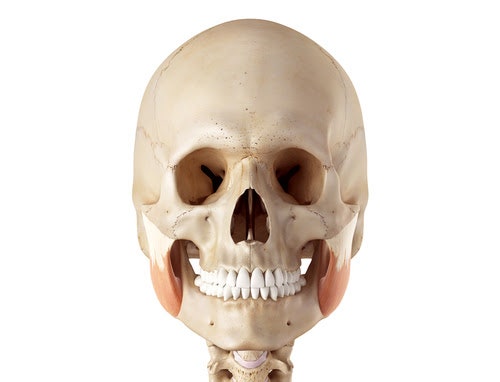
In 3D cheekbone reduction surgery, the 45-degree cheekbone rotates inward. At this point, the entire cheekbone from the 45-degree area to the arch area presses on the masseter muscle.
In people with large masseter muscles, when the cheekbone moves inward, the masseter can be compressed, causing the temples to become more prominent.
Conversely, for people with sunken temples, the postoperative protrusion is naturally less noticeable, and the temple volume may instead improve, creating a better appearance. However, for people whose temples are already prominent, there may be cases where only the temples appear more prominent after surgery.
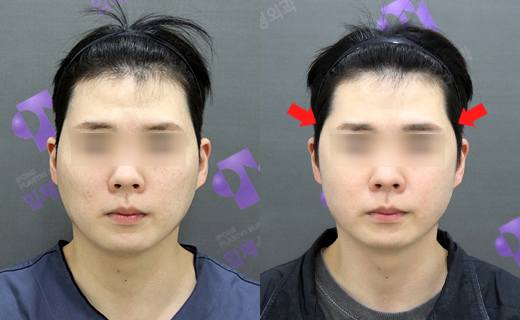
Case of temple prominence after cheekbone reduction surgery
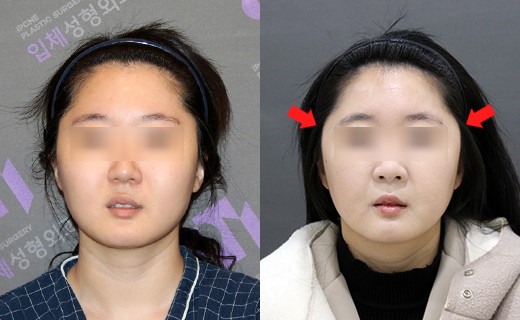
Case of temple prominence after cheekbone reduction surgery
Therefore, for these individuals, 230-degree three-dimensional cheekbone surgery may be more suitable than 3D cheekbone surgery.
In my personal opinion, 230-degree three-dimensional cheekbone reduction surgery may place much less pressure on the masseter muscle because the 45-degree cheekbone is not pushed inward but instead is shaved from the outer side.
- Surgery is possible without visible fixation pins.
In 230-degree three-dimensional cheekbone reduction surgery, the 45-degree cheekbone is not completely cut; only the bone at the arch is cut, so only the posterior arch area needs to be fixed.
Fixation of the posterior arch area can be done using dissolvable pins.
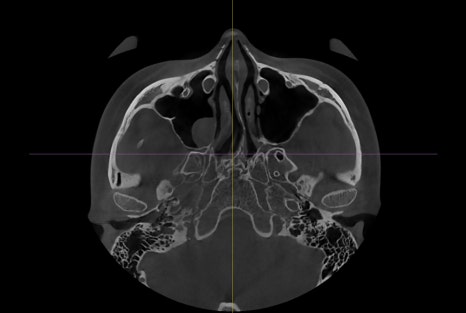
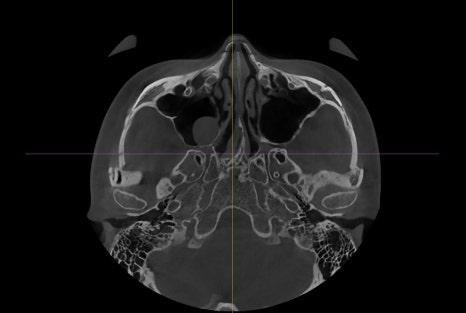
230-degree three-dimensional cheekbone reduction surgery (using dissolvable pins)
I believe dissolvable pins are somewhat less strong than titanium pins, so I avoid using dissolvable pins in the 45-degree cheekbone area and instead fix only the posterior area with dissolvable pins. When fixed with dissolvable pins, they do not appear on X-rays or CT scans, making pinless cheekbone reduction surgery possible.
- There is less scarring, and eating is easier.
Of course, cheekbone reduction surgery performed through an intraoral incision does not show visible scars, but that does not mean there are no scars.
Because the incision is made inside the mouth, mouth rinsing must be done continuously, and there can also be inconvenience when eating.
However, 230-degree three-dimensional cheekbone reduction surgery involves a scalp incision of about 1 cm, so no visible scar appears externally, and there are no restrictions on eating.
Therefore, if eating is important to you, this can be a good alternative.
- There is no possibility of nonunion.
Because 230-degree three-dimensional cheekbone reduction surgery only partially cuts the 45-degree cheekbone, nonunion cannot occur.
Nonunion can cause cheek sagging and pain, so it is something that must be carefully avoided.
A properly performed 230-degree three-dimensional cheekbone reduction surgery can fundamentally prevent this possibility, so it can be considered safe.
- There is no possibility of sinusitis.
Because 230-degree three-dimensional cheekbone reduction surgery does not open the sinus through osteotomy, it can fundamentally block the possibility of sinusitis caused by the surgery.
Of course, even with 3D cheekbone surgery, the chance of sinusitis occurring is extremely low, but this can be considered a method that preemptively blocks the possibility of sinusitis that could otherwise occur.
So far, I’ve explained about eight advantages of 230-degree three-dimensional cheekbone reduction surgery over the existing 3D cheekbone surgery from my perspective.
I think opinions may differ among surgeons.
Despite these various advantages, it is an undeniable fact that 3D cheekbone surgery reduces the cheekbones more than 230-degree three-dimensional cheekbone reduction surgery.
Therefore, for patients who want to reduce their cheekbones as much as possible, I believe choosing 3D cheekbone surgery is more appropriate.
Facial contouring surgery is not a procedure that is easy to undergo again once it has been done, so it is best to think carefully about how the surgery will be performed before proceeding.
Therefore, if you choose the surgery that suits you best, I believe you can achieve a more satisfying result.
Thank you.