Provider: 입체성형외과의원

Facial contouring surgery that considers facial harmony
The start of a slim face: V-line square jaw reduction
Chin surgery that creates a more defined facial shape
A choice for a softer impression: zygoma reduction
230-degree three-dimensional zygoma reduction that more conveniently improves facial shape
Accurate diagnosis, thorough surgical management, post-op care for facial contouring

You have beautiful and harmonious facial features, but your face shape is angular and uneven?
You may be remembered by others as someone whose image feels incomplete because it is somehow out of balance.
Recently, more people are looking into facial contouring surgery to achieve a smaller face along with refined features.
In this post, we will take a look at everything about facial contouring surgery.
Unlike other cosmetic surgeries, facial contouring surgery is an operation that corrects the bones. Through sufficient consultation with a board-certified plastic surgeon,
it is necessary to understand the condition of the bones and find the surgical method and process that best suits you.
A safe surgery must be performed.

Facial contouring surgery
Facial contouring refers to surgery that corrects the facial bones. By operating on the square jaw, protruding cheekbones, chin, and so on,
it is a procedure that corrects the face to appear aesthetically softer.
Facial contouring surgery can largely be divided into three types: square jaw surgery, zygoma reduction, and chin surgery.
Facial contouring is a surgery that allows these procedures to be performed more harmoniously, without damaging the facial structure,
and can produce more natural results.
The highlight of facial contouring
Square jaw reduction
Square jaw reduction, also called square jaw resection, is a procedure
that has the advantage of producing significant effects from both the front and side after surgery.
Square jaw reduction is usually performed through an intraoral incision,
with an incision of about 3 cm in the mucosa between the lower gums and the lips.
The masseter muscle surrounding the outside of the jawbone is moved aside, and the periosteum is dissected,
allowing surgery to be performed on the exposed jawbone while avoiding major nerves and blood vessels.
The average surgery time is within about one hour, and it is performed under general anesthesia.
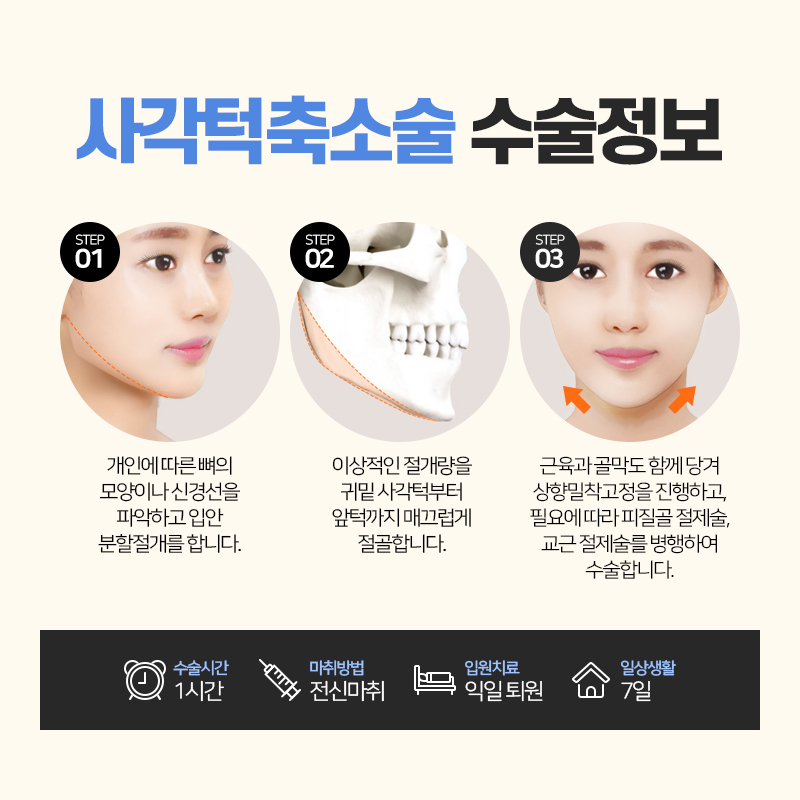
In the past, square jaw reduction often involved resecting only the protruding square jaw,
which led to side effects such as a second angle forming.
However, more recently, square jaw reduction surgery has allowed for a wider field of view and precise visualization of the jawbone,
so long-curved resection, which cuts the square jaw along a long curve, is being performed more often.
In the case of long-curved resection, surgery can be performed more safely than with conventional square jaw reduction.
★ Of course, bone resection varies from person to person, but because visibility is clearly secured, a high level of effect can be expected. ★
Chin surgery (T osteotomy)
As the number of patients wanting a V-line has increased sharply recently,
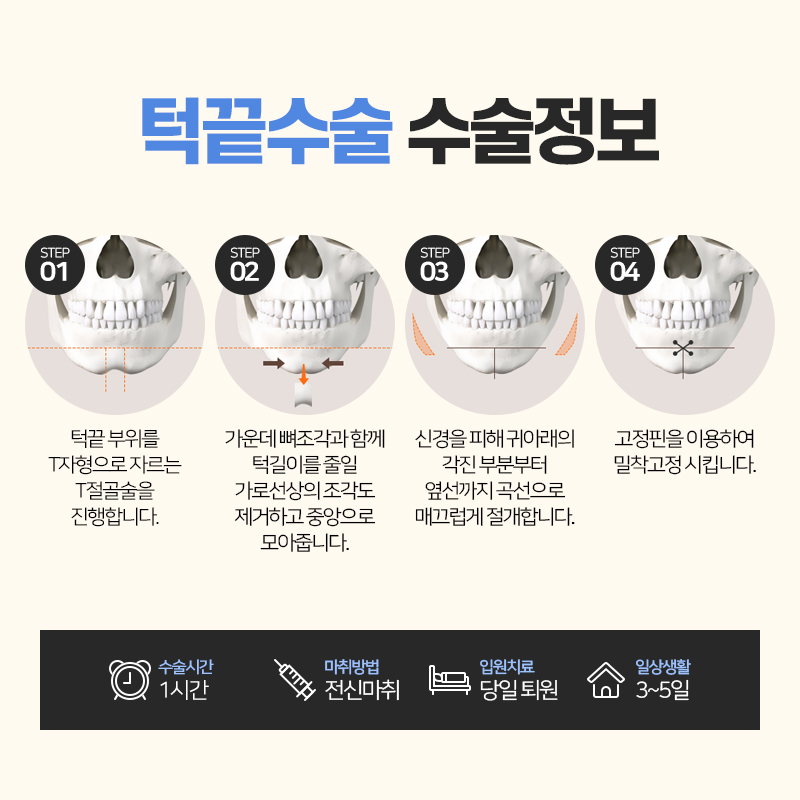
T osteotomy is being performed to make the chin sharper and smoother.
T osteotomy has the advantage of allowing both advancement and setback of the chin at the same time,
and it is a procedure with the major benefit of safely protecting the nerve line.
Even patients who do not undergo square jaw reduction can have T osteotomy performed alone.
The surgery takes about 1 hour to 1 hour and 30 minutes.
It is performed under general anesthesia, requires suture removal, and after about 3 to 5 days of recovery after surgery,
it is also a procedure that does not significantly disrupt daily life.
The side effect that comes to mind most often with chin surgery is the worry that sensation in the nerves may not return.
In fact, if the nerve line is distributed low, long-curved square jaw surgery may be difficult to perform,
but most chin surgeries, including T osteotomy, can be performed without difficulty.
If the nerve line is abnormally positioned very low and shifted toward the front,
chin surgery is possible, but it may be difficult to achieve satisfying results.
However, this is a very rare case, so you do not need to worry too much about the relationship between chin surgery and the nerve line.
Cheekbone reduction
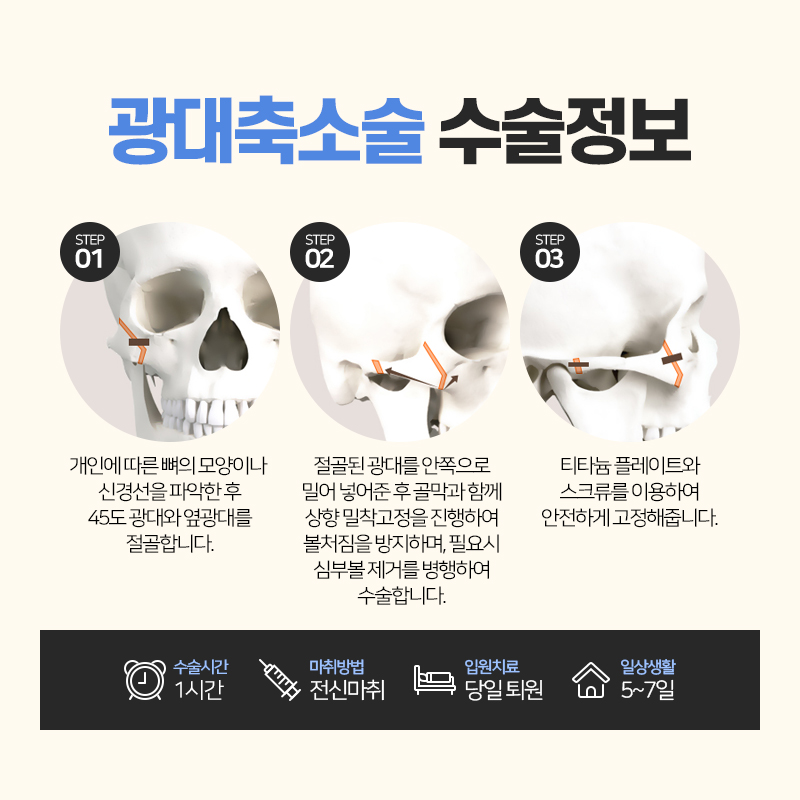
Cheekbone reduction is a procedure in which protruding cheekbones in the front and side are cut and pushed inward,
and the advantage of this surgery is that it can produce strong effects on both the side and the front after surgery.
In general, cheekbone reduction is performed through an intraoral incision by dissecting the cheekbone incision area,
and the surgery is carried out through a skin incision in front of the ear or through a scalp incision to cut the bone in the front of the ear.
The anesthesia method is general anesthesia, and the surgery takes about 1 hour.
The part that many patients worry about the most is sagging cheeks.
In the case of cheek sagging, if the medical staff has abundant know-how and skill, there is no need to worry too much,
but if the dissection is minimized during cheekbone reduction and the cheekbone body and arch are firmly fixed to the maxilla so that they do not move,
the possibility of cheek sagging after cheekbone surgery is significantly reduced.
230-degree three-dimensional cheekbone reduction
Considering the long recovery time, which is a drawback of conventional cheekbone reduction,
quick cheekbone reduction has recently received a great response in order to shorten the recovery period and achieve the same effect.
In the case of quick cheekbone reduction, the surgery is performed through a scalp incision and endoscopy,
and one advantage is that there is no discomfort in speaking or eating after surgery.
However, because its effect is limited to the side cheekbones, there was a drawback that only a limited number of people could benefit from it.
The 230-degree three-dimensional cheekbone reduction developed to compensate for those drawbacks is a surgical method designed to preserve the advantages of conventional quick cheekbone reduction,
such as scalp incision and fast recovery, while also allowing effects on the front, side, and 45-degree semi-side through 45-degree cheekbone shaving.
The 230-degree three-dimensional cheekbone reduction is performed under sedation anesthesia, and the surgery takes about 20 minutes.
A small scalp incision of about 1 cm is made, and the surgery is performed through an endoscope.
Since the scar is not exposed externally, it also has the advantage of no risk of visible scarring.
Unlike conventional cheekbone reduction, the 230-degree three-dimensional cheekbone reduction uses a natural adhesion fixation method without plate fixation,
and one advantage is that it does not look like you have had surgery even at airport security checkpoints or on X-ray imaging.
Of course, if plate fixation is desired, fixation is also possible.
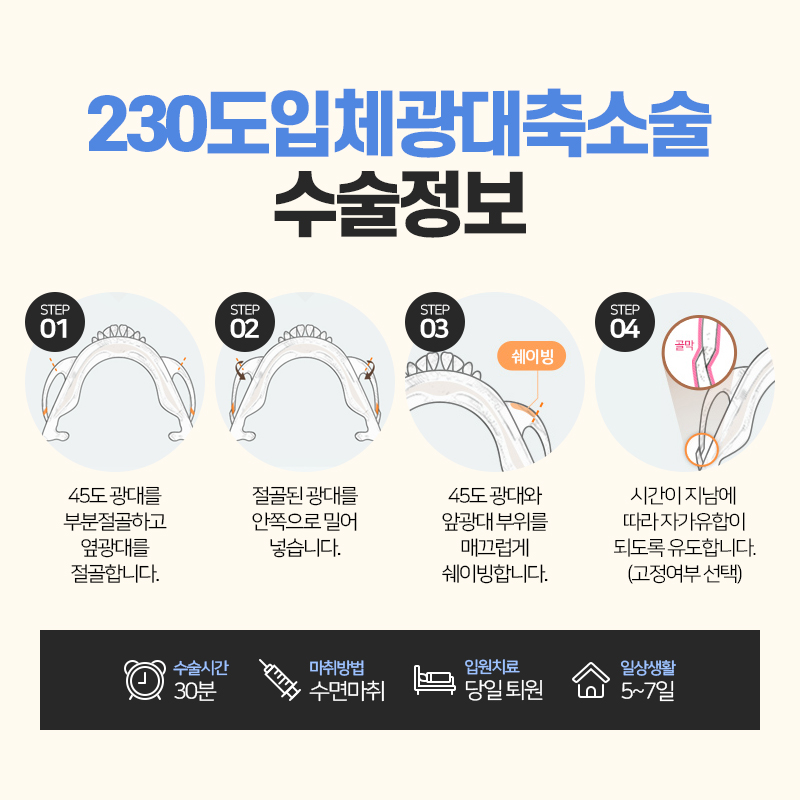
Because 230-degree three-dimensional cheekbone reduction is performed without fixation,
many people worry that the bone may not knit properly or may protrude,
but recently, since the cut surface is made at an angle so that the bone does not pop back up during the process of pushing the cheekbone inward,
you do not need to worry.
입체성형외과의원 provides direct diagnosis and surgery by a board-certified plastic surgeon, and based on the surgeon's experience and know-how,
it carefully checks the patient's condition before surgery, so safe and highly refined results can be expected.


With the unique know-how of 입체성형외과의원,
you can expect natural and highly refined results.