Hello.
I am Huh Jae-won, a board-certified plastic surgeon at 3D Plastic Surgery, where I treat facial rejuvenation procedures.
When consulting with patients, there is a question I hear especially often these days.
“Am I too young to get a facelift?”
“Could this be too late a choice?”
The fact that so many people are worrying about the timing of a facelift means this concern has become increasingly common.
So today, I would like to talk about the characteristics of different age groups that consider a facelift, based on my experience.
Based on what I actually see in practice, people who consider a facelift can largely be divided into two groups.
These two groups show quite different patterns in terms of why they start thinking about surgery, what results they expect, and what points need to be considered during surgery.
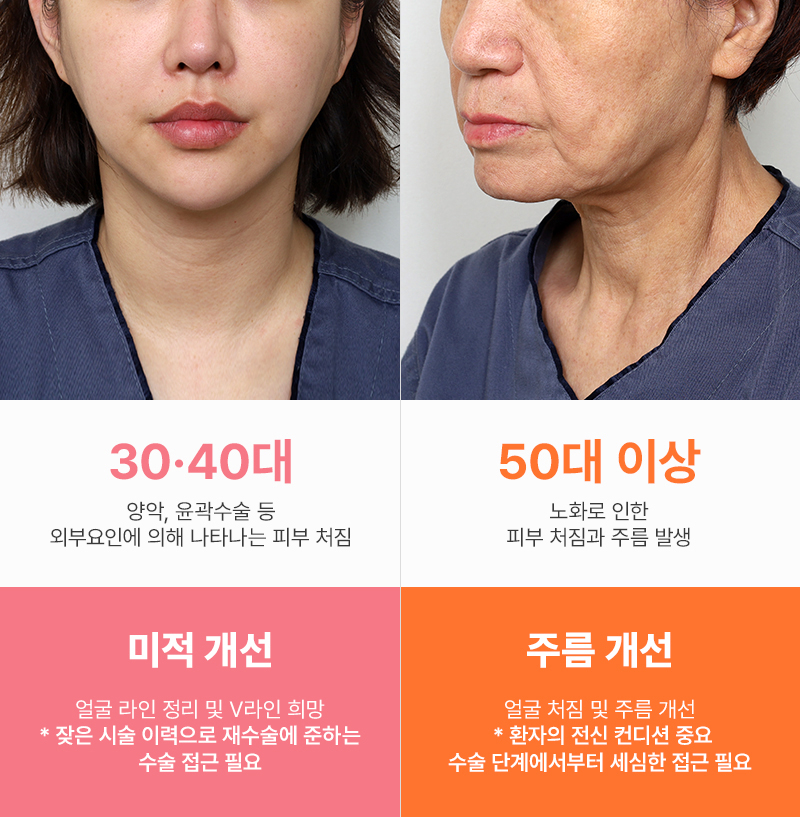
Characteristics of Patients in Their 30s to 40s
Patients in this age range often have what you might call an “early adopter” personality.
Many were proactive about aesthetic care from a young age, underwent eye, nose, and contouring surgery in their 20s,
and in their 30s, they have often consistently received lifting devices such as Ulthera and Thermage, as well as various skin booster treatments.
Because of this, when I meet them in the consultation room, they often look much younger than their actual age.
There are two reasons behind this background.
First, because they were relatively satisfied with their surgical experiences in their 20s, they have a lower psychological barrier to cosmetic surgery.
Second, even after faithfully receiving non-surgical treatments, they feel disappointed that the improvement in sagging has not been as great as they hoped.
People like this naturally come to want a more definite change.
However, in these cases, the purpose of a facelift is often less about pure “correction of aging” and more focused on aesthetic improvement, such as wanting the face to look smaller, the contours to look more defined, or the overall face to appear slimmer.
Therefore, the surgical plan should also be designed to sufficiently reflect these needs.
Another important point is that a history of frequent procedures can actually increase the difficulty of surgery.
This is because soft fat tissue injected through fat grafting may be scattered between normal fascial layers, or collagen-based products such as Sculptra, Radiesse, and Juvelook, or fillers, may remain in unexpected locations.
In situations like this, even though it is a primary surgery, the approach may actually need to be similar to that used for revision surgery.
It is most important to have the procedure performed by a surgeon who accurately understands anatomical structures, can distinguish foreign material from normal tissue, and is familiar with the results expected by younger patients.
Characteristics of Patients in Their Late 60s
By contrast, patients in their late 60s often had fewer opportunities to be exposed to cosmetic procedures when they were younger.
When they were in their 20s and 30s, around the 1990s, most either had only double eyelid surgery or lower eyelid surgery, or there are also many who are considering cosmetic surgery for the very first time.
In these cases, the surgery itself is relatively straightforward.
The anatomical structures are relatively well preserved, and the degree of sagging is often more pronounced, so the potential for improvement is clearly visible.
However, the most important factor to consider in this age group is the patient’s overall physical condition.
After the age of 60, it is common to have chronic conditions such as high blood pressure, diabetes, and hyperlipidemia, and many patients also have a long history of smoking.
In such cases, skin blood flow may be reduced or recovery ability may be weakened, so a more careful approach is needed from the surgical planning stage.
As I write this, it seems the discussion has broadened a bit from the direction I initially had in mind.
In the next post, I will explain in more detail when the most appropriate time to consider a facelift actually is.
Thank you.