Hello, this is Director Hyeon-woo Jo of 입체성형외과.
Facial contouring surgery is generally regarded as a relatively safe procedure, but because it involves work on the facial bones, observation immediately after surgery is very important.
Most patients can be discharged within a day, but in some situations, hospitalization and observation are absolutely necessary.
In this column, I’ll summarize the situations in which hospitalization is needed after contouring surgery, as well as the warning signs to watch for at home.
Contouring surgery is not a simple cosmetic procedure; it is a surgery that involves osteotomy of the facial bones, mucosal incisions, and extensive dissection.
Therefore, more important than the surgery itself is the stable recovery process during the 24 to 48 hours after surgery.
Problems that arise during this period can usually be resolved without major issues if they are addressed quickly, but delayed initial response can lead to reoperation or complications.
Typical cases in which hospitalization is needed after contouring surgery
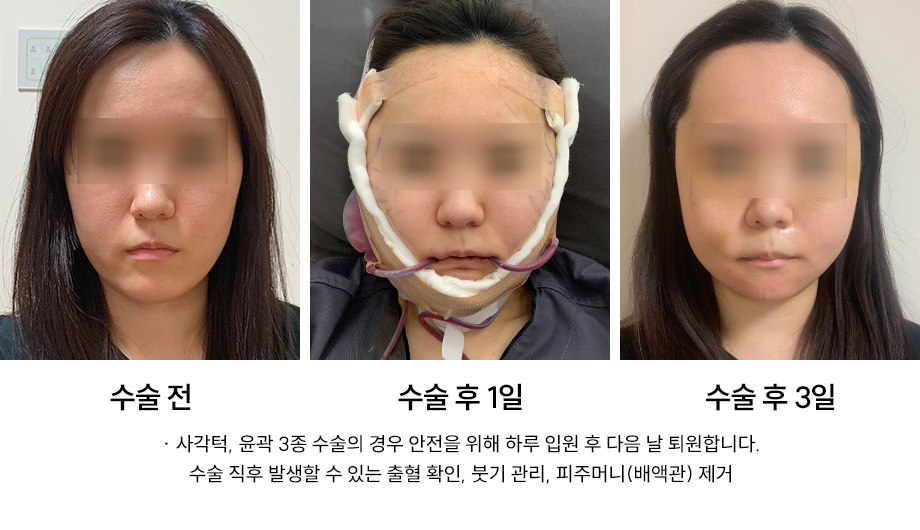
The most common reason hospitalization is needed after contouring surgery is the risk of bleeding.
In particular, if extensive dissection was performed, if the surgery took a long time, if the patient has high blood pressure, or if it is a revision surgery, the risk of bleeding is relatively higher, so it is safer to stay in the hospital and monitor the recovery.
Bleeding often occurs not immediately after surgery but rather 6 to 24 hours afterward, so it is important to check the drainage amount and swelling during this period, and hospitalization monitoring may be needed for safety.
In general, pain after contouring surgery can be managed with painkillers.
However, situations that require hospitalization include pain that suddenly becomes severe, pain that does not respond to pain medication, and repeated vomiting, which may be early signs of infection. Therefore, hospitalization is a preventive measure to reduce the possibility of complications (side effects).
Warning signs that must be checked at home
After discharge, the most important thing for patients to do is distinguish normal recovery from warning signs.
Symptoms that require contacting the hospital right away are:
✔ Rapid swelling of the face
✔ Sudden worsening of facial pain
✔ Fever above 38°C
✔ A persistent sensation of blood pooling in the mouth
✔ Difficulty breathing
These symptoms may mostly be early signs of a hematoma or inflammation.
In particular, if swelling suddenly increases instead of gradually decreasing 3 to 4 days after surgery, that is the most important warning sign.
Symptoms that are easy to confuse with normal recovery
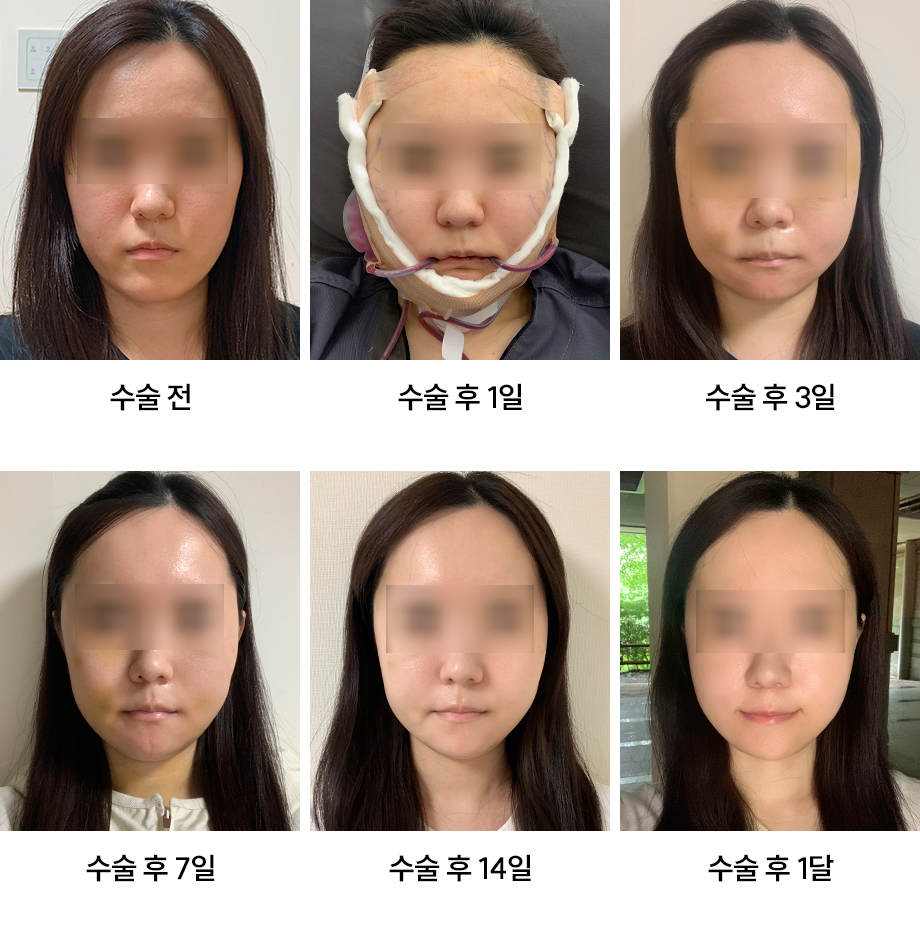
Among the symptoms patients often worry about, many are actually part of the normal recovery process.
✔ Bruising moving downward
✔ Swelling increasing on day 2 to 3
✔ Reduced sensation around the mouth
✔ Mild asymmetry
These symptoms usually improve naturally over the course of a month.
The important point is whether the trend is gradually improving or suddenly getting worse.
Surgery that absolutely requires hospitalization vs. selective cases
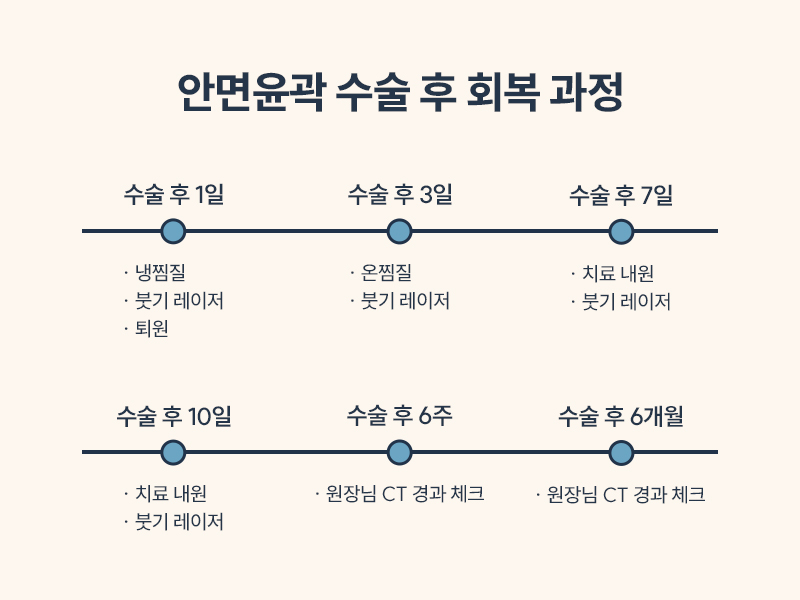
After contouring surgery, the decision about hospitalization is made depending on the patient’s condition and the scope of surgery.
At 입체성형외과, patients stay in the hospital for one day after square jaw surgery. In cases where the surgical area is wide or it is a revision surgery, hospitalization is recommended because tissue damage and bleeding risk are relatively higher.
On the other hand, for cheekbone or chin surgery, if the surgical area is limited, there is almost no bleeding, and the overall condition is stable, patients are discharged on the same day.
Hospitalization after contouring surgery is sometimes absolutely necessary, but it is also often chosen as a preventive measure.
During recovery after surgery, an approach of “let’s check just in case” ultimately leads to the safest outcome, rather than thinking, “This should be fine.”
Contouring surgery does not end in the operating room; the recovery process is also part of treatment.
A patient’s own observation is very important, and the most stable results are achieved when patients and medical staff observe and manage the process together.
Thank you.