Hello.
I am Jae-won Heo, a board-certified plastic surgeon performing facial rejuvenation surgery at Iptae Plastic Surgery.
While performing facelift surgery, I sometimes have an interesting experience.
Even when the surgical method and suturing are similar, the condition of the scars can look completely different several months later.
Some people recover with incision lines so thin and clean that they are barely visible, while others are left with red, thick scars for a long time.
In the past, I also thought that this difference was mostly due to individual factors.
However, as I gained more surgical experience, I discovered one common factor.
Many of the patients who developed thick scars had engaged in activities or habits that could pull on the wounds, such as massages.
“I wanted to reduce the swelling quickly.”
“The clinic said it would help with recovery.”
“I thought my face would get better faster if I loosened it up.” I hear comments like these quite often.
However, immediately after facelift surgery, these very actions can actually have a negative effect on the scars. Why is that?
To understand why, we first need to look at how scars form.
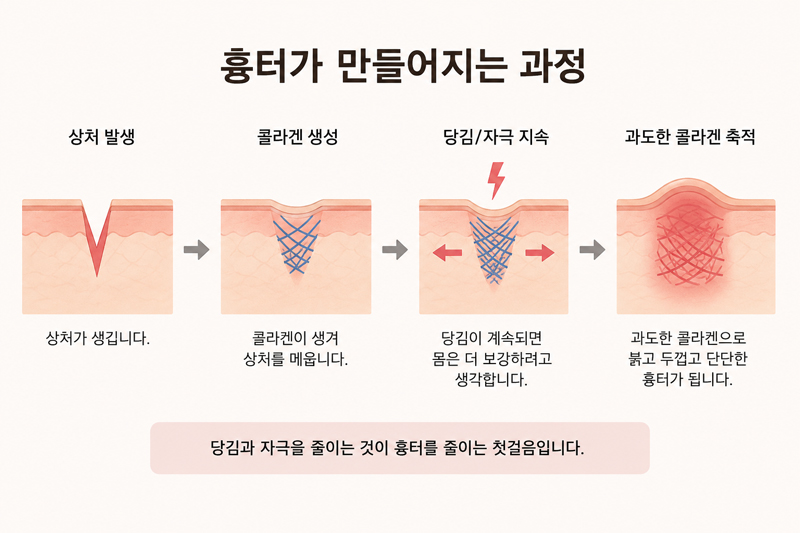
When a wound forms, our body produces collagen to connect the separated tissue. Simply put, it begins construction to fill in the wound.
But what happens if the area under construction is continuously pulled in opposite directions?
The body concludes, “It is not strong enough yet,” and “I need to reinforce it further.”
As a result, it produces more collagen than necessary, and the scar may become red, thick, and firm.
This is medically known as a hypertrophic scar.
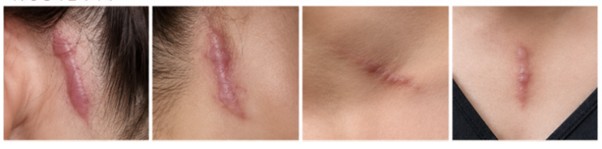
Therefore, the outcome of a scar is not determined solely by the surgeon’s suturing technique.
Rather, a very important factor is how much tension was placed on the scar during the recovery period after surgery.
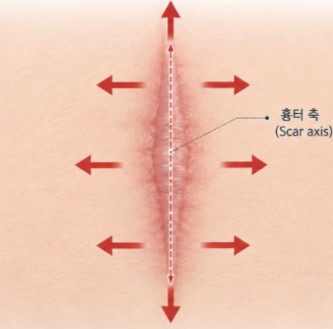
A facelift is a procedure that repositions sagging tissue in the face and neck upward.
Therefore, some degree of tension is inevitably present around the incisions and sutured areas near the ears immediately after surgery.
If additional pulling forces are repeatedly applied to the face during this period, the burden placed on the scars increases further.
That is why I explain that, for approximately two months after surgery, patients should avoid treatments that strongly stimulate or pull the face whenever possible.
These include, in particular:
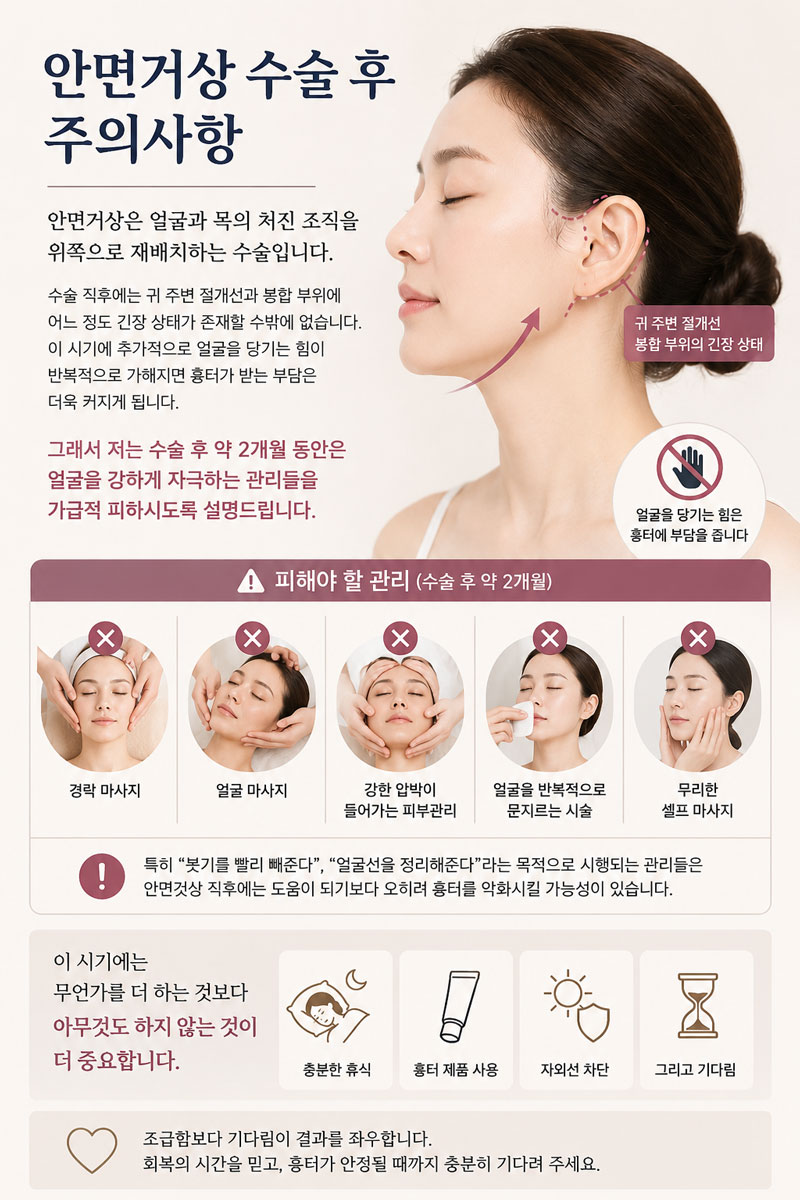
In particular, treatments performed with the goal of “reducing swelling quickly” or “defining the facial contours” may worsen scars rather than help immediately after a facelift. During this period, I believe that doing nothing is more important than doing something extra.
Sufficient rest, scar care products, sun protection, and patience.
If I had to name one thing that should absolutely be avoided after facelift surgery, I would say “any type of massage that pulls on the face.”
The outcome of surgery is not determined in the operating room alone. The recovery process is also part of the surgery.
If you have any questions about the recovery process after a facelift, please leave them in the comments.
I will respond. Thank you.