Hello, this is Lucid Dental Clinic.
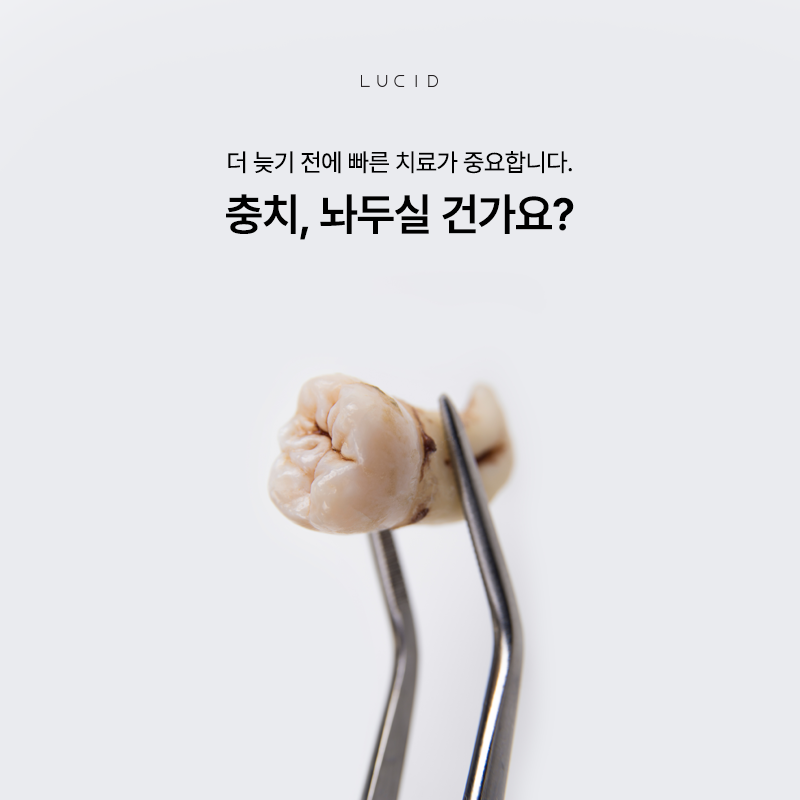
Today, I’d like to begin with a story about cavity treatment.
Tooth decay starts with a small hole in the tooth
and gradually deepens, making it one of the most common oral diseases.
Many people visit the dentist only after pain appears,
but in fact, treating cavities in the early stage
is the most important.
Today, let’s look at the treatment process and symptoms
of cavity care that is often performed at a Gangnam dental clinic,
as well as precautions after treatment.
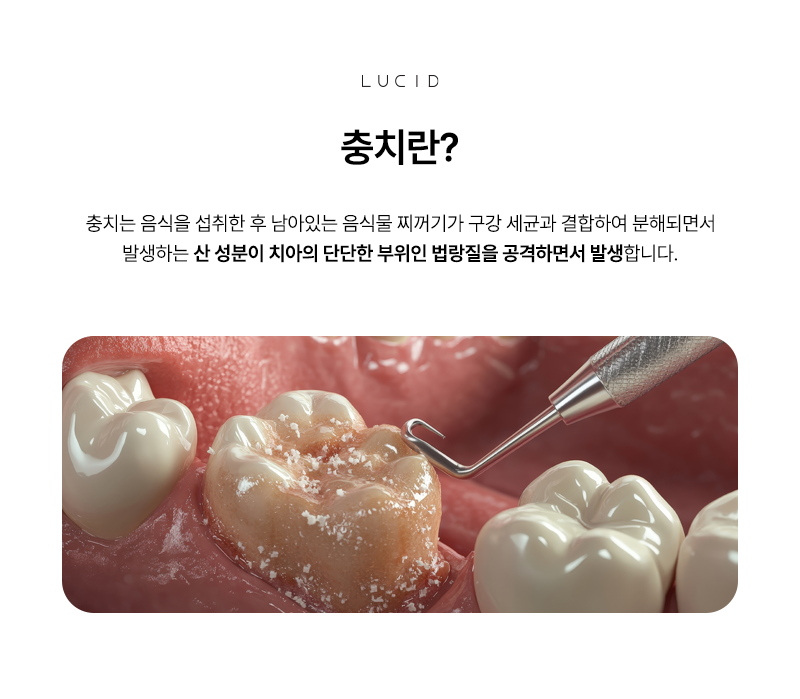
What is cavity treatment?
Cavity treatment refers to the process of removing the damaged part of the tooth caused by decay
and filling the area with artificial material.
The earlier the cavity, the simpler the procedure can be,
and there is almost no pain.
At a Gangnam dental clinic, advanced diagnostic equipment is used
to identify even early cavities that are not visible to the eye.
 How does tooth decay progress?
Tooth decay can be broadly divided into three stages.
How does tooth decay progress?
Tooth decay can be broadly divided into three stages.
The first stage is early decay, when the enamel layer begins to be damaged,
and it is characterized by white discoloration without pain.
The second stage is the middle stage, when decay progresses to the dentin,
and sensitivity appears when drinking cold water or eating sweets.
The final third stage is severe decay, when the pulp becomes infected,
and root canal treatment is needed along with persistent pain.
Because treatment is simpler and costs less in the early stage,
it is important to visit a Gangnam dental clinic for regular checkups.
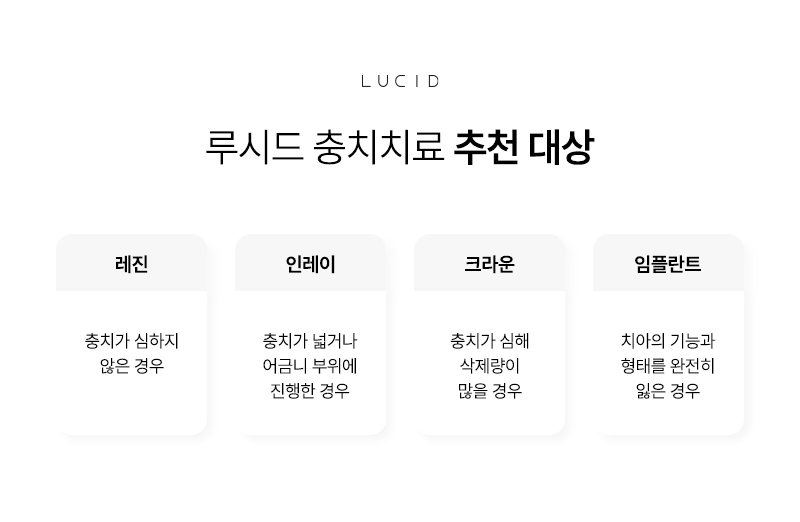 Who is cavity treatment for?
Tooth decay is a condition that can occur in people of all ages and genders.
However, people who frequently eat sweets,
children who spend little time brushing, and those undergoing orthodontic treatment
need especially careful management.
Who is cavity treatment for?
Tooth decay is a condition that can occur in people of all ages and genders.
However, people who frequently eat sweets,
children who spend little time brushing, and those undergoing orthodontic treatment
need especially careful management.
At a Gangnam dental clinic, treatment tailored to each age group is provided.
Cavity symptom checklist
If even one of the following applies to you, it is a good idea to
visit a nearby Gangnam dental clinic.
▪ You felt sensitivity to cold or sweet food.
▪ Brown or black spots appeared on the tooth surface.
▪ Your tooth hurt while brushing.
▪ You had a sharp, tingling pain even when doing nothing.
▪ Food frequently got stuck in certain areas.
These symptoms may not simply be due to fatigue,
but could be early signs of tooth decay.
 Precautions after cavity treatment
After treatment, the following habits are important
for protecting your teeth.
Precautions after cavity treatment
After treatment, the following habits are important
for protecting your teeth.
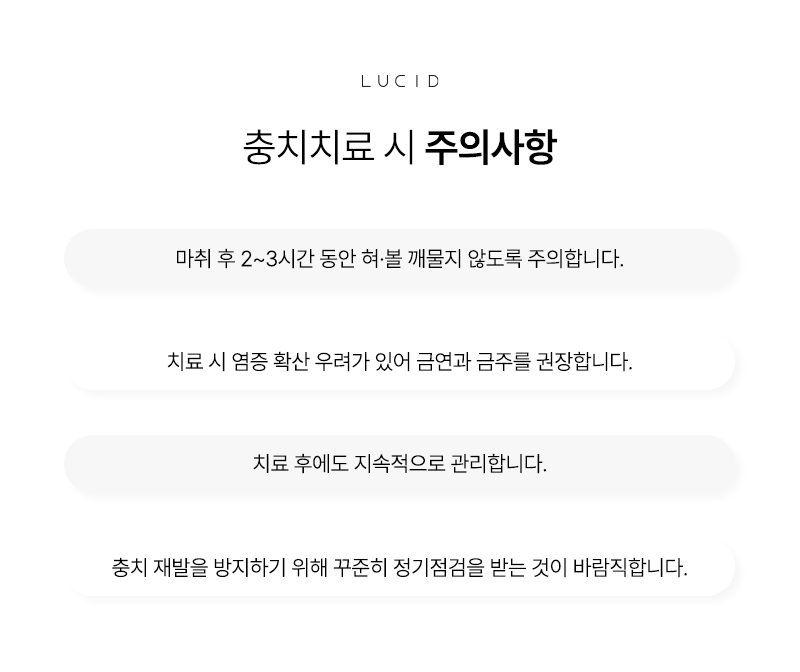
▪ Anesthesia wears off after about 2–3 hours, so avoid eating on the treated area.
▪ Because there is a risk of inflammation spreading during treatment, we recommend not smoking or drinking alcohol.
▪ Reduce your intake of foods high in sugar.
▪ Use the treated area carefully for about 2–3 days.
▪ Brush thoroughly at least twice a day.
▪ Visit the Gangnam dental clinic regularly for checkups.
▪ Prioritize consultation with a specialist over self-diagnosis.
In particular, cavities can recur even after treatment,
so management and regular checkups are essential.
Prevention and early treatment are the most important things for cavities.
Do not let your guard down just because there is no pain,
and visit a Gangnam dental clinic before symptoms appear
for regular diagnosis.

Lucid Dental Clinic
3rd–4th floors, Coway Building, 606 Nonhyeon-ro, Gangnam-gu, Seoul