
Hello. This is Lucid Dental Clinic.
Wisdom teeth are one of the common oral concerns that many people experience.
Even when there does not seem to be any obvious problem at first glance, many people feel discomfort due to wisdom teeth or end up considering extraction. So today, at the Gangnam dental clinic, we have organized the information you should know before extraction, focusing on frequently asked questions about wisdom teeth.
What exactly do wisdom teeth mean?
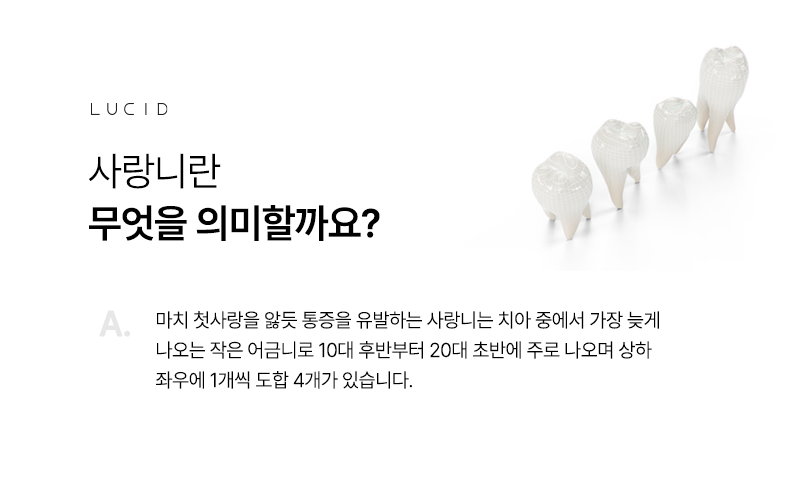
Wisdom teeth refer to the third molars, which are the last teeth to erupt.
They usually come in between the late teens and early twenties, and there can be up to four of them in the upper, lower, left, and right areas.
They are called “wisdom teeth” because they erupt at the age when one comes of age, and in English they are called “wisdom teeth.” However, unlike the name suggests, they often cause pain and inflammation and make things difficult for people.
In fact, many patients who visit the Gangnam dental clinic complain of discomfort caused by wisdom teeth.
Because they grow deep inside the back of the mouth, it is difficult to check or manage them on your own, and this can also affect the teeth around them.
Q. Do wisdom teeth always need to be extracted?
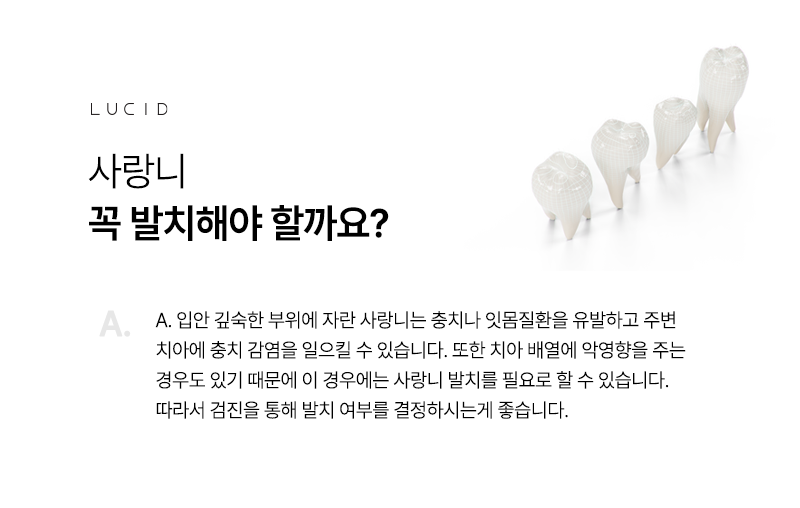
A. Wisdom teeth do not always have to be extracted.
However, extraction is recommended when wisdom teeth grow in an abnormal direction, cause inflammation in the surrounding gums, or push against adjacent teeth and lead to cavities.
In particular, lower wisdom teeth that grow sideways or are only partially erupted can easily lead to periodontitis and gum pain.
At the Gangnam dental clinic, to prevent these problems, the condition of the wisdom teeth is checked through regular examinations, and early extraction is recommended when necessary.
Early extraction is best done before the pain becomes severe, when recovery is relatively quick.
Q. Are there wisdom teeth that do not need to be removed?
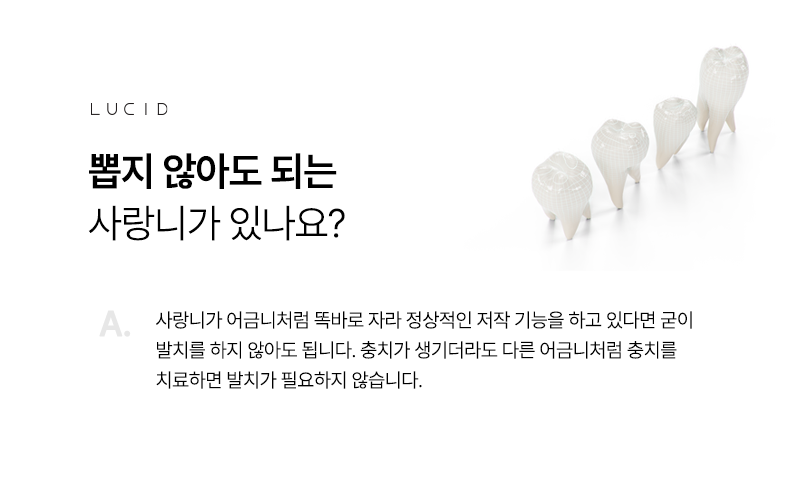
A. Yes, they do not always have to be extracted.
If the wisdom teeth are straight and in a normal position, and they are functioning well by biting properly with the surrounding teeth, there is no need to remove them unnecessarily.
Also, even if a wisdom tooth has a cavity, if it can be treated like a regular molar, its function can be maintained through cavity treatment instead of extraction.
At the Gangnam dental clinic, after carefully reviewing the patient’s wisdom tooth position and condition, as well as the relationship with the surrounding teeth, efficient treatment is suggested while avoiding unnecessary extraction.
It is important to avoid unnecessary extraction and perform it only when it is truly needed.
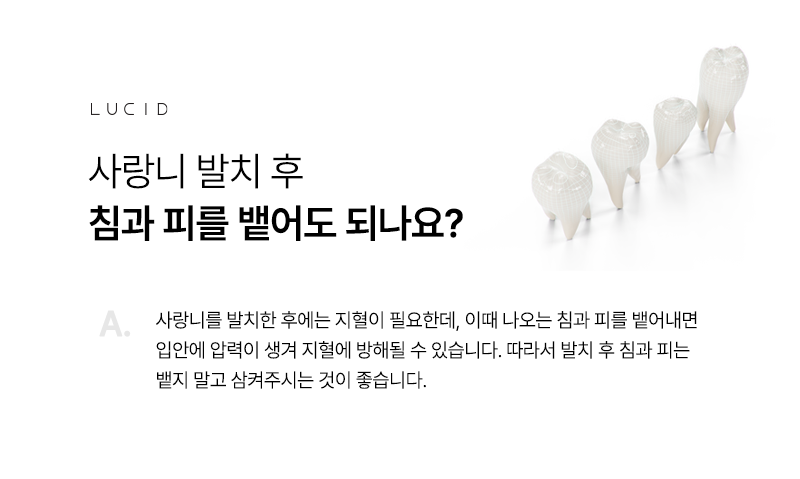
Q. How should recovery be managed after wisdom tooth extraction?
A. To recover well after wisdom tooth extraction, several precautions had to be followed.
▪ Reduce swelling with cold compresses
For the first 24 hours after extraction, swelling should be controlled with cold compresses, and after that, warm compresses help improve blood circulation.
▪ Avoid hard or irritating foods
In the early stage of recovery, it is best to eat soft foods such as rice porridge or congee.
▪ Do not miss your medication
Antibiotics and pain relievers must be taken exactly according to the prescribed schedule.
▪ Be careful when brushing your teeth
Brush gently, avoiding the extraction site, and rinse lightly as well.
At the Gangnam dental clinic, even after wisdom tooth extraction, guidance on care methods and precautions to support recovery is provided carefully.
Because wisdom teeth vary greatly from person to person depending on when and how they grow, it is especially important to determine their condition through regular oral examinations.
Rather than having them removed carelessly, we recommend receiving treatment at a trustworthy place like the Gangnam dental clinic.

Lucid Dental Clinic
3rd–4th Floors, Coway Building, 606 Nonhyeon-ro, Gangnam-gu, Seoul