Hello, this is Lucid Dental Clinic.
It is important to receive cavity treatment properly, but
being mindful of care after treatment is what truly
means 'protecting your teeth.' Did you know that?
Today, at the Yeoksam Station dental clinic, we’ll explain what cavities are,
what steps the treatment process involves,
and how to care for your teeth after cavity treatment.
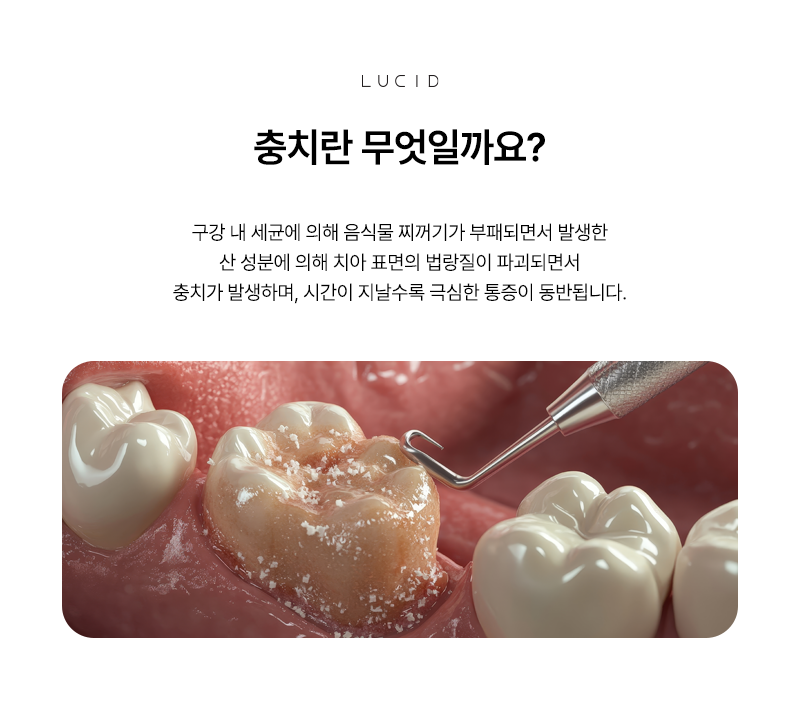
What is a cavity?
A cavity begins when acids produced as oral bacteria break down
food debris dissolve the enamel that makes up the tooth surface.
Although it starts small,
if left untreated it gradually damages deeper parts of the tooth over time
and leads to severe pain.
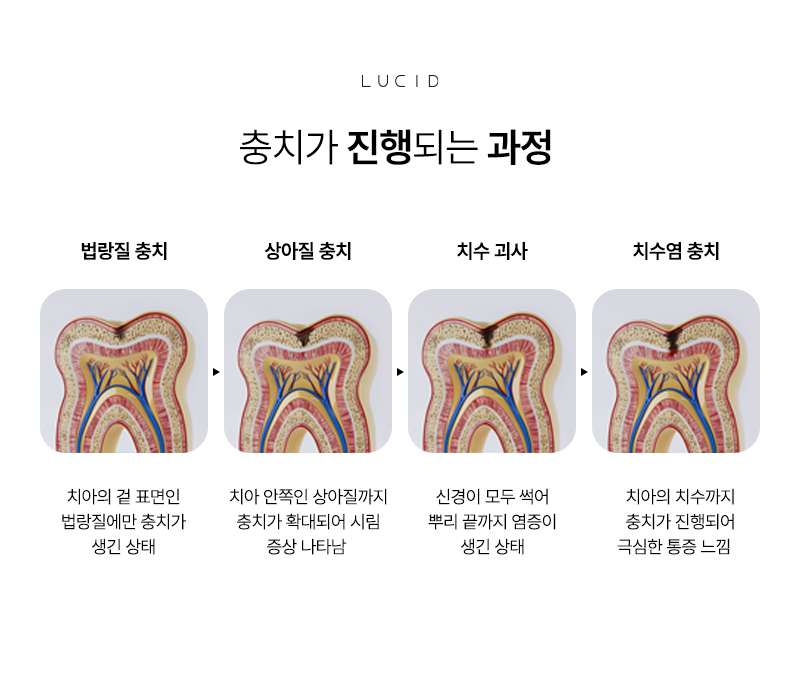
How cavities progress
Stage 1: Enamel cavity
→ A cavity limited to the enamel, the outermost layer of the tooth; at this stage, there is almost no pain.
Stage 2: Dentin cavity
→ When the cavity spreads to the dentin inside the tooth,
sensitivity and a cold, sharp feeling begin to appear.
Stage 3: Pulpitis cavity
→ When the cavity penetrates the pulp, the nerve tissue,
very severe pain occurs. At this stage, root canal treatment is
likely to be necessary.
Stage 4: Pulp necrosis
→ This is a serious condition in which the nerve tissue decays and inflammation reaches the tip of the tooth root.
If recovery is difficult even after root canal treatment,
extraction followed by an implant may be necessary.
If you have these symptoms, it may be a cavity!
▪ You feel sensitivity to cold or sweet foods
▪ You feel pain when brushing your teeth
▪ A specific tooth reacts sensitively to food
▪ Your tooth has turned darker in color
▪ Your gums bleed often, and your breath has become stronger
▪ You feel pain in that area when chewing something
If you have any of these symptoms, we recommend visiting
a nearby Yeoksam Station dental clinic for an examination.
The earlier a cavity is found, the smaller the scope of treatment,
and the more time and cost you can save!
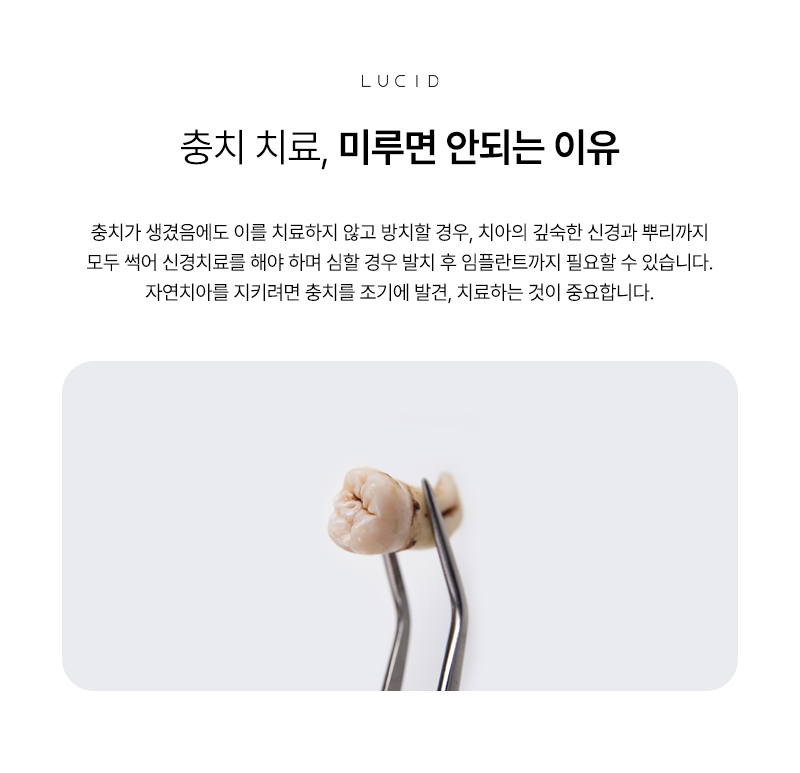
Why shouldn’t cavity treatment be delayed?
Cavities do not heal on their own.
If left untreated, they spread deeper and deeper and can lead to root canal treatment or even extraction.
In particular, if bacteria penetrate all the way to the tooth root,
inflammation can spread to the bone, and in some cases,
it can ultimately lead to a situation where an implant procedure is needed.
So rather than thinking, “I’ll go to the clinic when it hurts,”
it is much more important to get checked in advance
when something seems off.
Then how can you prevent cavities from recurring?
It is also more common than expected for the treated area to decay again,
or for cavities to develop in neighboring teeth, so
managing your daily habits after treatment is very important.
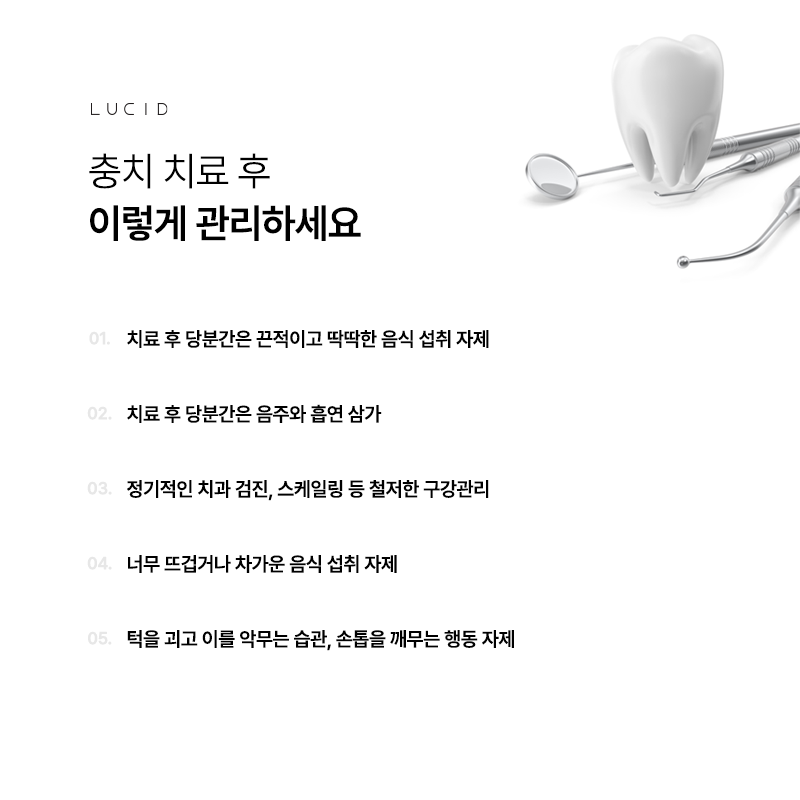
Take care after cavity treatment like this.
- Avoid sticky or hard foods
Chewing gum, jelly, nuts, and hard jerky can place strain on the treated area.
- Avoid alcohol and smoking for a while
These can hinder inflammation recovery and increase the risk of infection.
- Avoid foods that are too hot or too cold
After treatment, teeth can be sensitive,
so changes in temperature may cause irritation.
- Be sure to get regular checkups and scaling
You can protect your overall dental health through early cavity detection and tartar removal.
- Correct unconscious habits as well
Habits such as resting your chin on your hand, clenching your teeth, and biting your nails can negatively affect not only the treated area but your overall dental health.
Cavity treatment is not the end; it is the beginning.
In other words, how well you manage your teeth after treatment
determines how long they stay healthy.
At the Yeoksam Station dental clinic, we provide not only cavity treatment
but also guidance on follow-up care after treatment.
Cavities are not about happening often; rather, what matters more is managing them so they do not recur once they appear.
With a little attention, you can keep your natural teeth
healthy for a long time.
Starting today, please take good care of your teeth again.

Lucid Dental Clinic
3rd–4th Floors, Coway Building, 606 Nonhyeon-ro, Gangnam-gu, Seoul