�
Hello. This is Lucid Dental Clinic.
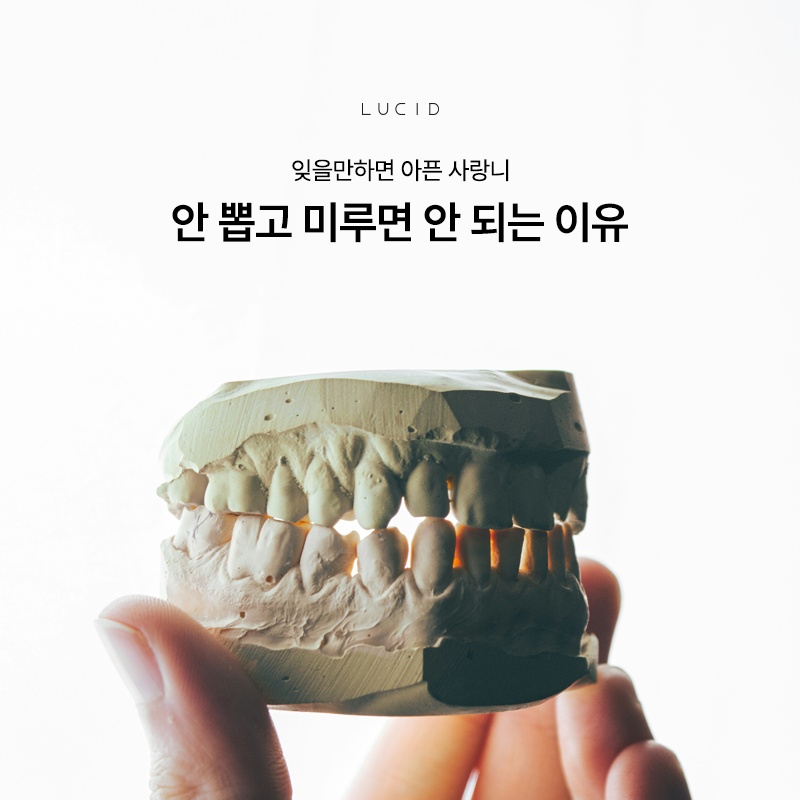
Have you recently been feeling a strange dull soreness around your molars,
or discomfort when opening your mouth?
Or have you heard that your wisdom tooth is growing in,
but been putting off treatment because you're scared?
�
For those of you in that situation, today at Sinnonhyeon Dental Clinic
we'd like to explain wisdom tooth extraction in detail.
We hope this will be helpful for those who need accurate information
rather than vague fear.
�
�
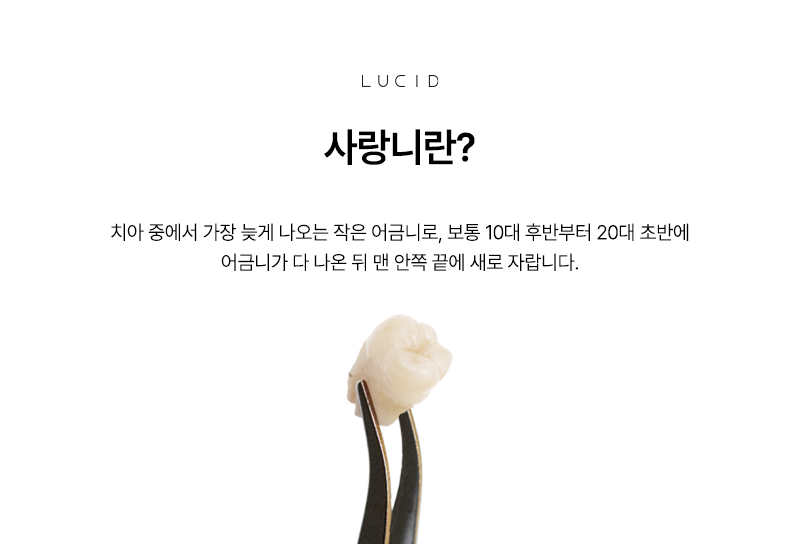
What is a wisdom tooth?
�
A wisdom tooth is the third molar that grows in
at the very back of the mouth when you become an adult.
�
It usually begins to appear in the late teens to early twenties.
Typically, one can grow on each side of the upper and lower jaws,
for a total of four, but it varies from person to person,
and some people may have only a few, or none at all.
�
The problem is that because wisdom teeth grow at the very end of the jaw,
there is often not enough space for them to erupt properly.
�
When they grow in crooked or remain buried in the gums,
they can put pressure on nearby teeth or cause repeated inflammation.
�
Also, because a toothbrush cannot easily reach wisdom teeth, cavities can develop easily,
and in severe cases, they can even affect adjacent teeth.
That is why it is important to check their condition through regular oral examinations
even if there is no pain.
�
At Sinnonhyeon Dental Clinic, we use various devices to precisely assess
the direction and depth of wisdom teeth,
and, if needed, we also guide you through a safe extraction plan.
�
�
�
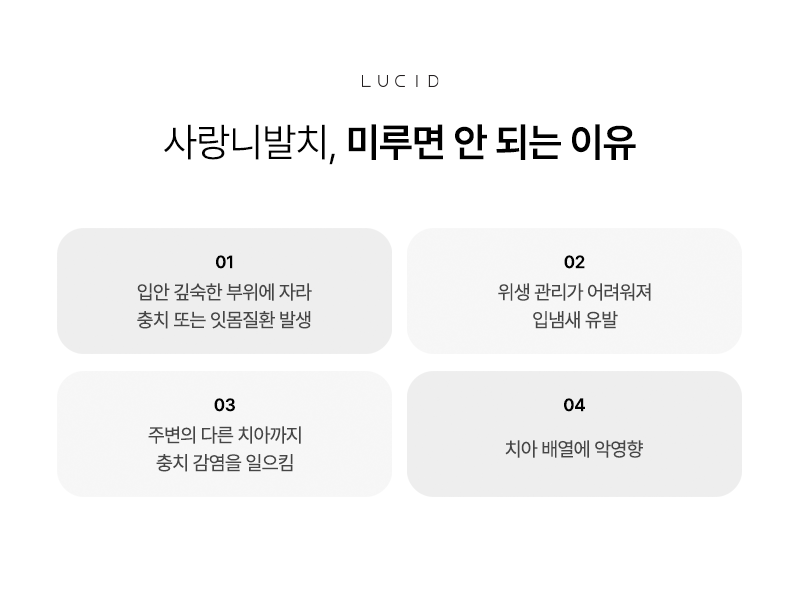
Why you should not delay wisdom tooth extraction
�
- Cavities and inflammation caused by the deep location in the mouth
Wisdom teeth are in a position that makes brushing difficult,
so food easily gets trapped and cavities can develop.
In particular, the risk of secondary infection affecting the adjacent molars is higher.
�
- Bad breath
When food debris and bacteria build up around a wisdom tooth, it can cause bad breath.
Repeated odor problems are often caused by wisdom teeth.
�
- Changes in tooth alignment
A crooked wisdom tooth can push the teeth in front of it,
affecting the overall alignment of the dentition.
This is especially true if you are undergoing orthodontic treatment, as the teeth may shift again.
�
- Risk of gum inflammation and cyst formation
Repeated inflammation can occur around impacted wisdom teeth,
and cysts may also form, which makes extraction necessary.
�
Because wisdom teeth can cause bigger problems if left alone,
it is important to have them examined even if you have no symptoms.
At Sinnonhyeon Dental Clinic, we do not simply 'pull' wisdom teeth;
we diagnose them while considering your overall oral health.
�
�
Wisdom tooth symptom checklist
▪ You feel a heavy or throbbing pain around the molars.
▪ It seems like bad breath develops easily even after brushing.
▪ When chewing food, there is pain as if the gum is being pressed.
▪ The area under the jaw is swollen, or you feel heat there.
▪ You feel pain when opening your mouth, or it does not open well.
�
If even one of the symptoms above applies to you,
there is a high chance your wisdom tooth is causing problems.
Prompt diagnosis and treatment are needed.
�
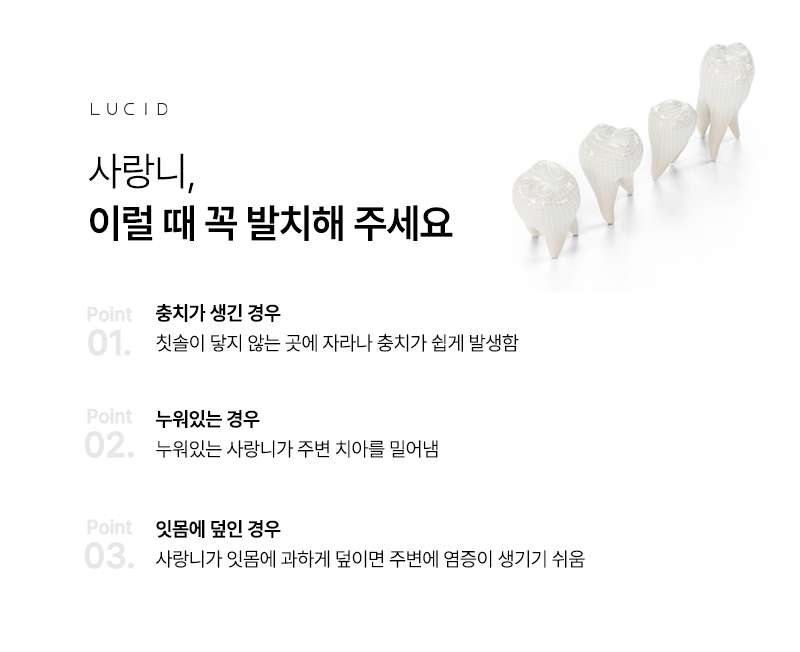
Wisdom teeth should definitely be extracted in these cases.
- When a cavity has formed
Wisdom teeth are very prone to cavities because they grow in a deep location
that a toothbrush cannot easily reach.
If left untreated, the pain can become severe and infection can spread to adjacent teeth.
�
- When it is lying sideways
If a wisdom tooth grows in horizontally, it can press against the root of the neighboring tooth,
causing pain and, in severe cases, damage to the adjacent tooth.
Horizontal impaction usually requires extraction.
�
- When it is covered by the gums
If a wisdom tooth is partially covered by the gums, food debris and bacteria can accumulate easily,
leading to inflammation.
Repeated inflammation can weaken the gums and may also cause abscesses.
�
- When an abnormal finding is discovered during a regular checkup
Even without symptoms, if an abnormality is found on an X-ray,
early extraction may be recommended.
Taking preventive action before a problem breaks out is safer and leads to faster recovery.
�
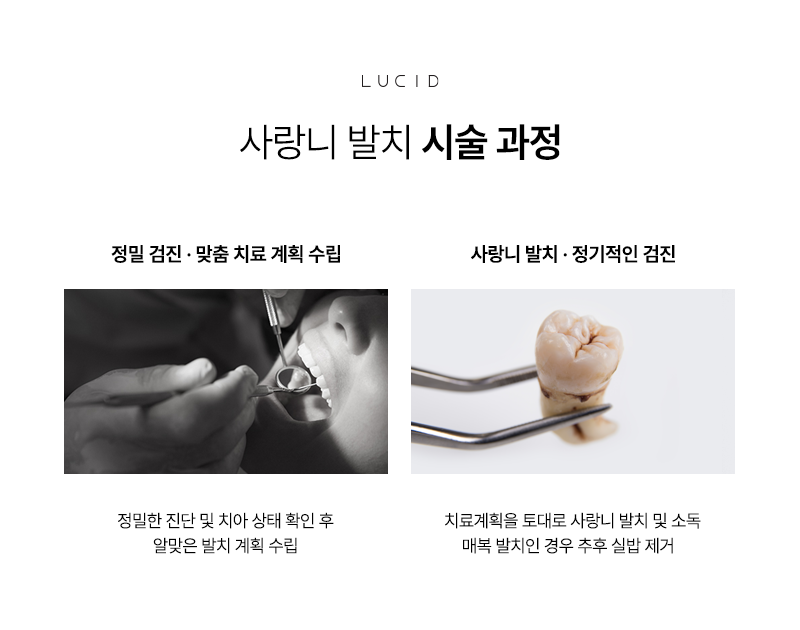
Wisdom tooth extraction procedure
- Detailed examination and treatment planning
We identify the wisdom tooth's position, direction, and whether it is impacted through X-rays and an oral examination,
then create a customized treatment plan.
�
- Wisdom tooth extraction and disinfection
After local anesthesia, the wisdom tooth is removed, and if it is impacted, an incision in the gum
and sectioning extraction may be performed together.
Bleeding control and disinfection are provided to prevent bleeding.
�
- Recovery care and suture removal
Sterile gauze is used to protect the extraction site,
and in some cases, stitches are placed and removed 5 to 7 days later.
After that, regular follow-up visits are needed to check for swelling, pain, and inflammation.
�
Not all wisdom teeth must be extracted,
but because they are likely to cause problems depending on their position, direction, and your oral structure,
we recommend that you get examined.
�
In particular, busy office workers may have a longer treatment period if they visit after pain has already started,
so it is better to get a diagnosis in advance and plan the extraction.
�
At Sinnonhyeon Dental Clinic, we provide systematic oral surgery care,
including wisdom tooth extraction,
and we help reduce pain as much as possible and support a speedy recovery.
�
If you're worried about a wisdom tooth, feel free to contact us anytime.
Lucid Dental Clinic will be with you for your healthy smile.
�
�



�
Lucid Dental Clinic
3rd-4th Floors, Coway Building, 606 Nonhyeon-ro, Gangnam-gu, Seoul