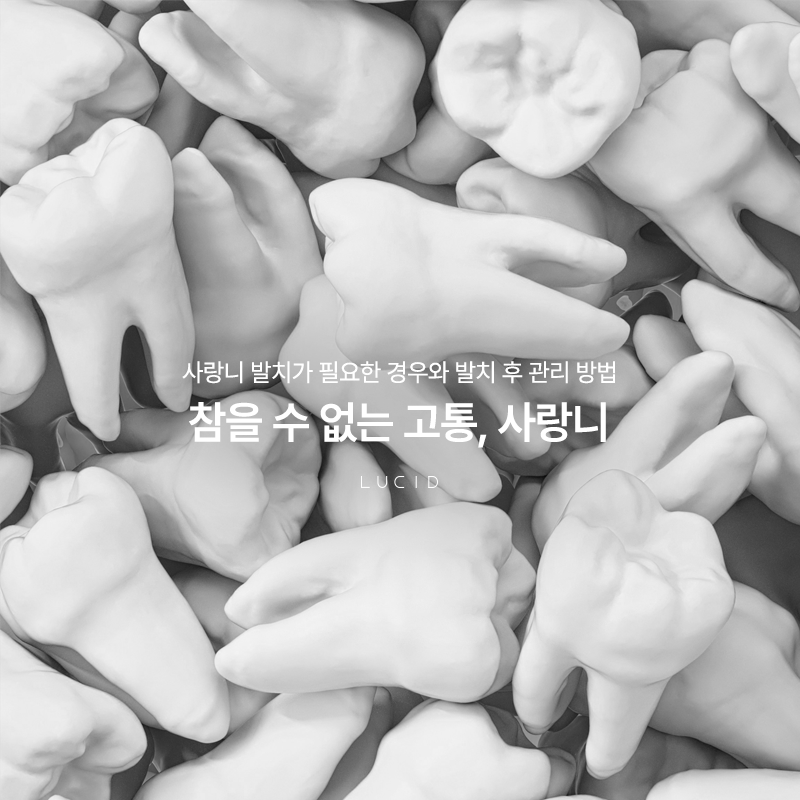
Hello, this is Lucid Dental Clinic.
Even if wisdom teeth do not seem to have any obvious problems on the outside,
they can suddenly affect our daily lives with symptoms such as pain, gum swelling,
and discomfort in the temporomandibular joint.
In particular, discomfort felt while chewing during meals or
situations where it is hard to open the mouth may be
typical signs caused by wisdom teeth.
Many people may think, “You can just leave wisdom teeth alone,”
but depending on their position and the direction in which they grow,
there are many cases where treatment or extraction is
essential.
Today, at our Gangnam dental clinic, we will explain in detail
what problems wisdom teeth can cause and in which cases extraction
should be considered.
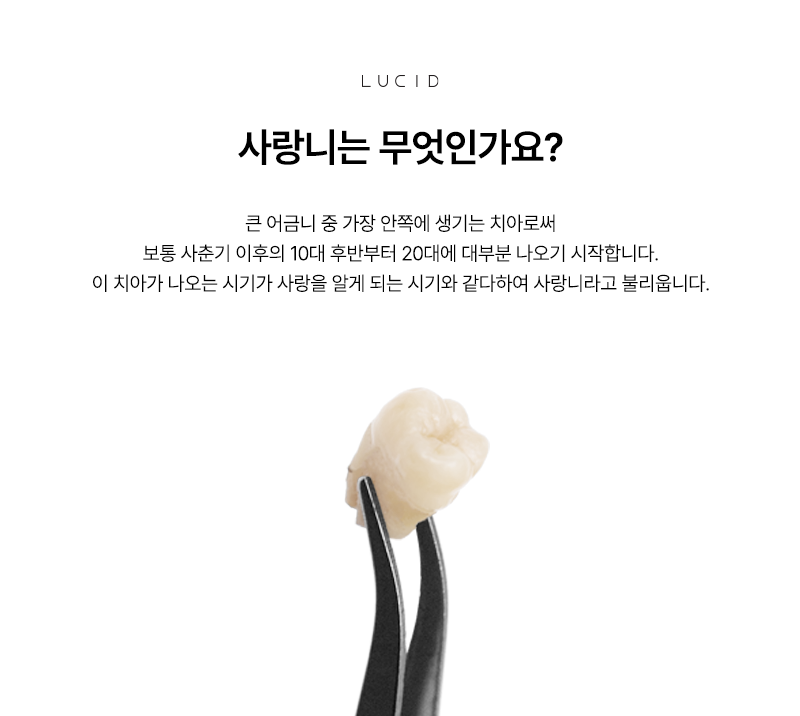
What kind of teeth are wisdom teeth?
Wisdom teeth are the last molars to emerge among the teeth we have,
and they usually appear between the ages of 17 and 25.
Because they are located at the very back of the mouth,
they are difficult to care for and can easily affect tooth alignment
and gum health.
Some people never develop wisdom teeth at all,
and for some, they erupt in a normal direction without causing any discomfort.
However, in most cases, problems occur because there is not enough space
or they grow in an abnormal direction, pressing on adjacent teeth or becoming
impacted beneath the gums.
Also, if a wisdom tooth does not fully erupt and remains
only partially visible inside the gums, food can get trapped or inflammation can occur frequently,
which can lead to pain and bad breath.
Therefore, with wisdom teeth, it is necessary to check not only whether they exist,
but also their position and the direction in which they are growing.

Do all wisdom teeth need to be extracted?
Depending on their condition, wisdom teeth may be kept
or may need to be extracted.
In some cases, if a wisdom tooth erupts normally outside the gums
and does not harm nearby teeth or gums, it may not need to be removed.
However, if a wisdom tooth is growing at an angle
or is half-covered under the gums, it becomes difficult to manage,
which can lead to cavities or gum disease.
In addition, such wisdom teeth can damage adjacent teeth,
ultimately leading to a situation where two or more teeth need treatment.
Especially for those planning orthodontic treatment,
or those who repeatedly experience wisdom tooth pain and swelling,
preventive extraction may be recommended.
Most importantly, the key is not whether a wisdom tooth must always be extracted,
but to receive an accurate diagnosis of the current condition of your wisdom teeth.
If left untreated, wisdom teeth can spread inflammation to the jawbone
or even affect the lymph nodes in the face, so it is wise to check for abnormalities
through regular examinations.
Situations in which wisdom tooth extraction is recommended
Damage to nearby teeth
A wisdom tooth growing sideways can push or press on the root of the front tooth,
causing pain and tooth damage.
Misalignment of the teeth
As the wisdom tooth pushes, the overall tooth alignment may become distorted
or affect the bite.
Cysts and inflammation
Cysts or pus may form around an impacted wisdom tooth,
and in some cases it may erode the jawbone.
Risk of nerve damage
Lower wisdom teeth are close to the nerve canal,
so if not properly managed, they can put pressure on the nerve
and cause pain or sensory abnormalities.
Persistent pain
If pain repeats or swelling and fever occur frequently,
do not leave it untreated; a dental visit is necessary.
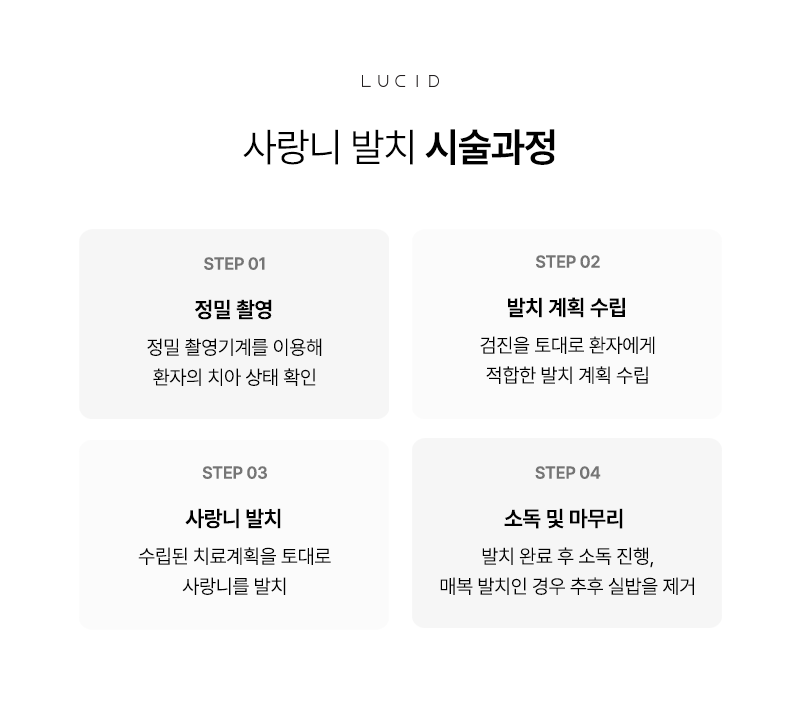
How does the wisdom tooth extraction process proceed?
- Precise diagnosis and imaging
Through imaging such as 3D scans and CT, the location and direction of the wisdom tooth,
and the distance to nearby nerves, are precisely diagnosed.
- Establishing the extraction plan
Depending on the patient’s oral condition, a plan is made for either a simple extraction or an impacted-tooth extraction,
and the timing of the extraction and anesthesia method are explained.
- Wisdom tooth extraction
After local anesthesia, the tooth is separated and safely extracted.
For impacted wisdom teeth, gum incision and bone removal may be involved.
- Disinfection and recovery care
Bleeding is controlled to prevent it, and along with antibiotic prescriptions,
you are guided on how to care for the extraction site.
If there are stitches, you will visit the clinic to have them removed after 5 to 7 days.
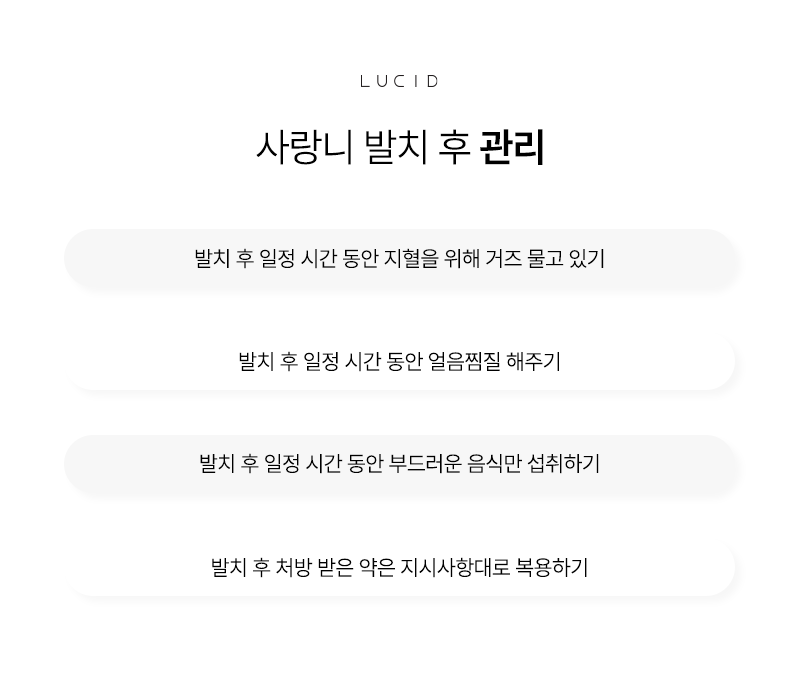
How to care after wisdom tooth extraction
▪ On the day of extraction, keep gauze in place for more than 30 minutes to help stop bleeding.
▪ Within 24 hours, it is good to apply an ice pack to reduce swelling and pain.
▪ Take medication as prescribed, and avoid excessive oral rinsing.
▪ Smoking and drinking interfere with recovery, so it is best to avoid them for at least 3 days.
During the recovery period, it is good to rest without overexertion,
and more careful hygiene than usual is needed.
To prevent the extraction site from becoming irritated, please also avoid touching it with your hands or using a straw.
Before and after wisdom tooth extraction, please be sure to know this.
▪ It is best to decide on extraction through an examination before symptoms become severe, even if there is no pain.
▪ If the pain is severe or there is swelling, you should visit the dental clinic immediately, and please avoid excessive self-treatment or folk remedies.
▪ Recovery speed after extraction varies from person to person, so following the medical staff’s instructions is the safest approach.
Wisdom tooth Q&A
Q. Do all four wisdom teeth always erupt?
A. No. It varies from person to person; some people do not develop any, while others may develop all 1 to 4.
Q. Should a wisdom tooth be extracted even if it does not hurt?
A. Even without pain, wisdom teeth that have grown in an abnormal direction or position can damage nearby teeth, so extraction is recommended.
Q. Isn’t extraction dangerous?
A. Since the distance to nerves and other factors are checked through precise diagnosis before the procedure, serious risks are rare when handled by experienced medical staff.
Q. Is it normal if swelling is severe after extraction?
A. Swelling or slight bruising is part of the normal recovery process. However, if the pain gets worse or you develop a fever, please visit the dental clinic.
Q. How much does extraction cost?
A. It depends on the difficulty of the extraction, and there is a cost difference depending on whether it is a simple extraction or an impacted-tooth extraction. We will explain in detail when you visit.
If you are reading this post now, many of you may be experiencing discomfort because of wisdom teeth
or be considering extraction.
The best choice is to detect wisdom teeth early and, when necessary,
manage them properly.
At Lucid Dental Clinic, through precise diagnosis and consultation tailored to each patient’s condition,
we reduce unnecessary extractions and recommend only those that are truly necessary.
We will help you receive treatment with less worry about pain and faster recovery,
based on professionalism and careful attention.
If wisdom teeth are interfering with your daily life,
now is the time to visit the dental clinic.
Lucid Dental Clinic always supports your comfortable smile :)
Lucid Dental Clinic
3rd–4th Floors, Coway Building, 606 Nonhyeon-ro, Gangnam-gu, Seoul