Hello, this is Lucid Dental Clinic.
Have you ever looked in the mirror and found your eyes lingering on the teeth visible when you smile?
Teeth can change a person’s impression without saying a word, and even when you smile silently, they are an important element that completes that person’s overall atmosphere.
But when you lose one tooth after another,
it turns out it is not just the chewing function that is lost.
It becomes harder to enjoy food freely,
and many people unconsciously
keep their mouths closed when taking photos.
The gaps between teeth are uncomfortable on their own,
and over time, nearby teeth can shift,
and the jawbone can also begin to sink inward.
These changes do not happen overnight,
but if you keep putting them off, before long you may
become accustomed to them without even realizing it.
So if discomfort has started after tooth loss,
it is important to calmly look into what kind of treatment is needed
from that point onward.
Among the representative solutions, there was the implant.
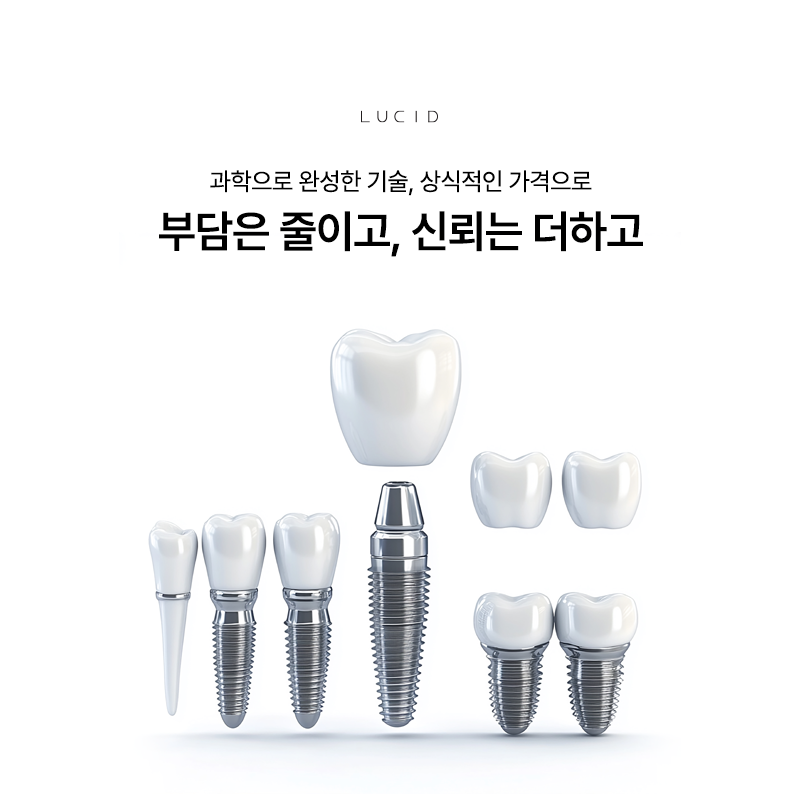
It has a structure in which an artificial root is placed into the jawbone, and a prosthetic tooth is mounted on top, allowing the function and shape of the missing tooth to be naturally replaced.
Because it does not need to be removed and put back in like dentures, and it does not wobble, it is one treatment method that allows daily life to continue more stably.
What is a Lucid implant?
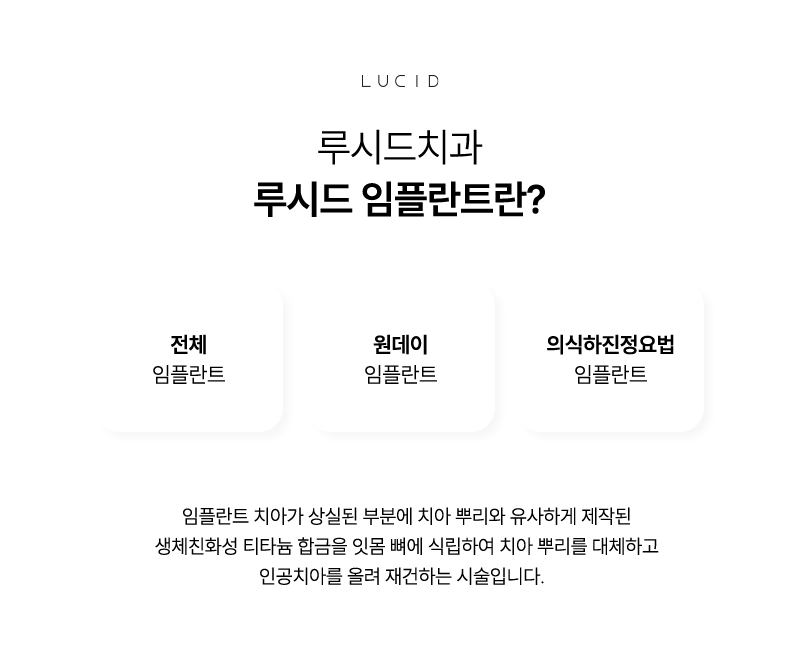
An implant is a treatment method that places an artificial structure in the area where a tooth has been lost, making it possible to function like a natural tooth.
It is designed not simply to fill the space in a way that looks good, but also with the functional role needed for chewing food and speaking.
The expression often used, “placing an implant,” refers to the process of inserting the “artificial root,” which serves the role of the tooth root, into the jawbone.
After this artificial root firmly integrates with the jawbone, a “prosthetic tooth” is placed on top to complete the visible tooth structure.
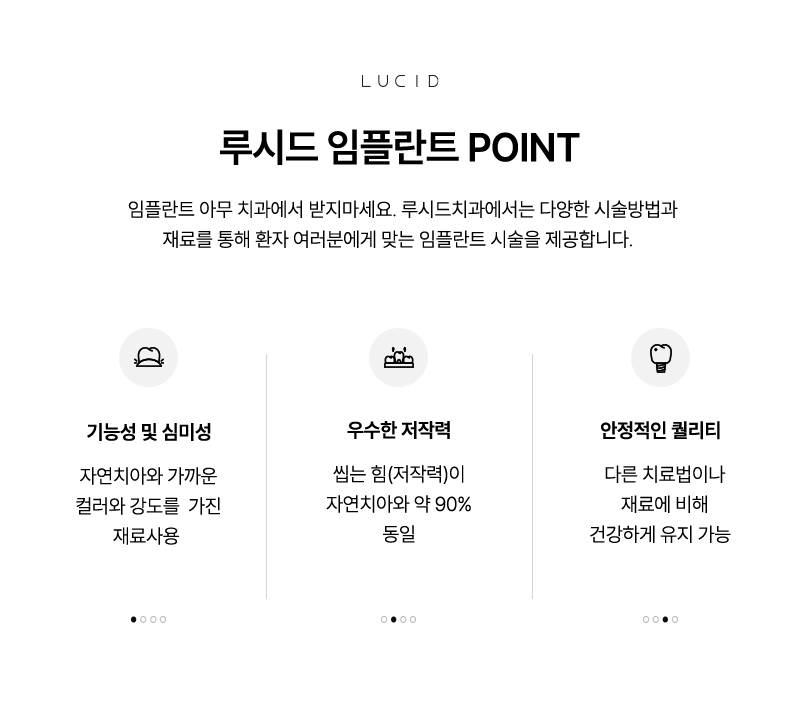
One advantage of implants is that they do not require affecting the surrounding teeth.
Bridges often require the adjacent teeth on both sides to be shaved down, but implants can restore only the missing area in a focused way.
Also, unlike dentures, there is no inconvenience of taking them out and putting them back in, so it is possible to maintain daily life more naturally in a fixed state.
Above all, because they can individually restore the function of each tooth, they are being considered a practical treatment option across various age groups.
How is implant treatment carried out?
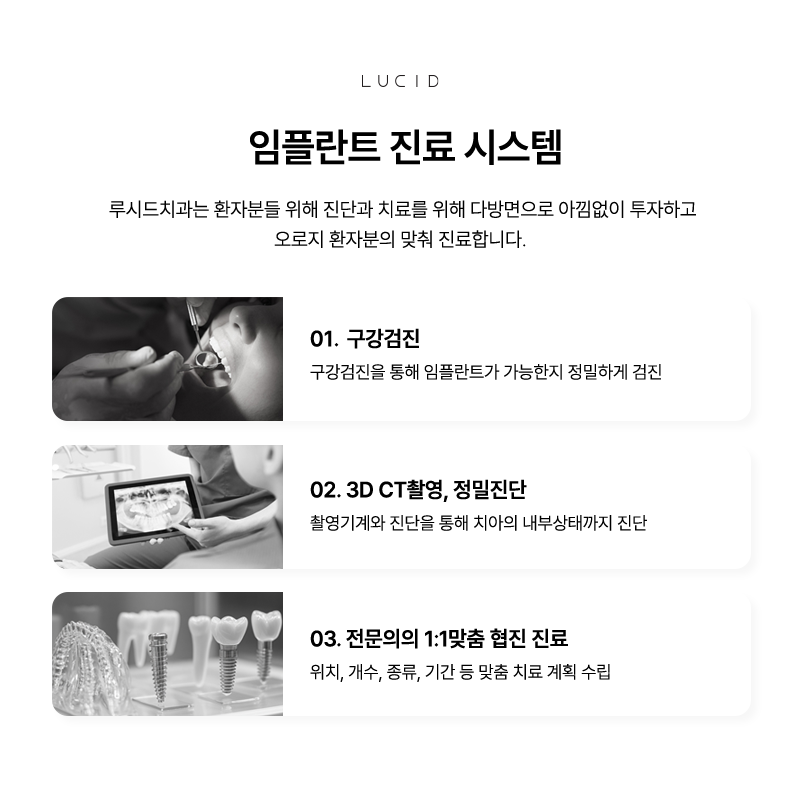
Because implants are not simply prosthetics but a treatment that includes a surgical procedure, they are carefully carried out in the following steps.
- Precise diagnosis
Through 3D CT imaging and similar methods, the height, thickness, density of the bone, and even the location of nerves were checked to prepare for accurate placement.
- Establishing a surgical plan
Considering the patient’s oral structure, gum condition, and amount of alveolar bone, the customized placement position and prosthetic shape were designed.
- Placement of the artificial root
After local anesthesia, the fixture was placed into the jawbone, and bone grafting was performed when necessary.
- Attachment of the prosthetic tooth and finishing
Once integration was complete, the artificial tooth was attached, the bite was checked, and the final finishing was done.
When can implants be considered?
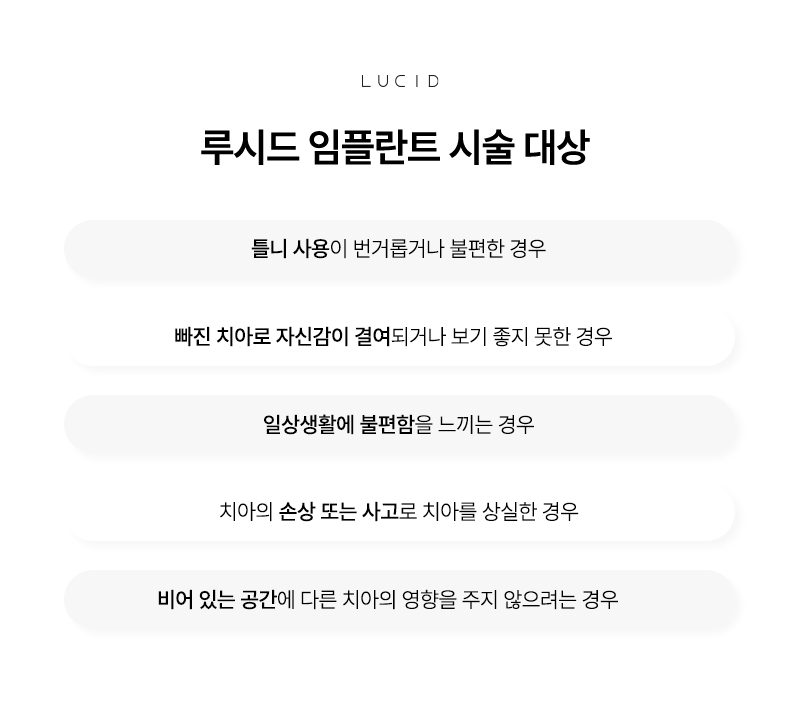
▪ When one or two teeth have been lost and you want to preserve the surrounding teeth as they are
▪ When dentures are uncomfortable and you want fixed prosthetics
▪ When replacement is needed after extraction due to cavities or gum disease
▪ When you want to consider both chewing function and aesthetic restoration at the same time
However, in the following cases, sufficient review is needed before the procedure.
▪ If you have a systemic disease such as diabetes, heart disease, or osteoporosis
▪ If you smoke heavily or have poor oral hygiene
▪ If there is insufficient jawbone and bone grafting must be done first
Because every condition differs from person to person, it is best to confirm everything through a consultation.
Precautions after the procedure are also important.
▪ On the day of the procedure, avoid hot or irritating foods and eat soft meals.
▪ Use a soft toothbrush when brushing, and it helps to use an oral rinse as well.
▪ Smoking cessation is essential. Smoking can interfere with integration and increase the risk of inflammation.
▪ It is good to visit the dental clinic regularly to check the condition of the implant.
An implant goes beyond simply filling a missing tooth,
and can affect overall oral health and quality of life.
Because it has a function and structure similar to a natural tooth,
many people consider it, but the procedure is not a simple one.
Above all, it is important to carefully review various conditions in advance,
such as the state of your bone and oral hygiene habits,
and to proceed only after 충분한 consultation with the medical staff.
At Lucid Dental Clinic, based on a diagnostic system using 3D CT and digital equipment,
we help with implant treatment through accurate condition analysis and patient-centered treatment planning.
If you are experiencing discomfort due to tooth loss,
we recommend starting by getting an accurate diagnosis of your current dental condition.
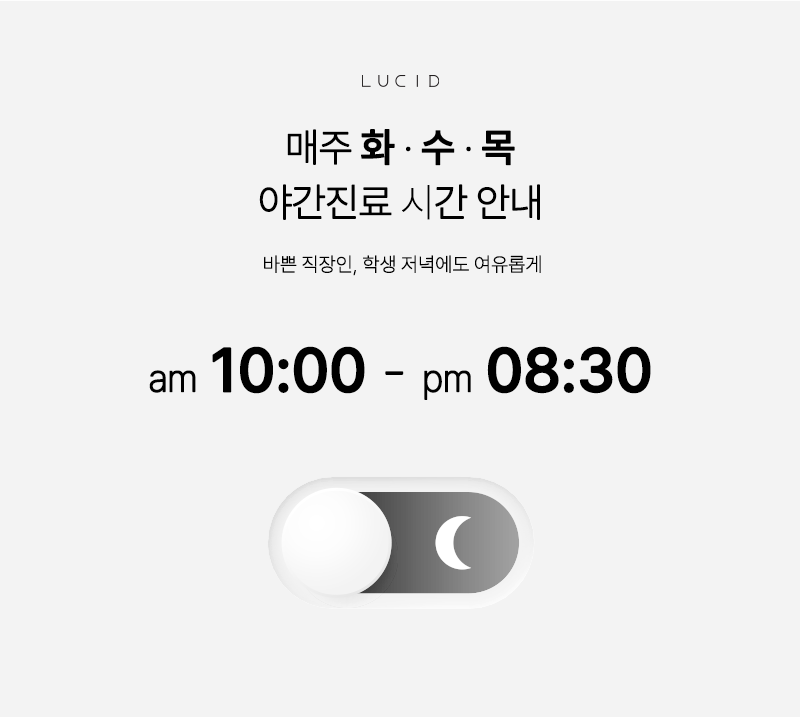
Lucid Dental Clinic
3rd–4th Floors, Coway Building, 606 Nonhyeon-ro, Gangnam-gu, Seoul