Hello, this is Lucid Dental Clinic.
Have you ever lost sleep because of tooth pain?
Even though you clearly brushed carefully.
If a dull, heavy feeling keeps lingering somewhere, or
there are moments when it suddenly throbs even when you have not done anything,
that may not be simple fatigue, but a warning signal sent by the nerve inside the tooth.
Many people experience tooth pain
and think,
"If I just endure it now, it will get better."
"It will be fine after some time."
and end up delaying treatment.
But in cases like this, the inflammation has often already
spread to the nerve,
and by the time they visit the hospital late, more advanced treatment
is often needed.
In particular, root canal treatment requires treatment deep inside
the tooth, beyond simple cavity treatment,
so the timing and method of treatment can affect
the tooth’s prognosis.
That is why it is important to make an early and accurate assessment
and, if necessary, save the tooth through the right procedure.
Today at Lucid Dental Clinic, we will explain one by one the information
many of you often ask about regarding root canal treatment.
▪ What root canal treatment is
▪ When it is needed and how it is performed
▪ Foods and habits to avoid during treatment
▪ And even how to self-check!
If you are considering root canal treatment,
or if you have been worried because of tooth pain,
we hope this article can be the
first step you need.
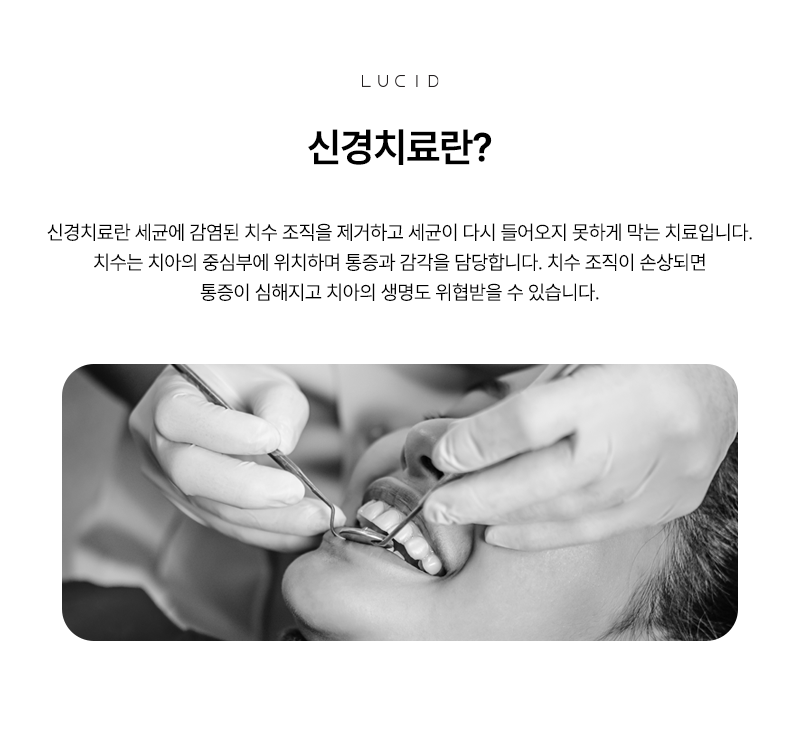
What is root canal treatment?
Root canal treatment is, quite literally, the treatment performed when
there is a problem with the nerve tissue inside the tooth.
This nerve is located in the center of the tooth,
and together with blood vessels, it plays an important role in supplying nutrients
to the tooth and sensing external stimuli.
However, when a cavity becomes deep or the tooth is injured by an external impact,
inflammation can develop in this nerve, leading beyond simple pain to
various symptoms that can interfere with daily life, such as severe sensitivity,
throbbing pain, and pain when chewing.
If left untreated, the inflammation can spread to the root tip,
and may affect the jawbone and surrounding tissues as well.
At that point, root canal treatment is the procedure that removes only
the infected nerve and tissue inside the tooth, without extracting the entire tooth,
after which the inside is thoroughly disinfected and sealed.
Through this process, the infected area is removed while helping
preserve as much of the natural tooth as possible.
In other words, root canal treatment can be considered the 'last chance to save a painful tooth'
and a decisive way to avoid extraction.
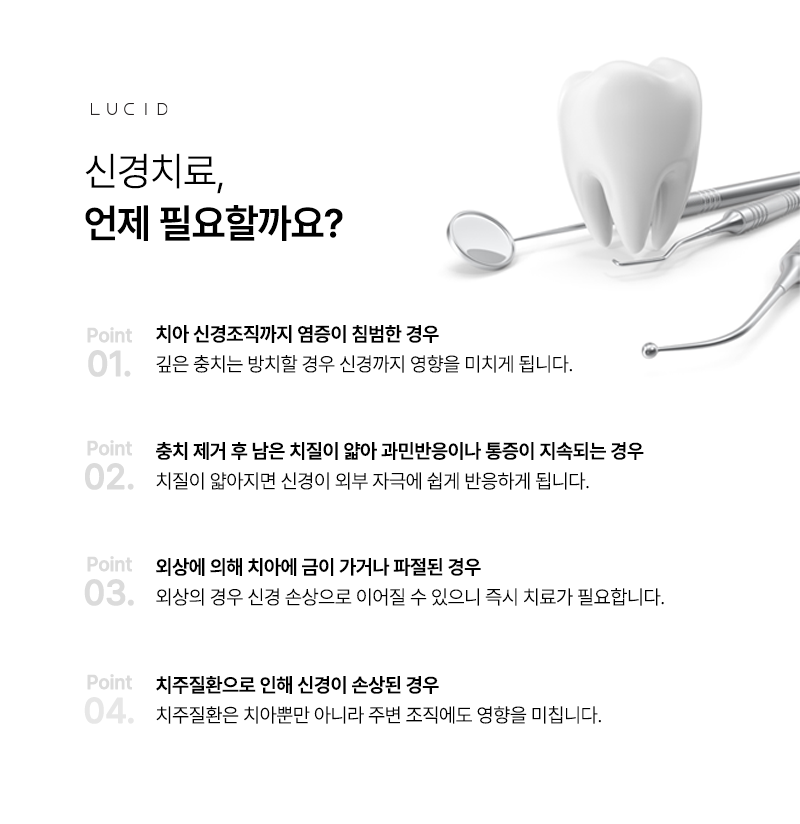
When is root canal treatment needed?
If you have any of the following symptoms,
root canal treatment may be needed.
▪ Teeth that feel sensitive and hurt for a long time after cold water / sweets
▪ Persistent dull pain in a tooth for no apparent reason
▪ Pain that gets worse when lying down at night
▪ Pain felt near the tooth root when chewing
▪ Recurrent pain even after cavity treatment has already been done
▪ A tooth that has broken or been damaged by trauma
▪ Repeated swelling or pus coming from the gums
Root canal treatment is a step beyond simple cavity treatment,
and it is the final step in "saving the tooth," helping prevent a situation
where the tooth may otherwise need to be removed.
Is root canal treatment really necessary?
Yes. If it is needed, it is best to receive it without fail.
If you endure it thinking,
"It hurts a little, but it will pass"
or "It will be fine as time goes by,"
the entire tooth may decay, or the inflammation may spread to the surrounding tissues,
eventually leading to a situation where extraction is necessary.
Also, if an infected nerve is left untreated, inflammation at the root tip can become
chronic and lead to bigger problems such as jawbone damage, facial swelling,
and systemic inflammatory responses. For that reason, receiving root canal treatment
at the right time is the smartest way to protect tooth health.
Root canal treatment procedure
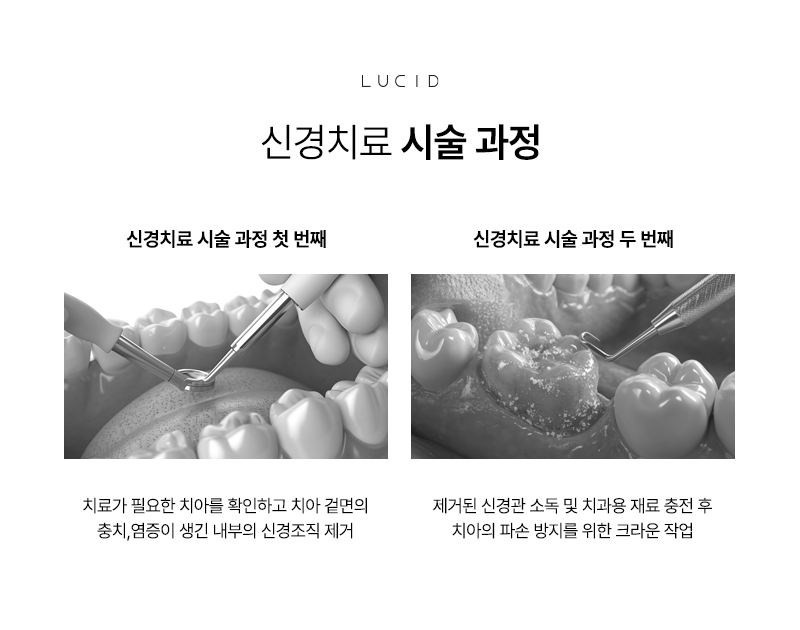
Root canal treatment is carried out in stages over 1 to 3 visits.
The number of sessions may vary depending on the condition of the tooth
and the extent of inflammation.
- 확인 of the inflamed area and anesthesia
▪ X-ray or CT imaging is used to determine whether the nerve is infected and to assess the location and depth.
▪ Treatment begins after local anesthesia.
- Nerve removal and removal of infected tissue
▪ After removing the cavity or damaged area, access is made to the inside of the tooth and the infected nerve is removed.
▪ The root canal is thoroughly disinfected, and temporary medication is placed.
- Internal sealing and reinforcement treatment
▪ After confirming that the infection has subsided, the inside of the root canal is sealed with medication.
▪ If needed, the tooth is reinforced with a prosthetic restoration to restore function.
Foods and habits to avoid during root canal treatment
During root canal treatment, the tooth is in a weakened state, so
it is best to avoid the following foods and habits.
▪ Hard or chewy foods (meat with bones, dried squid, etc.)
▪ Sticky foods (caramel, jelly, taffy, etc.)
▪ Foods that are too hot or too cold
▪ Chewing food with the tooth being treated
▪ Brushing too hard
Also, until the treatment is finished, it is important to eat mainly on the opposite side
so as not to strain the tooth, and after treatment, to complete the prosthetic
treatment according to the dentist’s guidance.
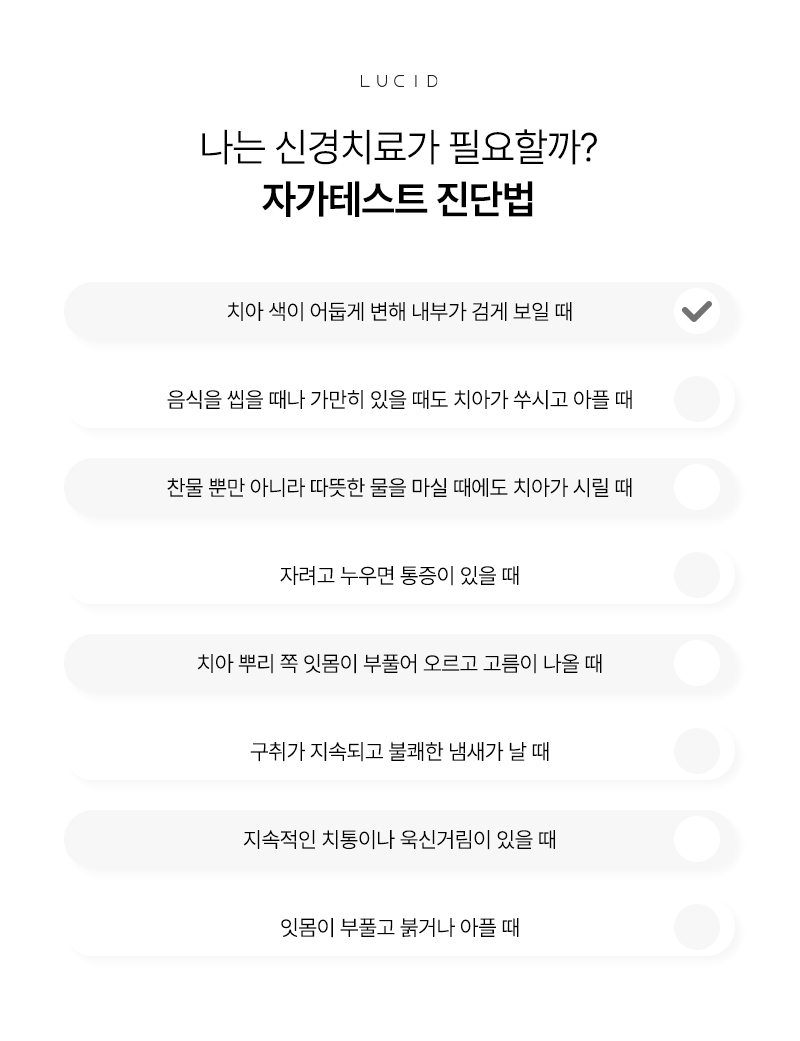
Root canal self-check test
If 4 or more of the following apply to you,
root canal treatment may be needed.
- My tooth stays sensitive for a long time when I eat cold foods or sweets.
- I feel a sharp twinge in one tooth when chewing.
- The pain gets worse when I lie down at night.
- The pain continues even after cavity treatment.
- I have had pus-like discharge from the gums.
- A tooth that was injured in the past has recently changed color or started hurting.
- One side of my face has swollen, and it seemed like the pain started from a tooth.
Result interpretation
▪ 0–2 items: There does not seem to be any major issue, but be sure to keep up with regular checkups!
▪ 3–4 items: There may be inflammation of the nerve. We recommend getting examined.
▪ 5 or more items: There is a high possibility that root canal treatment is needed. Please visit a nearby Gangnam dental clinic.
Root canal treatment is not something to be afraid of.
It is a process designed to help you use your tooth for as long as possible, and if treated at the right
time, both pain and recovery can be managed sufficiently.
At Lucid Dental Clinic, our medical team with extensive
root canal treatment experience and a systematic equipment system
provides customized treatment suited to each patient’s dental condition.
Do not just endure it thinking, 'It will be fine.'
Please remember that even small pain can be a signal.
To help keep your teeth healthy for a long time,
Lucid Dental Clinic will be with you.
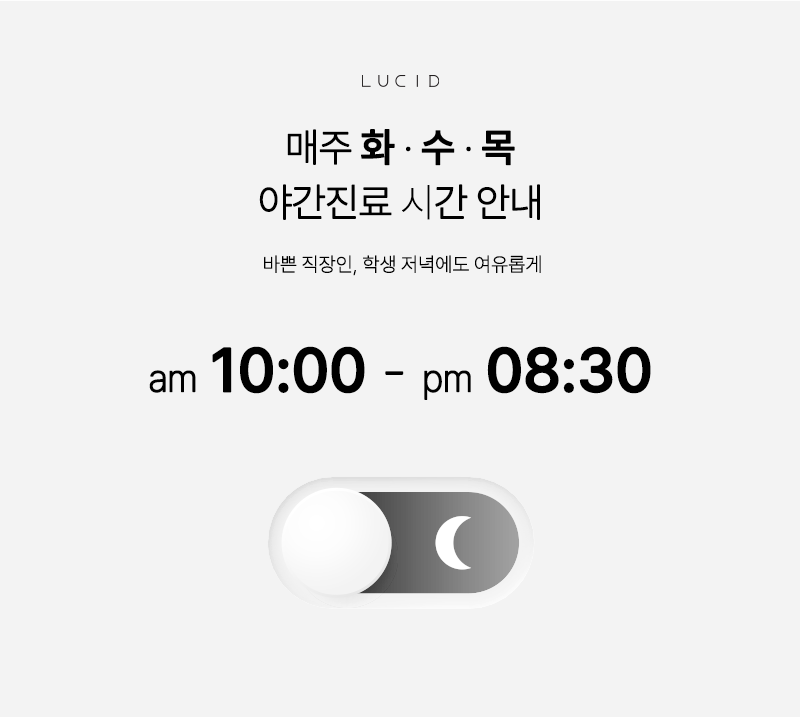 Lucid Dental Clinic
3rd–4th floors, Coway Building, 606 Nonhyeon-ro, Gangnam-gu, Seoul
Lucid Dental Clinic
3rd–4th floors, Coway Building, 606 Nonhyeon-ro, Gangnam-gu, Seoul