
Hello. This is Lucid Dental Clinic.
Have you ever felt a numb, tingling sensation in your mouth that made even speaking
and eating uncomfortable?
The inside of the mouth is a space that usually does not get much attention,
but even a little inflammation there can be sensitive enough to affect everyday life.
In particular, a small pain that you may casually brush off could actually be an inflammatory disease called
“stomatitis.”
Stomatitis is a condition that is easy to dismiss as just having a sore spot in the mouth,
but if it occurs repeatedly or the pain is severe, it is necessary to examine the cause closely.
It often appears when stress and fatigue accumulate and immunity weakens,
or when nutrients are lacking.
Sometimes mechanical irritation, hormonal changes, infections, and other
various causes can also work together.
Above all, stomatitis may sometimes heal on its own, but
if symptoms occur frequently or recovery is slow, getting help from a dentist
can be a wise choice.
If you miss the timing for treatment, it can interfere with eating and talking,
as well as act as a small source of stress in daily life and lower your quality of life.
In this post, together with Lucid Dental Clinic, we will take a step-by-step look at
stomatitis—from its common causes and types to prevention and treatment methods.
Why not take this opportunity to understand the mouth sores you may have brushed off lightly
and prevent them in advance?
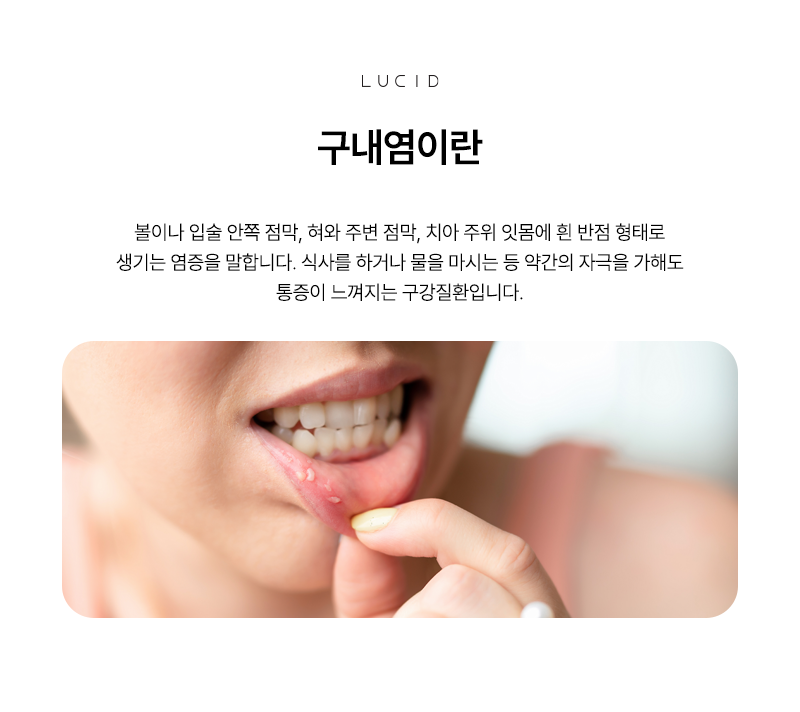 What Is Stomatitis?
Stomatitis is, quite literally, an inflammatory disease that occurs in the mucous membrane of the mouth.
It can occur anywhere from the inside of the lips to the tongue, gums, and palate, and is accompanied by symptoms such as pain, burning, swelling, and ulcers.
It may start with a sharp pain while eating or discomfort when speaking,
but depending on the case, it can spread enough to cause major disruption to daily life.
In particular, stomatitis is a condition that is easy to think will just “heal after a while,” but if it recurs or the healing period becomes longer, it may be a signal that something is wrong with the body rather than just a simple mouth sore.
Because it is closely related to overall health conditions such as lowered immunity, stress, and nutritional deficiency,
it is often not just a local problem.
If managed properly at an early stage, it can improve quickly,
but if treatment is delayed, the inflammation may worsen or lead to a secondary infection.
That is why it is important not to take stomatitis lightly,
but to pay attention from the early symptoms and manage it properly.
 Various Causes of Stomatitis
Stomatitis can occur due to a surprisingly wide range of causes.
▪ Lowered immunity
Immunity weakened by overwork, stress, and lack of sleep is a major cause of stomatitis.
▪ Nutritional imbalance
In particular, deficiencies in B vitamins, iron, and folate can easily trigger stomatitis.
▪ Mechanical irritation
Unconscious biting inside the mouth, or irritation from orthodontic appliances or dentures, can also induce inflammation.
▪ Hormonal changes
In women, stomatitis may occur due to hormonal changes such as the menstrual cycle or pregnancy.
▪ Infection
It can also be caused by viral, fungal, or bacterial infections.
As such, stomatitis is difficult to explain simply as “having a sore in the mouth,”
so it is important to understand the cause and approach it accordingly.
 Types and Characteristics of Stomatitis
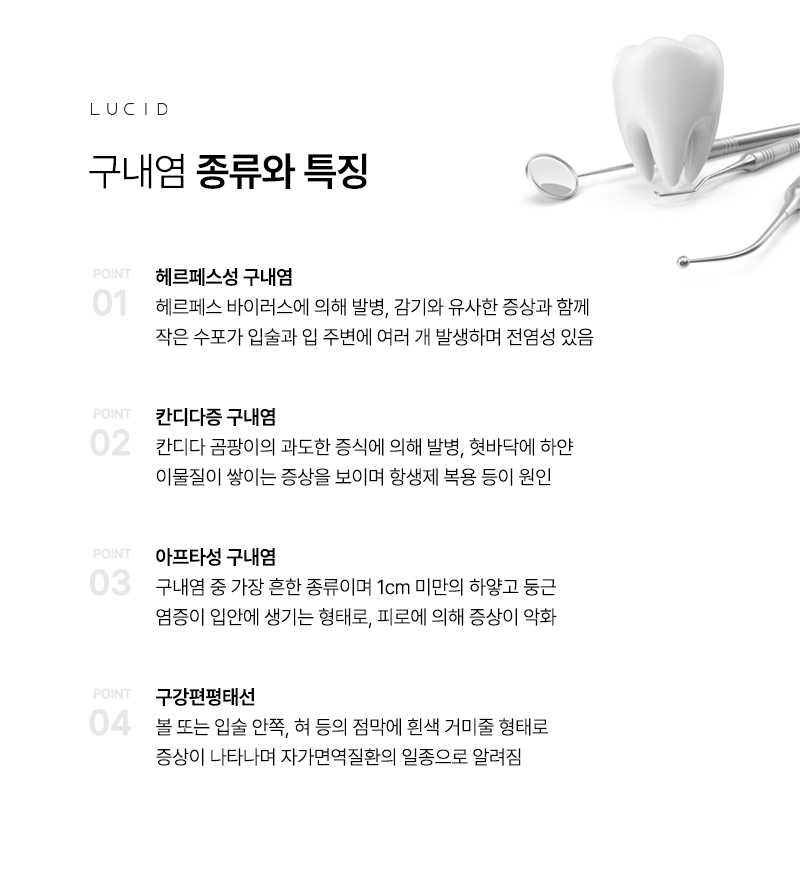
Stomatitis is divided into several types depending on the cause and symptoms.
Types and Characteristics of Stomatitis
Stomatitis is divided into several types depending on the cause and symptoms.
▪ Aphthous stomatitis
The most common type, it appears as small white ulcers in the mouth and is accompanied by pain. In many cases, it heals naturally within a few days to 1–2 weeks.
▪ Herpetic stomatitis
Caused by a viral infection, it develops as blisters that rupture and turn into ulcers. It is also common in infants and children.
▪ Candidal stomatitis
A stomatitis caused by fungal infection, it usually occurs after antibiotic use or when immunity is weakened. White patches may appear on the tongue or mucous membrane and can peel off.
▪ Traumatic stomatitis
This occurs when the inside of the mouth is physically injured and usually appears as a single ulcer.
Self-Diagnosis Checklist for Stomatitis Symptoms
If you have the following symptoms, you may want to suspect stomatitis.
▪ White or yellow ulcers have appeared in the mouth
▪ The area around the ulcer is red, swollen, and sensitive to irritation
▪ You feel pain when eating or speaking
▪ Inflammation repeatedly occurs in the same area
▪ Your tongue feels stinging, or your mouth feels dry
If two or more of these apply, stomatitis is likely.
In particular, if symptoms last longer than a week or recur frequently,
consider visiting a Gangnam dental clinic.
 How to Prevent Stomatitis in Daily Life
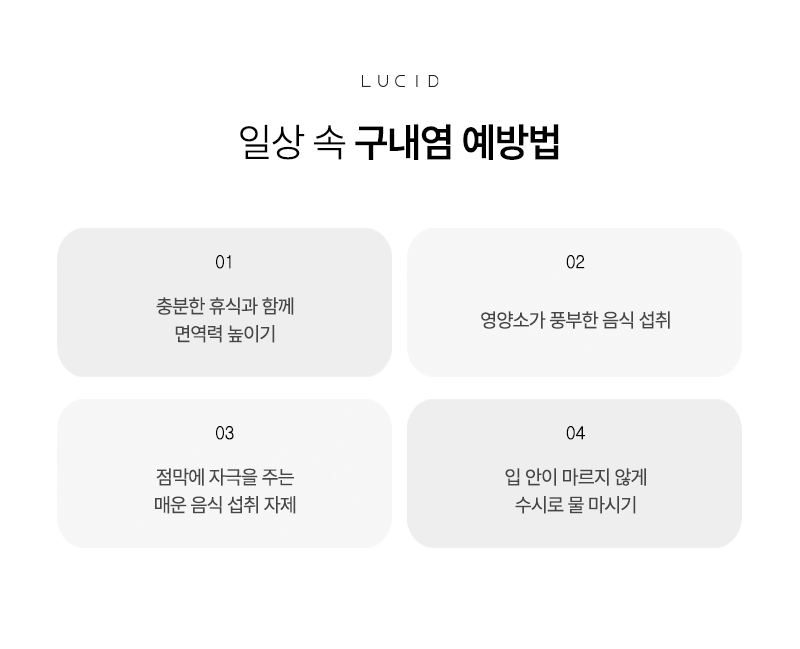
You can prevent stomatitis simply by managing your lifestyle habits well.
How to Prevent Stomatitis in Daily Life
You can prevent stomatitis simply by managing your lifestyle habits well.
▪ Manage stress and get enough sleep
▪ Eat foods rich in B vitamins and iron
(For example: spinach, eggs, bananas, etc.)
▪ Maintain thorough oral hygiene
▪ Be careful while eating or brushing so you do not injure the inside of your mouth
▪ Increase fluid intake if your mouth often feels dry
In particular, when the oral cavity is dry, bacterial activity can become more active,
so adequate fluid intake is also important.
How Is Stomatitis Treated at the Dental Clinic?
Treatment for stomatitis varies depending on the cause and severity of symptoms.
-
Cleansing and inflammation-relief treatment
The inflamed area is disinfected and medication is used to reduce pain and promote faster recovery.
-
Adjunctive treatment
Treatment using ultraviolet light or lasers may be used.
It helps support inflammation recovery and prevent recurrence.
-
Cause-focused management
In cases of recurring stomatitis, we also check for iron or vitamin deficiencies and whether any underlying disease is present.
-
Adjustment of oral appliances
If repeated injuries are caused by orthodontic appliances or prosthetic devices, adjustments or protective measures are also necessary.
Stomatitis often heals naturally,
but if symptoms are severe or occur frequently, leaving it untreated may actually prolong treatment.
If the discomfort continues, it is a good idea to visit a nearby Gangnam dental clinic
and receive an accurate diagnosis.
It is important to identify the cause
and receive appropriate treatment.
At Lucid Dental Clinic, we provide customized treatment that also considers the health of the oral mucosa,
so please feel free to consult us whenever you need help.
 Lucid Dental Clinic
3rd–4th Floors, Coway Building, 606 Nonhyeon-ro, Gangnam-gu, Seoul
Lucid Dental Clinic
3rd–4th Floors, Coway Building, 606 Nonhyeon-ro, Gangnam-gu, Seoul