

Hello, this is Lucid Dental Clinic.
A disease that quietly approaches and suddenly causes major discomfort one day
That is “gum disease.” Gum disease is a type of periodontal disease,
and its formal name is “periodontitis.”
This is not simply a problem limited to the gums;
it is a frightening disease in which inflammation spreads to the bone and tissues that support the teeth.
At first, there are no particular symptoms, so it is easy to dismiss,
but if left untreated, the teeth may become loose and
eventually fall out.
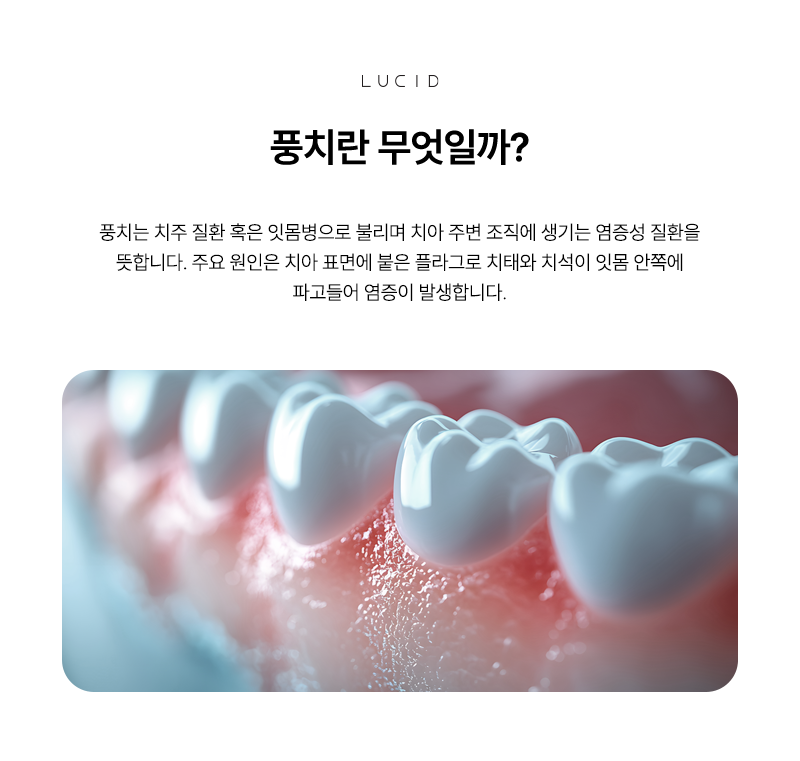
Why does gum disease occur?
The main cause of gum disease is bacteria.
If brushing is not done properly,
food debris combines with bacteria to form plaque,
and when this hardens, it becomes tartar.
The bacteria inside this tartar irritate the gums,
cause inflammation, and gradually dissolve the alveolar bone.
In addition, the following lifestyle habits can
make gum disease worse.
▪ Smoking
▪ Chronic stress
▪ Weakened immunity
▪ Improper brushing habits
▪ Poor oral care when you have orthodontic appliances or prosthetics
How is gum disease treated?
Treatment for gum disease varies depending on the severity of the symptoms.
In the early stages, it can be improved with relatively simple care,
but if the condition worsens,
more specialized treatment is needed.
- Scaling
The most basic treatment for removing tartar.
- Root planing
The root surface of the tooth is smoothed out
so that bacteria cannot stick to it.
It is usually performed together with the removal of tartar deep below the gums.
- Gum surgery
If inflammation has spread deeply, surgery to make an incision in the gums
and remove diseased tissue may be necessary.
Afterward, recovery can be supported through bone grafting or guided tissue regeneration.

Could I have gum disease too? Let’s do a self-check.
The more items below that apply to you,
the higher the likelihood of gum disease.
If you check 5 or more, visit the nearby Gangnam Dental Clinic.
▪ My gums bleed often when I brush my teeth
▪ I feel sensitivity when eating cold water or sweets
▪ My gums feel loose or separated
▪ Food often gets stuck between my teeth
▪ I develop bad breath easily and it lasts a long time
▪ My teeth feel longer than before
▪ My teeth feel loose
▪ When I wake up in the morning, my mouth feels sticky and unpleasant
Let’s correct some misconceptions about gum disease.
Do you still think gum disease only occurs when you get older?
In fact, periodontal disease commonly occurs
in people in their 20s and 30s as well.
In particular, people who are undergoing orthodontic treatment or have hormonal changes
after pregnancy or childbirth may experience a rapid decline in gum health.
In other words, the bigger cause is not age, but poor care.
There is also a misconception that brushing should stop if blood appears.
Bleeding from the gums while brushing may be a sign of inflammation,
and in such cases, it is actually important to clean the gum margins even more carefully.
With consistent care, bleeding can decrease,
and the gums can recover healthily.

Habits for preventing gum disease
Prevention is especially important for gum disease.
If you develop the habits below in daily life,
you can maintain healthy gums for a long time.
▪ Brush your teeth 2 to 3 times a day, within 3 minutes after meals
▪ Get regular scaling (every 6 months)
▪ Reduce or quit smoking
▪ Eat vegetables rich in fiber
▪ Manage stress

Proper brushing is the key
Many people think that brushing three times a day alone
is enough, but what matters is the “method.”
Please keep the following in mind.
▪ Use a toothbrush with soft bristles and replace it every 3 months.
▪ Pay attention to cleaning between the gums and teeth.
▪ At least once a day, be sure to use an aid such as dental floss or a Waterpik.
▪ Removing tongue coating with a tongue cleaner is also helpful in preventing bad breath.
Dental health is also connected to overall health.
The bacteria that cause periodontitis can spread throughout the body
through the bloodstream. Some studies also suggest that gum disease is associated with
risks such as heart disease, diabetes, and premature birth.
Oral care is not just about appearance; it is a basic part of health.
If you feel even the slightest abnormality, do not leave it untreated
and visit Gangnam Dental Clinic.
At Lucid Dental Clinic, through regular checkups and customized preventive care,
we carefully protect each patient's gum health.
Healthy gums are what make real smiling possible.

Lucid Dental Clinic
3rd–4th Floors, Coway Building, 606 Nonhyeon-ro, Gangnam-gu, Seoul