
Hello, this is Lucid Dental Clinic.
No matter how thoroughly you brush your teeth, have you ever stood in front of the mirror and
noticed that the spaces between your teeth somehow look dull,
and started worrying about bad breath?
This may not be a simple illusion,
but a sign that tartar has already taken hold in your mouth.
Tartar is a hard mass formed when food debris we eat
combines with oral bacteria.
Once it forms, it cannot be removed with ordinary toothbrushing or
oral rinse alone.
In particular, when tartar builds up along the boundary between the gums and teeth,
it can easily lead to gum inflammation or periodontal disease.
"My gums are swollen"
"My gums bleed when I brush"
"I think I have bad breath"
If any of these concerns have come to mind even once, now is the time
to consider scaling.

What is scaling?
Scaling is a treatment that removes
tartar and plaque attached to the tooth surface and around the gums.
It is a simple yet highly effective oral hygiene method,
and generally uses instruments to physically remove tartar
adhered to the teeth, while ultrasonic equipment allows for a more
detailed and precise procedure.
Risks of periodontal disease when scaling is delayed
If scaling is not done for a long time,
tartar can move below the gumline and cause inflammation.
If this condition continues, it can develop into
periodontitis, and in severe cases, even the bone
that supports the teeth may be damaged, causing teeth to become loose or
fall out.
Because symptoms that start with simple bleeding or swelling can
lead to serious oral disease, early management is important.
Also, because tartar is a breeding ground for bacteria,
it can cause bad breath and interfere with other treatments.
Before orthodontic treatment, implants, or prosthetic treatment,
it is also necessary to check and tidy up the condition of the mouth
through scaling.

Who is scaling recommended for?
▪ People who frequently develop staining or tartar from coffee, wine, smoking, and similar habits
▪ People who often have bleeding or swollen gums
▪ People who have recently noticed bad breath or a foreign-body sensation while brushing
▪ People whose last regular checkup was more than 6 months ago
▪ People who are preparing for orthodontic or implant treatment
Even if you do not have symptoms, it is good to receive scaling as a preventive measure.
When symptoms appear, periodontal disease is often already somewhat advanced,
so regular management is necessary.
Scaling cycle,
how often should you get it?
Scaling is not a one-time care procedure.
The oral environment changes every day, so regular
checkups and management are needed.
For healthy people, an interval of about 6 months is usually
enough, but if you enjoy coffee or smoking, or if tartar forms easily,
it is better to manage it at shorter intervals.
In particular, if you have had gum treatment in the past,
careful examinations every 3 to 4 months can be a big help
in protecting gum health.
Because the types of bacteria in each person’s mouth and the composition of saliva
are all different, it is important to find the scaling interval
that fits your oral condition exactly.
Through regular dental checkups and professional consultation,
you can learn the care interval you need.
For one person, it may be 'once every six months,' and for another,
'once every quarter' may be the right answer.
Benefits of scaling
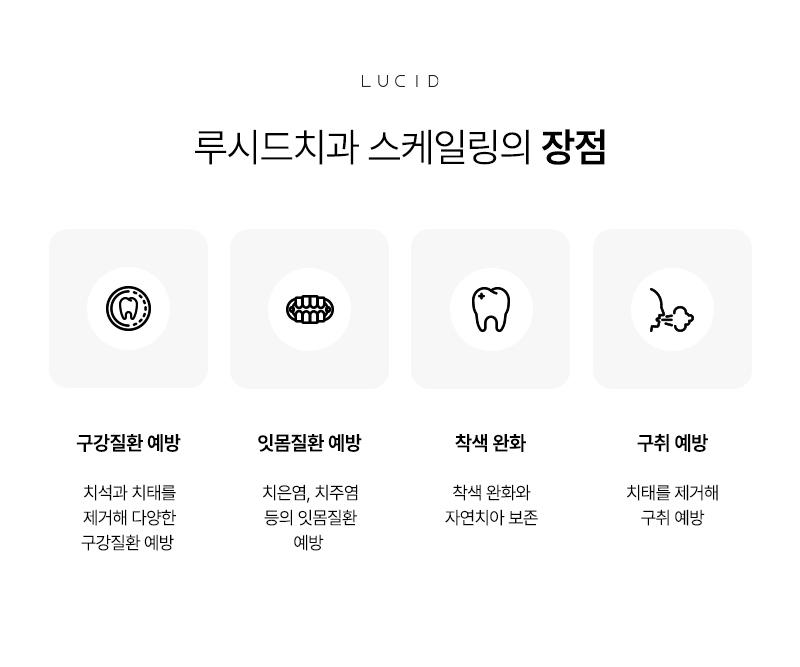
The biggest benefit of scaling is the prevention of periodontal disease.
It helps reduce problems such as gum inflammation, bleeding, and swelling,
and also contributes to giving a brighter, cleaner impression
from an aesthetic standpoint. In addition, it helps prevent bad breath,
and can also help improve the effectiveness of other treatments by securing
basic oral cleanliness before them.
After scaling, your mouth feels much fresher,
and your awareness of oral hygiene also changes.
Many people are so satisfied after treatment that they say,
'I wish I had gotten it more often.'
It is one of the procedures with very high satisfaction.
Post-scaling care and precautions
After scaling, temporary sensitivity
may occur.
This is temporary and usually improves within a few days.
If the sensitive symptoms continue, it is a good idea to visit Gangnam Dental Clinic
to have them checked.
On the day of the procedure, it is best to avoid foods that are too hot or cold,
as well as irritating foods, and to eat soft foods.
Also, after scaling, more
careful brushing habits are needed.
Using dental floss or a Waterpik together can be a great help
in maintaining gum health.
By consistently practicing the brushing method explained by the dental clinic
and receiving scaling according to the scheduled interval,
you can maintain a healthy mouth.
Lucid Dental Clinic always puts the patient’s oral health
first. Protect your teeth and gums with regular scaling.

Lucid Dental Clinic
3rd–4th Floors, Coway Building, 606 Nonhyeon-ro, Gangnam-gu, Seoul