Hello. This is Lucid Dental Clinic.
Have you ever felt a dull ache somewhere in your mouth, looked in the mirror,
and still couldn’t see anything clearly, then wondered if it might be your wisdom tooth?
"I know I’ll have to get it removed someday, but do I really need to do it right now?"
"It doesn’t really hurt, so can’t I just leave it alone?"
Many people have probably thought this at least once.
But wisdom teeth are not something you can judge simply by whether they hurt or not.
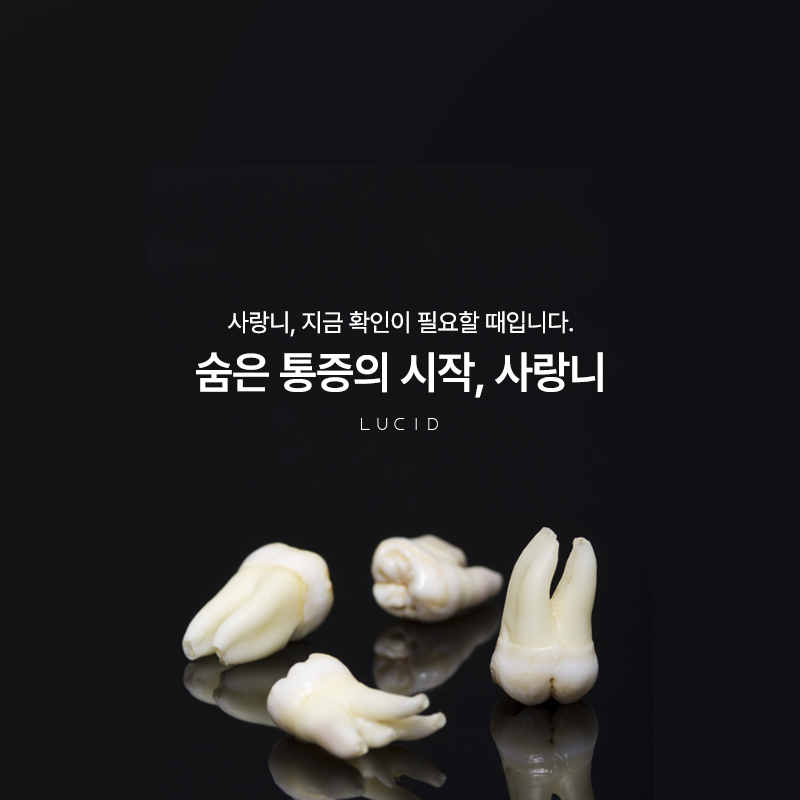
Today, let’s go over useful information you should know about wisdom teeth,
along with cases where extraction is needed and post-treatment care.
What is a wisdom tooth?
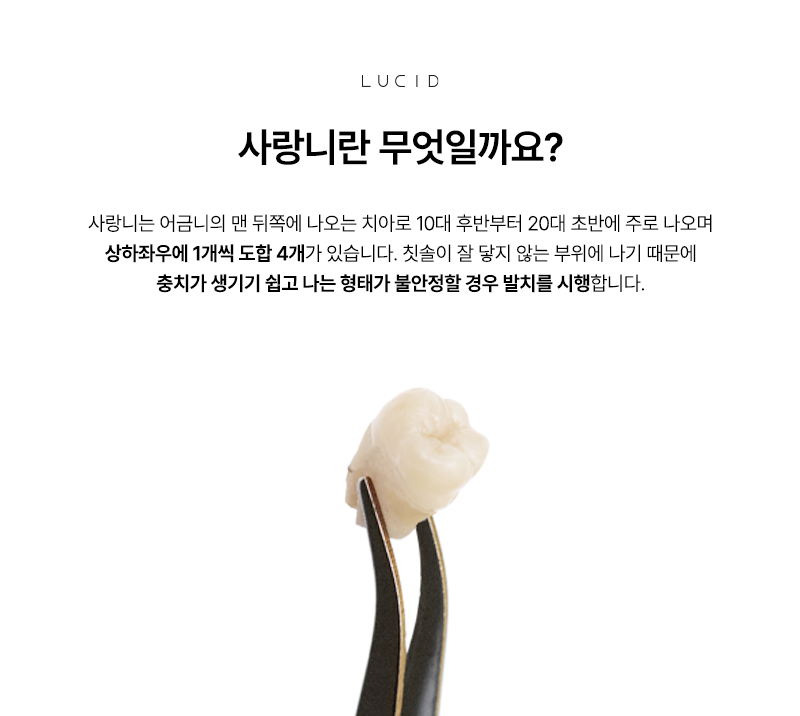
Wisdom teeth are commonly the last molars to appear,
usually making their first appearance in the late teens to early twenties.
They are called "wisdom teeth" because they come in at an age when people begin to understand love,
but in reality, they more often cause discomfort and pain when they erupt.
The main issue is that these teeth rarely come in straight and properly aligned.
If there isn’t enough space in the jawbone, or if the tooth erupts at an angle,
it may remain impacted without breaking through the gum,
or it may press against the adjacent tooth and cause pain and inflammation.
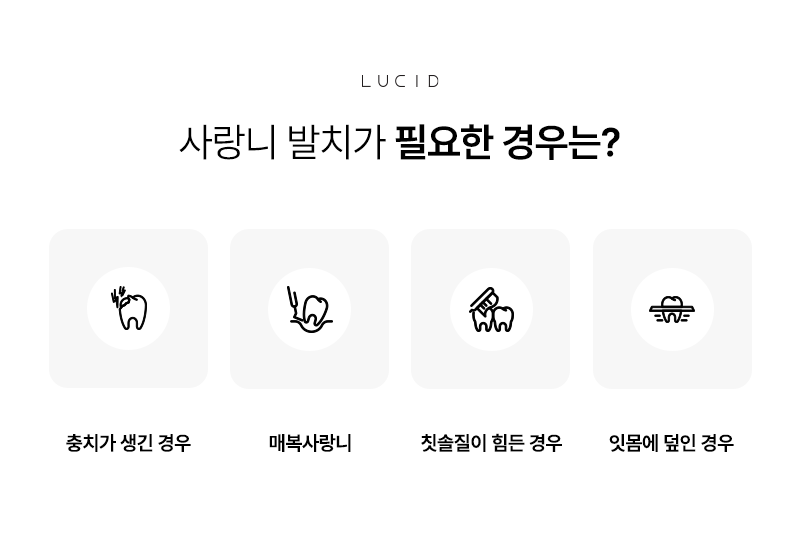
When is wisdom tooth extraction necessary?
Not all wisdom teeth have to be removed.
If a wisdom tooth has no problems and is positioned properly,
there is no need to extract it. However, if any of the situations below apply,
we recommend getting an accurate examination at a Gangnam Station dental clinic.
Wisdom teeth growing sideways
They may push against the front molar, causing cavities in two places
or weakening the gums.
If only a small part is exposed above the gums
Food can easily get trapped between them, and because brushing is difficult,
inflammation can occur repeatedly.
It can also cause bad breath or gum swelling.
If swelling or pain keeps recurring
If the area around the wisdom tooth swells often and throbs with pain,
inflammation may already be progressing.
If left untreated, it can affect the jaw joint or nearby teeth.
If a cyst is seen nearby
If a cyst is visible on an X-ray or CT scan,
it may damage the bone,
so appropriate treatment, including extraction, may be necessary.
Why wisdom tooth extraction requires caution
Wisdom teeth differ from person to person in position and shape.
Also, lower wisdom teeth are often close to the inferior alveolar nerve
(the jaw nerve), so careful diagnosis is essential before extraction.
Rather than simply saying, "It’s time to remove it, so let’s remove it,"
it is safer to decide after confirming the position through CT imaging
and understanding the surrounding structures.
In particular, if inflammation is already severe or pain keeps recurring,
the timing and order of treatment may also need to be adjusted.
All of these processes should be carried out through diagnosis and consultation
that fully consider the patient’s condition.
For those worried about pain
When people think about wisdom tooth extraction, the first thing that comes to mind
is "pain." However, in many cases it is not as severe as people worry,
and today there are various methods that allow the procedure to be done comfortably
without major pain during treatment, thanks to advances in sedation therapy and local anesthesia.
Set your worries aside for a moment and visit a Gangnam Station dental clinic
to check your exact condition.
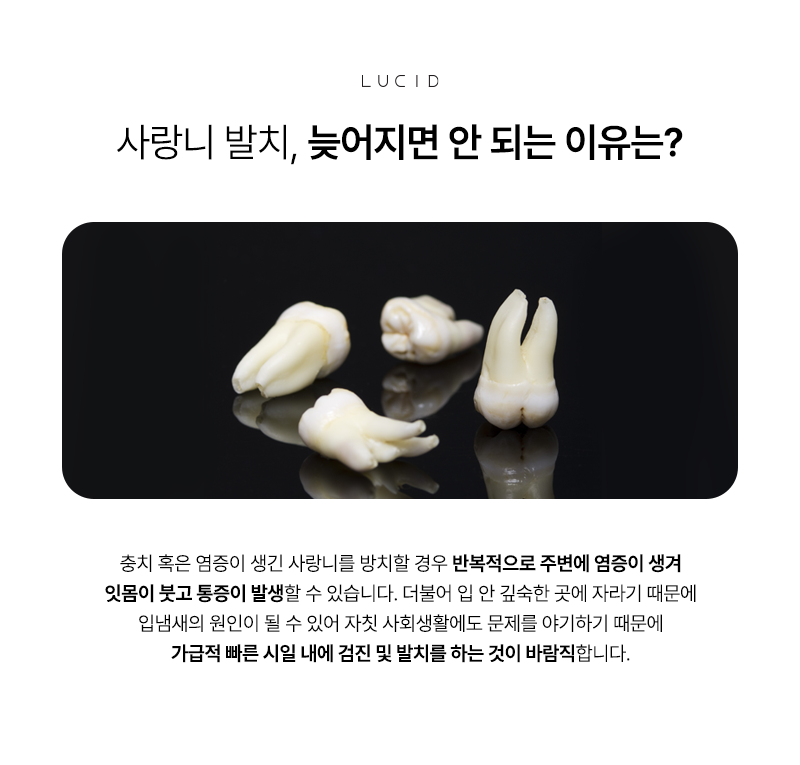
Why shouldn’t wisdom tooth extraction be delayed?
"It doesn’t hurt much yet, so I’ll get it removed later."
Many people say this, but wisdom teeth often cause sudden problems.
Especially when a lower wisdom tooth is lying sideways,
cavities can develop in the front molar as well,
or the situation can progress to one that requires root canal treatment.
Also, as people get older, the bone becomes harder
and recovery slows down, so the early 20s to early 30s
are considered the most appropriate time for wisdom tooth extraction.
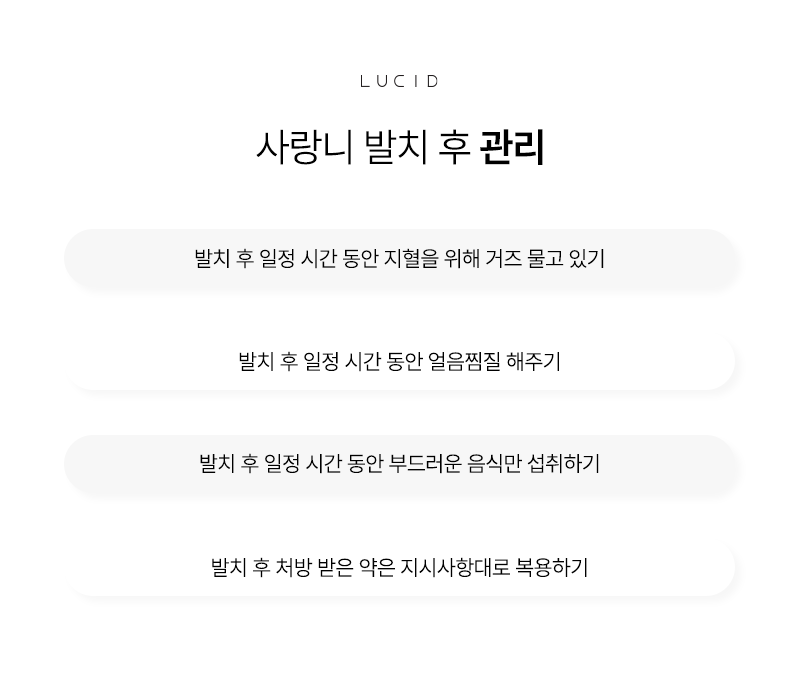
Post-extraction care after wisdom tooth removal
After extraction, the recovery period is the most important.
Please refer to the following.
Bleeding management
Be sure to bite on the gauze for at least 30 minutes.
It is okay if a little blood mixes with your saliva.
Cold compress
Cold compresses are good for the first 1–2 days to help prevent swelling.
Eating
Avoid spicy foods, hot soup, and drinks that require a straw.
Brushing
Do not touch the extraction site, and brush the other areas gently.
No smoking or drinking
Avoid both for at least 3 days.
They can have a major impact on recovery.
Above all, if any unusual symptoms occur, do not make your own judgment,
and be sure to contact the Gangnam Station dental clinic.
A quick response can greatly affect the speed of recovery.
For some people, wisdom teeth pass without any issues,
but for others, they can become pain that disrupts everyday life.
Please do not decide on your own; be sure to check the condition of your wisdom teeth
through a Gangnam Station dental clinic.
At Lucid Dental Clinic, we check the direction of the wisdom tooth,
the root structure, and its relationship with the surrounding nerves before carefully advising extraction only when necessary.
We will help you avoid unnecessary extractions
and not miss the right timing for necessary treatment.
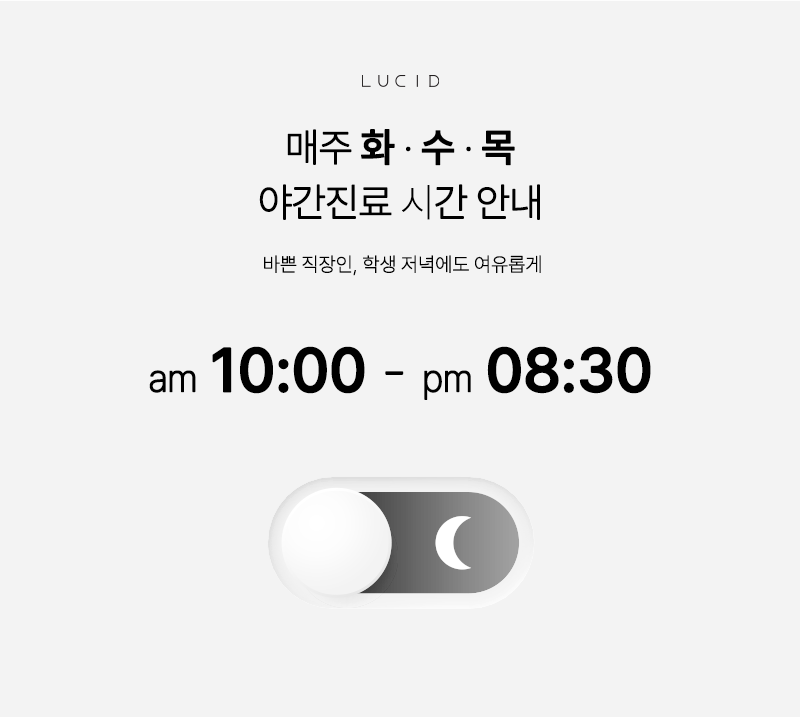
Lucid Dental Clinic
3rd–4th Floors, Coway Building, 606 Nonhyeon-ro, Gangnam-gu, Seoul