Hello. This is Lucid Dental Clinic.
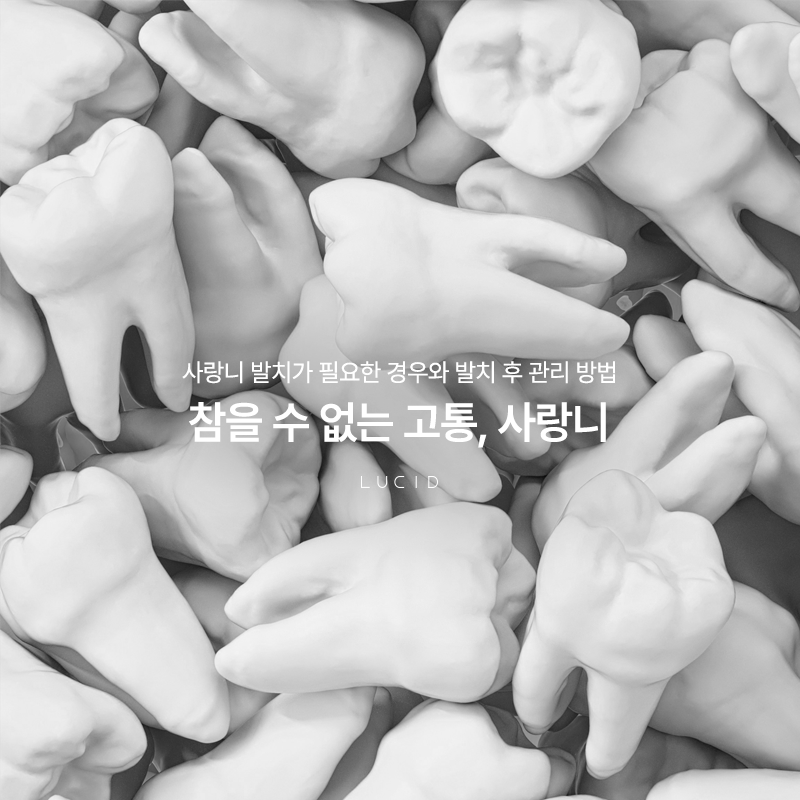
Among dental treatments, there is a word that people unexpectedly come across:
wisdom teeth.
Unlike the eruption timing of ordinary permanent teeth,
this tooth quietly appears at some point after growth has completely finished.
When there are no particular symptoms, you may not even notice it exists,
but once it starts causing problems, it can affect not only the periodontal tissue
but also the surrounding teeth and the structure of the jawbone, so careful observation and judgment are needed.
Rather than being seen as a simple “extra tooth,”
wisdom teeth are also complex teeth whose treatment approach changes depending on an individual’s anatomical structure,
oral hygiene status, and overall dental arch structure.
In this post, we will cover the basics of wisdom teeth,
cases in which extraction should be considered, the procedure before and after treatment,
and frequently asked questions.
What Are Wisdom Teeth?
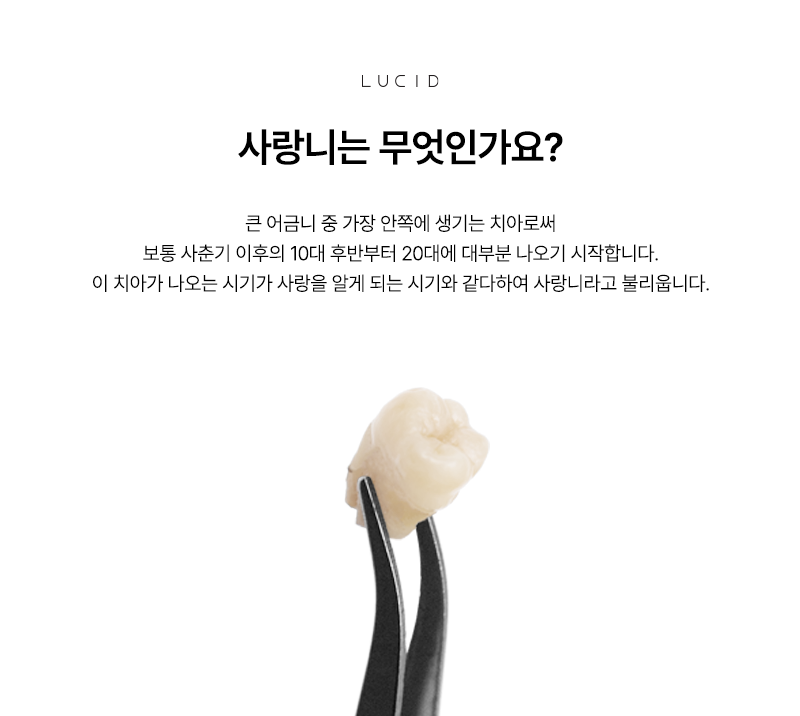
Wisdom teeth are the teeth located at the very back of the molars,
usually beginning to erupt in the late teens to early twenties after puberty.
They are named “wisdom teeth” in the sense that they grow around the time one becomes aware of love,
and in dental terminology they are also called third molars or “wisdom molars.”
Normally, there are a total of four wisdom teeth,
but depending on the person, only one or two may erupt,
or none at all.
They may fail to erupt properly and remain impacted inside the gums,
or they may grow at an angle and push against adjacent teeth.

Cases Where Wisdom Tooth Extraction Is Recommended
Wisdom teeth do not always need to be extracted.
However, extraction is generally considered in the following cases.
- Causing Tooth Damage
If a wisdom tooth grows sideways,
it can press against the second molar in front of it
and damage it. This can also lead to cavities or
gum inflammation in the tooth in front.
- Adverse Effect on Tooth Alignment
As wisdom teeth push the teeth forward, the bite can become misaligned.
After orthodontic treatment, wisdom teeth in particular must be managed carefully to help maintain alignment.
- Possibility of Cyst Formation
A cyst can form around an impacted wisdom tooth.
In some cases, this cyst can worsen the jawbone or
encroach on the roots of other teeth.
- When Close to Nerves
In particular, lower wisdom teeth are often located close to the mandibular nerve canal,
so if they are extracted without a precise diagnosis,
there may be a risk of nerve damage.
Therefore, an accurate diagnosis through CT imaging, etc. is essential.
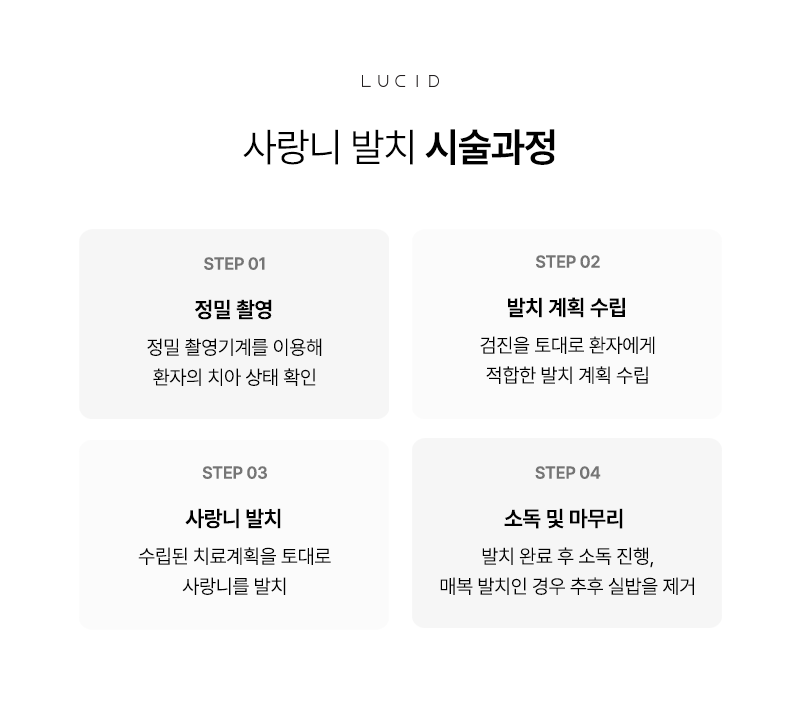
Wisdom Tooth Extraction Procedure
At Lucid Dental Clinic, before extracting wisdom teeth,
we carefully analyze the patient’s condition
and follow a systematic process to ensure safe extraction.
- Detailed Imaging
We use equipment to check the wisdom tooth’s position, angle, and distance from the nerve.
- Extraction Plan
Based on the imaging results, we explain the appropriate extraction timing and method for the patient, as well as precautions.
- Wisdom Tooth Extraction
The tooth is extracted after anesthesia to minimize pain. In the case of impacted wisdom teeth, incision and sectioning extraction may be performed.
- Disinfection and Completion
The extraction site is thoroughly disinfected, and suturing is performed if necessary. If it is an impacted extraction, you will need to return after one week for stitch removal.
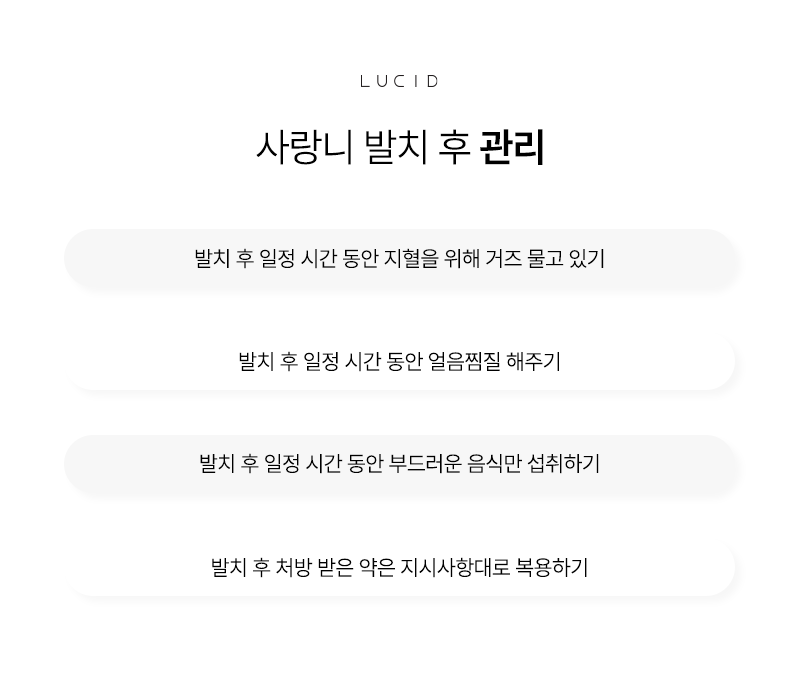
How to Care After Wisdom Tooth Extraction
After wisdom tooth extraction, recovery speed and pain management can affect how inconvenient daily life feels.
Please be sure to follow these care instructions.
▪️For 1–2 hours after extraction, bite down firmly on sterile gauze to stop the bleeding.
▪️Applying an ice pack at 15–20 minute intervals after extraction helps reduce swelling.
▪️For at least one or two days, it is best to avoid hot or hard foods, smoking, and alcohol.
▪️Eat mainly soft foods such as porridge or rice gruel.
▪️Take the prescribed medication as directed, and contact the clinic if you experience the following symptoms.
Wisdom Tooth Q&A Many People Ask About
Q. Do all four wisdom teeth have to erupt?
A. It depends on the person. Some people may only have one or two, and some may not have wisdom teeth at all.
Q. How long do I need to rest after wisdom tooth extraction?
A. After a simple extraction, you can usually return to daily life in about one day, but after an impacted extraction, it is best not to overexert yourself for 2–3 days.
Q. What happens if I leave it unremoved?
A. If it has grown normally without problems, it does not have to be extracted. However, if there are complications such as cavities, inflammation, pain, or cysts, early extraction is recommended.
Q. Is the extraction very painful?
A. Before the procedure, local anesthesia is used to suppress pain as much as possible, and after impacted wisdom tooth extraction, there may be some pain and discomfort, but it can be managed with medication and cold compresses.
Rather than asking “When should it be extracted?”
the important first step is to determine “Is it a condition that must be extracted?”
At Lucid Dental Clinic, we carefully diagnose each patient’s condition,
do not perform unnecessary extractions,
and when treatment is needed, we carry it out in a safe and systematic manner.
If you are dealing with wisdom tooth pain or gum discomfort,
we recommend not hesitating and getting a consultation.
Because once a tooth is damaged, it cannot be restored,
there is a need for the habit of checking and managing it in advance.
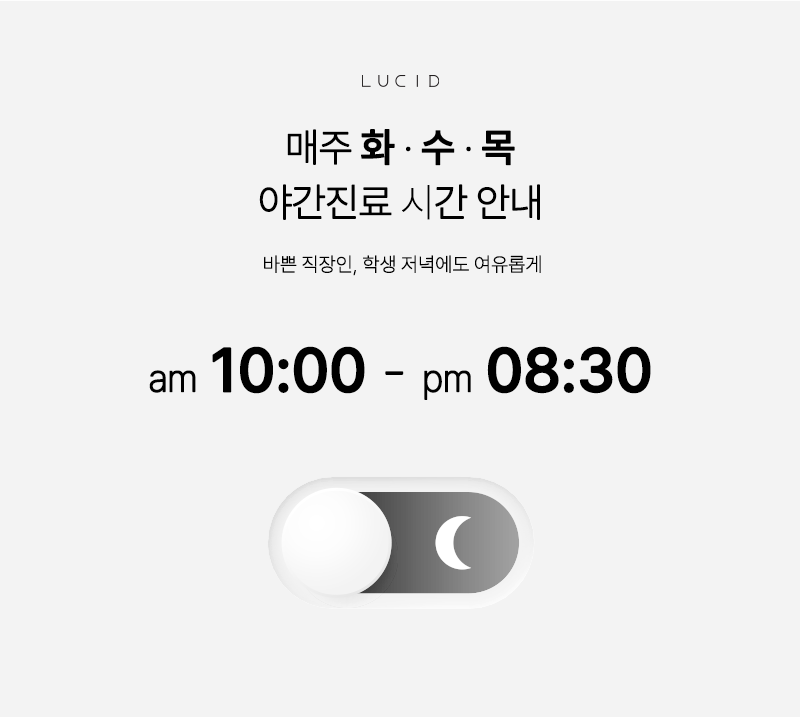
Lucid Dental Clinic
3rd–4th Floors, Coway Building, 606 Nonhyeon-ro, Gangnam-gu, Seoul