
Hello, this is Lucid Dental Clinic.
Among dental treatments, one of the most basic and important
forms of care is scaling.
It may seem like a procedure that simply cleans the teeth,
but scaling plays a very important role in protecting overall
oral health.
Today, we’ll provide a broad overview of when scaling is needed,
the procedure itself, whether it hurts, how often it should be done,
and post-care.
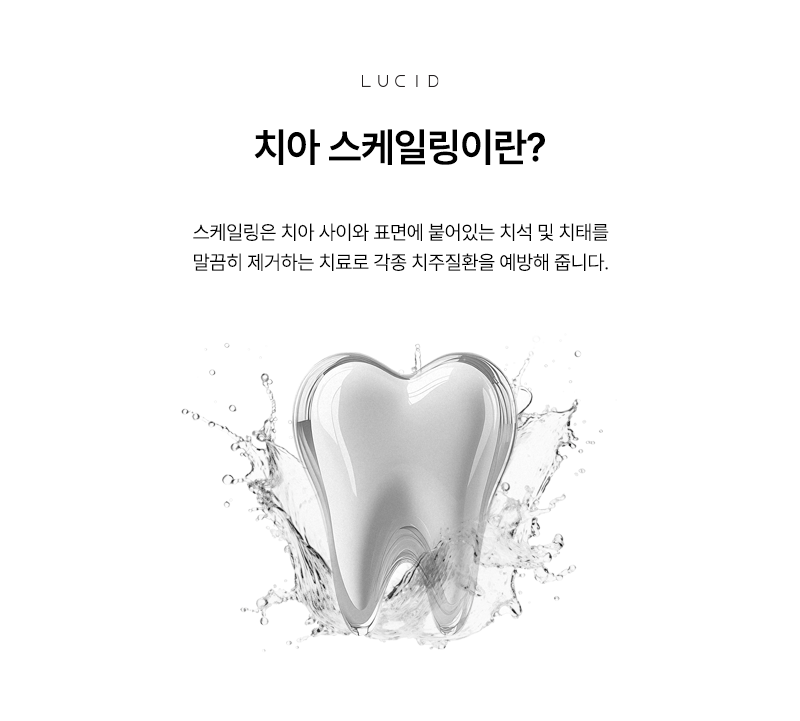
What is scaling?
Scaling is a dental treatment that removes tartar and
plaque accumulated on the tooth surface and below the gums.
Plaque is a sticky substance formed by food debris and bacteria,
and over time it hardens into “tartar.”
This tartar is difficult to remove on your own,
and can only be removed through scaling.

When scaling is absolutely necessary
- Preventing bad breath and periodontal disease
When tartar builds up between the gums and teeth, it can lead to
“gum inflammation” or “damage to the jawbone supporting the gums.”
These gum problems can cause bad breath,
and in severe cases may cause teeth to become loose or fall out.
Regularly removing tartar and plaque through scaling helps protect gum health and prevent bad breath.
- Preventing tooth staining
Tartar is not just a hard, foreign substance;
it also becomes a base that allows staining agents such as
coffee, tobacco, and wine to easily adhere to it. Therefore,
if tartar is left untreated, teeth may turn yellow,
and whitening effects can also diminish.
Scaling is effective at removing tartar, which is a cause of staining,
and helps maintain clean teeth.
- Preserving natural teeth
Periodontal disease gradually dissolves the jawbone that supports
the roots of the teeth, causing the teeth to become loose.
Eventually, no matter how strong a tooth is, if the supporting
structure collapses, it cannot help but fall out.
Regular scaling suppresses the progression of gum disease
and plays an important role in preserving natural teeth for a long time.
How is scaling performed?
- Detailed oral examination
First, a diagnosis is performed to check the condition of the gums
and the extent of tartar distribution.
- Ultrasonic scaling
Ultrasonic vibrations are used to gently remove tartar on the tooth surface and beneath the gums. At this stage, the spaces between the teeth and deep areas of the gums are also carefully cleaned.
- Polishing and disinfection
After tartar removal, the tooth surface is polished smooth,
and if necessary, a disinfectant is applied to finish the procedure.
Polishing is an important step that helps plaque adhere less in the future.
Does scaling hurt?
Whether scaling hurts can vary depending on the condition
of the gums and the amount of tartar.
If gum inflammation is severe or a lot of tartar has built up,
it may feel sensitive and bleeding may occur.
However, when the gums are healthy, most people experience only
mild discomfort, and there is almost no pain.
If necessary, the procedure may be performed after local anesthesia,
so there is no need to worry too much.

How often should you get scaling?
Scaling is more than just cleaning the teeth;
it is an important way to maintain gum and oral health.
It is best to receive it regularly,
and generally scaling is recommended once every 6 months to 1 year.
However, depending on an individual’s oral condition or lifestyle habits,
there are cases where the scaling interval should be shorter.
▪️People who frequently develop gum inflammation
▪️People wearing orthodontic appliances or receiving implant treatment
▪️People who often notice bad breath
Even if you do not notice it yourself,
when tartar builds up inside the gums, inflammation can easily begin.
At Lucid Dental Clinic, when you visit,
we provide guidance on a scaling schedule tailored to each patient’s oral condition through a detailed examination.
With regular care alone, you can protect the health of your teeth and gums,
so don’t miss it.

Precautions after scaling
▪️Avoid hot or irritating foods
Your gums may be sensitive after the procedure, so it is best to eat soft foods for a few days.
▪️Do not brush too aggressively
Just because there is bleeding does not mean you should brush harder!
Gentle and thorough brushing is important.
▪️Temporary sensitivity
You may temporarily feel sensitivity to cold water,
but in most cases it subsides within 1 to 2 days.
▪️Regular care
Even after scaling, you need to continue proper brushing, flossing,
and using mouthwash to maintain the effects for longer.
Scaling is not simply about cleaning the tooth surface;
it is a key method for fundamentally maintaining the health of the gums and teeth.
Regular scaling is an important routine that leads to the prevention of bad breath,
prevention of periodontal disease, maintenance of tooth color,
and preservation of natural teeth.
At Lucid Dental Clinic, we carefully take care of your dental health
with precise scaling tailored to each person’s oral condition.
Please visit us anytime for a consultation.
Lucid Dental Clinic
3rd–4th Floors, Coway Building, 606 Nonhyeon-ro, Gangnam-gu, Seoul