

Hello, this is Lucid Dental Clinic.
Have you ever noticed bleeding when brushing your teeth, or lately felt that your teeth are unusually sensitive?
Or if you feel that your breath has gotten worse for no clear reason,
or that your teeth look longer than before,
this may be an early sign of 'gum disease.'
Today, we’ll take a step-by-step look at what 'gum disease' is,
why it should not be ignored,
and what daily habits can help prevent it.
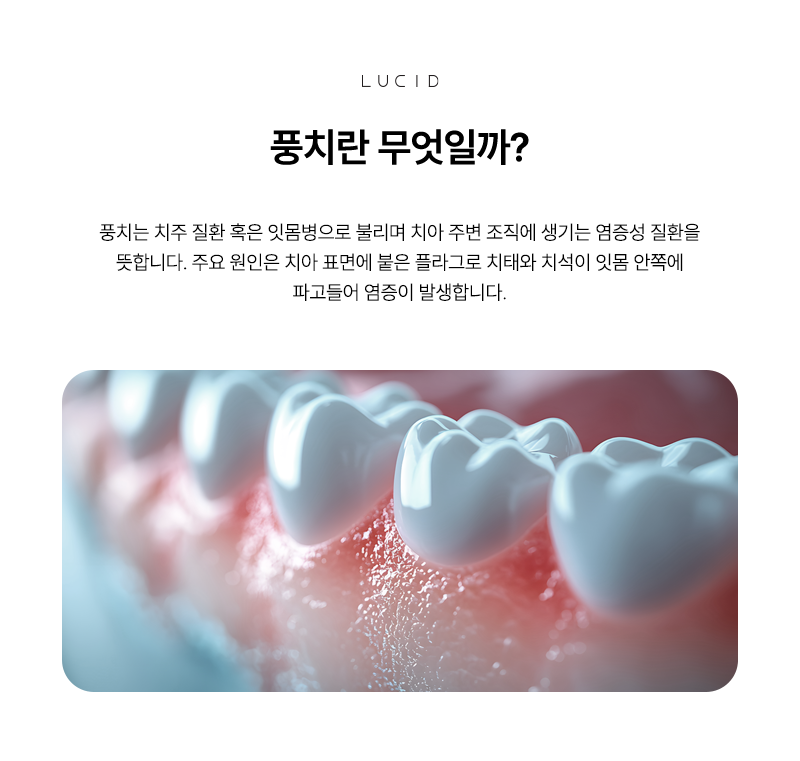
What is gum disease?
Gum disease is an inflammatory condition commonly called
'gum disease' or 'periodontal disease.'
It mainly affects the gums and bone that support the teeth,
and as it progresses, the teeth may become loose or,
in severe cases, fall out.
The biggest causes are 'plaque' and 'tartar.'
When plaque formed from food debris is not removed,
it hardens into tartar,
and as this tartar penetrates deeper into the gums,
it causes inflammation.

Typical symptoms of gum disease that come quietly
In the early stages, gum disease progresses without pain,
so it is often discovered late.
If you have any of the symptoms below, it is a good idea to have a dental checkup.
▪️Your gums bleed when brushing or using dental floss
▪️Your gums gradually recede and the tooth roots begin to show
▪️Your teeth feel sensitive when eating cold or hot foods
▪️Bad breath does not go away easily
▪️Your teeth feel slightly loose when chewing
In this way, gum disease can start with symptoms that are easy to overlook in daily life
and develop into a chronic condition that affects even the bone supporting the teeth.
Why can ignoring gum disease lead to tooth extraction?
As periodontitis progresses, the bone around the teeth gradually begins to break down.
When the bone is lost, it can no longer firmly support the teeth,
and the looseness eventually becomes severe.
In severe cases, it becomes difficult to maintain natural teeth,
which can lead to extraction.
It may sound frightening, but in fact gum disease is one of the leading conditions that causes more tooth loss than cavities.
However, the good news is that if it is detected and managed early,
it is a condition that can be sufficiently prevented and controlled.

Lifestyle habits to prevent gum disease
- Regular scaling
Since tartar cannot be removed with normal brushing alone,
it is important to manage tartar through regular scaling.
- Use dental floss and interdental brushes
Because brushing alone makes it difficult to clean between the teeth,
try to make a habit of using dental floss or interdental brushes at least once a day.
- Check prosthetic appliances
If you use prosthetic appliances such as implants, crowns, or bridges,
you should also regularly check and care for the areas around them.
This is because inflammation can also start in areas that are not visible.
- Quit smoking and moderate alcohol consumption
Smoking is one of the major factors that interferes with the healing of periodontal tissue
and worsens inflammation.
Also, alcohol can affect gum health,
so it is best to reduce it.

The correct way to brush your teeth to prevent gum disease
▪️Brush at a 45-degree angle so the bristles gently touch the gums
▪️Also brush other parts of the mouth, such as the tongue and the palate
▪️Use dental floss or interdental brushes together to remove food debris
▪️If the interdental brush does not fit well, switch to a smaller size
▪️Brush thoroughly at least twice a day for at least 2 minutes
Because gum disease progresses slowly and invisibly,
it is easy to brush it off by thinking, “It’ll be fine,”
but if left untreated, the results can be serious.
Along with proper oral care in daily life,
regular dental checkups are the most important way to detect and manage it early.
At Lucid Dental Clinic, we provide personalized oral care and prevention programs
to help protect your gum health.
If you feel even the slightest discomfort,
please feel free to visit us anytime.
Lucid Dental Clinic’s sincerity for your healthy smile remains the same.

Lucid Dental Clinic
3rd–4th Floors, Coway Building, 606 Nonhyeon-ro, Gangnam-gu, Seoul