Hello. This is Lucid Dental Clinic.
Even if you brush your teeth thoroughly three times a day, have you ever still felt like something wasn’t quite fresh?
Especially on days when you have to be close to other people,
bad breath or that unpleasant feeling in your mouth can seem even more noticeable.
What can help in situations like this is mouthwash.
Today, we’ll take a close look at what mouthwash does,
how to use it, and how to choose a product that suits you.
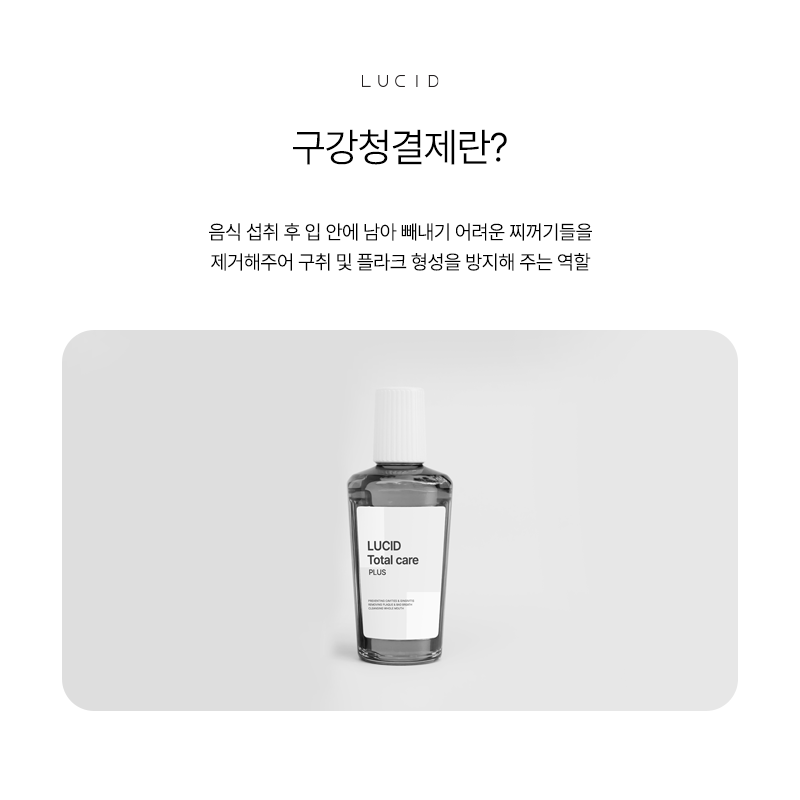
What Is Mouthwash?
Mouthwash is an auxiliary oral hygiene product that reaches the hard-to-clean areas of the mouth that a toothbrush cannot easily reach, helping reduce bacteria in the mouth and suppress food debris and plaque formation.
Because it manages tiny particles and bacteria that are not removed by physical brushing alone through chemical action, it can be useful for people concerned about bad breath or oral inflammation.

Main Effects of Mouthwash
- Bad breath removal
It helps maintain a fresh oral state by suppressing anaerobic bacteria, the main cause of bad breath.
- Relief of oral inflammation
It may be effective in lowering the risk of inflammatory conditions such as gingivitis and periodontitis.
- Plaque suppression
Plaque that sticks to the surface of the teeth can easily cause cavities, and mouthwash helps suppress plaque formation.
- Maintaining a fresh feeling in the mouth
It can help keep your mouth feeling fresh even after meals or after long periods of conversation. It is especially useful before going out or before meetings.

How to Use Mouthwash
- Shake before use
Shake well so the contents mix evenly.
- Check whether dilution is needed
Some highly concentrated products need to be mixed with water, so be sure to check the label.
- Gargle for 30 seconds
Put an appropriate amount in your mouth and slowly gargle all around for at least 30 seconds.
- Spit it out without swallowing
After use, be sure to spit it out, and if possible avoid drinking water or eating for about 30 minutes.
When Is It Best to Use Mouthwash?
▪️After meals or after brushing, as a finishing step
Using mouthwash after brushing may help the bacteria-suppressing effect last longer.
▪️Right after waking up in the morning
This is a suitable time to reduce bacteria that have accumulated overnight in a dry mouth.
▪️Before an important appointment
In situations where you are sensitive about bad breath, it can also provide psychological reassurance.

Things to Keep in Mind When Using Mouthwash
- Avoid excessive use
Using it once or twice a day is appropriate, and using it too often may suppress even the normal bacteria in the mouth and make the mouth drier.
- Be careful if you have sores in your mouth
Products containing alcohol can irritate the oral mucosa, so caution is needed.
- Stop immediately if any unusual reaction occurs
If you experience stinging, pain, dry mouth, or similar symptoms, stop using it and consult a specialist.
- Check the ingredients when choosing a product
There are various types, such as alcohol-free products, products for dry mouth, and products with enhanced antibacterial functions, so it is important to choose one that fits your oral condition.
Should You Always Use Mouthwash for Bad Breath?
Just because you have bad breath does not mean you should always use mouthwash.
Bad breath may be a simple oral hygiene issue, but it can also have systemic causes such as gastrointestinal disorders, tonsils, or rhinitis.
Therefore, mouthwash should be used only as an auxiliary management method, and basic brushing, flossing, and regular dental checkups should come first.
How Do You Choose the Right Mouthwash for You?
▪️If you are worried about bad breath?
Products specialized for suppressing bad breath, such as those containing antibacterial ingredients, zinc, or chlorhexidine
▪️If you dislike irritation?
A mild alcohol-free product is suitable
▪️If your gums often swell?
Consider a product containing ingredients that help relieve gingivitis
▪️If your mouth is often dry?
Choose a product containing moisturizing ingredients
Mouthwash is a very useful product when you want to keep your mouth feeling fresher.
However, it is important to understand its purpose and precautions well, and choose one that suits your oral condition.
At Lucid Dental Clinic, we provide guidance on proper oral care habits based on your oral condition, so we hope you will help build a healthy oral environment through regular checkups.

Lucid Dental Clinic
3rd–4th Floors, Coway Building, 606 Nonhyeon-ro, Gangnam-gu, Seoul