Hello. This is Lucid Dental Clinic.
Have you ever felt a dull ache deep inside your mouth all of a sudden,
or felt a heavy pulling sensation at the tip of your jaw while chewing food?
Or while looking at your teeth in the mirror,
have you ever noticed something coming up at an angle
from the very back molar area?
At times like these, the tooth that many people think of first
is the 'wisdom tooth.'
However, a wisdom tooth is more than just
'a tooth that needs to be removed eventually.'
For some people, it may be a tooth that stays with them for life
without causing any problems, while for others it can become
a source of sudden inflammation, pain, and temporomandibular joint problems.
In addition, because the timing, shape,
and pain pattern of wisdom teeth differ from person to person, it is more important than anything else
to check and understand the condition of your own wisdom tooth directly through
Gangnam Station Dental Clinic rather than relying vaguely on what others say.
Today, at Gangnam Station Dental Clinic,
- What a wisdom tooth is
- The typical situations in which extraction is needed
- Why extraction difficulty differs from person to person
- The various forms of wisdom teeth and how to distinguish wisdom tooth pain
We will provide practical information based on these topics.
If you are wondering,
'Should I get it removed now?'
'Can I just leave it for now?'
this article may serve as a clear standard for making your treatment decision.
What is a wisdom tooth?
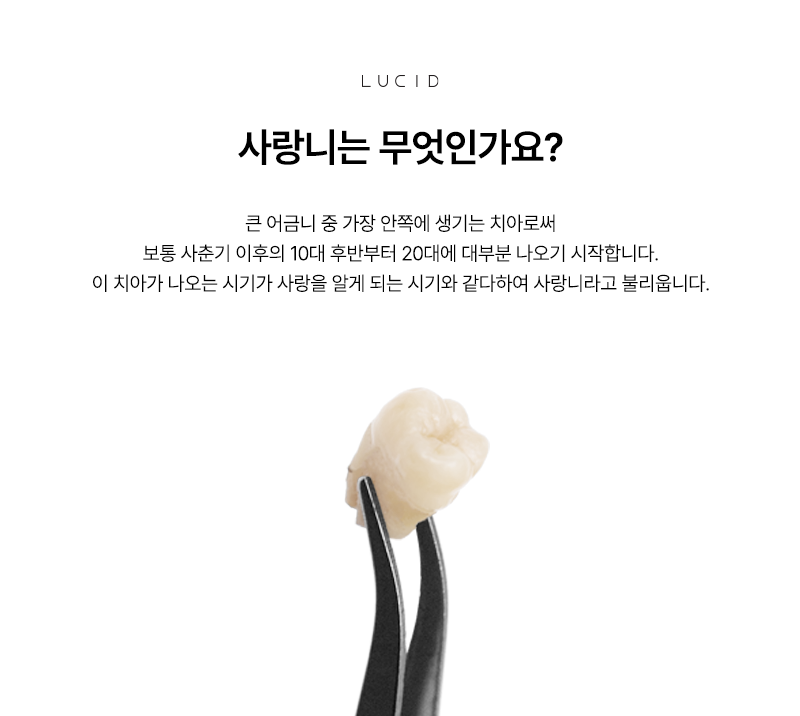
A wisdom tooth is the third molar located at the very back,
and it usually begins to erupt in the late teens to early twenties.
Depending on the size of the individual jawbone and the state of the teeth,
all four may erupt, or only one or two may appear,
or they may not erupt at all.
The problem is that wisdom teeth rarely grow in a normal position
or at a normal angle.
As they begin to grow at an angle or in an impacted form beneath the gums or bone
within an oral structure with limited space,
brushing becomes difficult and a structure is created where bacteria can easily accumulate.
Because of this, you should not overlook the fact that they can be the cause of various oral diseases,
such as cavities, gum inflammation,
damage to the roots of nearby teeth, and jaw pain.
What matters more than simply whether a wisdom tooth has erupted or not is
checking whether it is growing properly and whether it is causing problems,
and managing it accordingly.

In these cases, wisdom tooth extraction is needed
Wisdom teeth do not necessarily have to be removed only when they hurt;
in many cases, extraction is needed in advance to maintain oral health. If any of the following situations apply,
you should consider wisdom tooth extraction.
If cavities have developed
Because of their location, toothbrushes do not easily reach them, so cavities develop easily,
and treatment is also difficult.
If the tooth is lying down
It may push against the adjacent tooth or irritate the inside of the jawbone,
causing pain or malocclusion.
If brushing is difficult
If it is located deep inside the mouth and cannot be properly cared for,
bacteria can easily proliferate.
If it is covered by the gums
Gum inflammation can recur repeatedly, and it may be accompanied by pain and swelling.
Why does wisdom tooth extraction difficulty
differ from person to person?
The difficulty of wisdom tooth extraction is not determined simply by
whether it is inside or outside.
Various factors work together.
The eruption direction of the wisdom tooth
If it is growing straight, it may end with a simple extraction,
but if it is growing horizontally, bone removal may be necessary.
The position of the wisdom tooth
The deeper it is embedded inside the jaw,
the harder it is to secure a field of view and the more difficult access becomes.
The distance between the wisdom tooth and the nerve
In particular, lower wisdom teeth are close to the inferior alveolar nerve,
so the possibility of nerve damage must be carefully considered.
The shape of the tooth roots
If the roots are curved or split into multiple branches,
they may need to be removed in sections.
As such, while some people can have a wisdom tooth removed quite simply,
others require meticulous treatment close to surgery, so establishing a treatment plan through a detailed examination
is the most important thing.
What kinds of wisdom teeth are there?
Wisdom teeth are divided into several types depending on their angle and position.
The representative types are as follows.
Vertical impacted wisdom tooth
A case where it is growing correctly but is hidden beneath the gums or jawbone
Horizontal impacted wisdom tooth
A form that grows lying sideways and pushes the front tooth outward
Angled impacted wisdom tooth
A tooth growing at an angle of 45 degrees or more
Partially impacted wisdom tooth
Only part of the tooth is exposed, while the rest is covered by the gums
Fully impacted wisdom tooth
The entire tooth is buried within the gums or jawbone
Depending on the type, the extraction method and difficulty differ,
and the procedure time may be longer.
Pain caused by wisdom teeth,
how is it different from other pain?
Wisdom tooth pain can show a different pattern from 일반 cavities or gum pain.
The typical features are as follows.
The pain starts at the very back of the mouth.
You may feel a dull ache much deeper than a regular molar,
near the jaw joint.
The pain worsens when chewing or opening the mouth
Especially when the gums are covering the tooth or inflammation is present,
even opening the mouth can feel uncomfortable.
Intermittent pain that appears suddenly and then disappears
At first, it may hurt for a few days and then get better,
but if left untreated, it repeats.
As such, wisdom tooth pain can appear very differently depending on location, direction, and condition,
and it can be difficult to distinguish it from ordinary toothache.
For an accurate diagnosis, visiting Lucid Dental Clinic and taking an X-ray are essential.
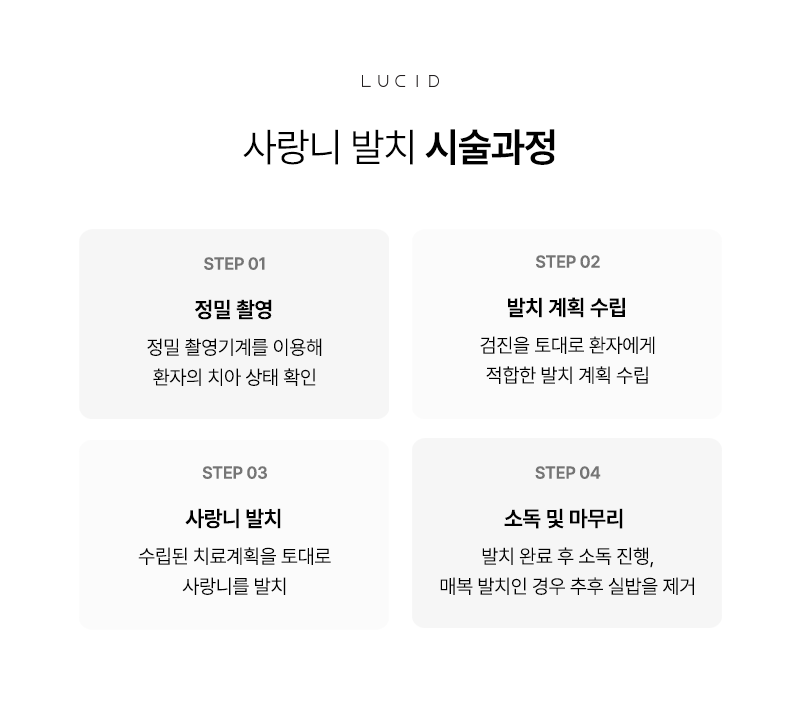
How is wisdom tooth extraction performed?
At Gangnam Station Dental Clinic, wisdom tooth extraction is carried out systematically in the following order.
- Detailed examination
Check the wisdom tooth's location and its distance from the nerve through detailed imaging equipment
- Treatment planning
Explain the level of difficulty and the method to the patient based on the examination results
- Wisdom tooth extraction
Perform simple extraction or surgical extraction
- Regular checkups
Remove stitches if necessary and check the recovery status
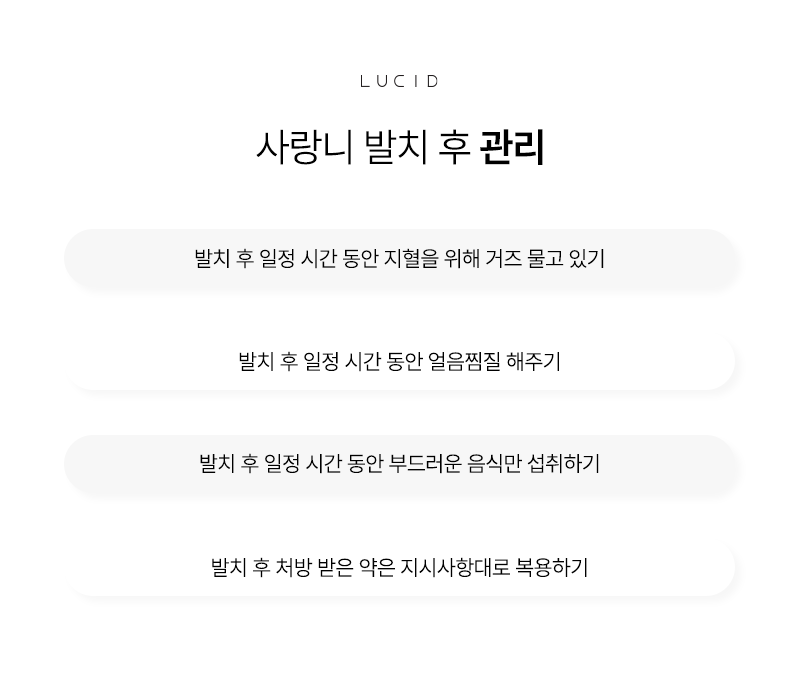
After wisdom tooth extraction, care that helps recovery is important
▪️To help stop bleeding, do not spit out saliva or blood; swallow them instead
▪️If there is swelling or pain, apply cold compresses consistently within 24 hours
▪️Avoid spicy or hot foods, and eat soft, cold foods
▪️No drinking, smoking, sauna use, or strenuous exercise for at least 3 days
▪️After meals, rinse your mouth lightly to keep it clean
Wisdom teeth are teeth that anyone can have erupt,
but depending on where and how they grow, their direction,
their distance from the nerve, and the surrounding environment,
their effects and the treatment needed can be completely different from person to person.
Sometimes they may pass without any problems,
but in some cases they can damage nearby teeth and lead to much bigger problems than expected,
so they should not be taken lightly.
In particular, because it is difficult to recognize a problem until pain develops,
wisdom teeth require more careful observation and regular checkups.
It is most important to recognize that they are not simply
'teeth that will have to be removed someday,' but teeth that must be managed appropriately
when needed and in the proper way.
At Lucid Dental Clinic, we precisely assess the location of wisdom teeth
and their relationship to the nerves, establish customized treatment plans
based on each patient's oral condition, avoid unnecessary extractions,
and carefully manage recovery after treatment as well.
If you are experiencing discomfort from wisdom tooth pain,
or if you are planning future orthodontic or prosthetic treatment,
we recommend checking the condition of your wisdom teeth first.
If you miss the right timing, a wisdom tooth can go beyond simple extraction
and develop into a larger treatment issue.
Now may be the best time.
Lucid Dental Clinic will help you make that decision safely.
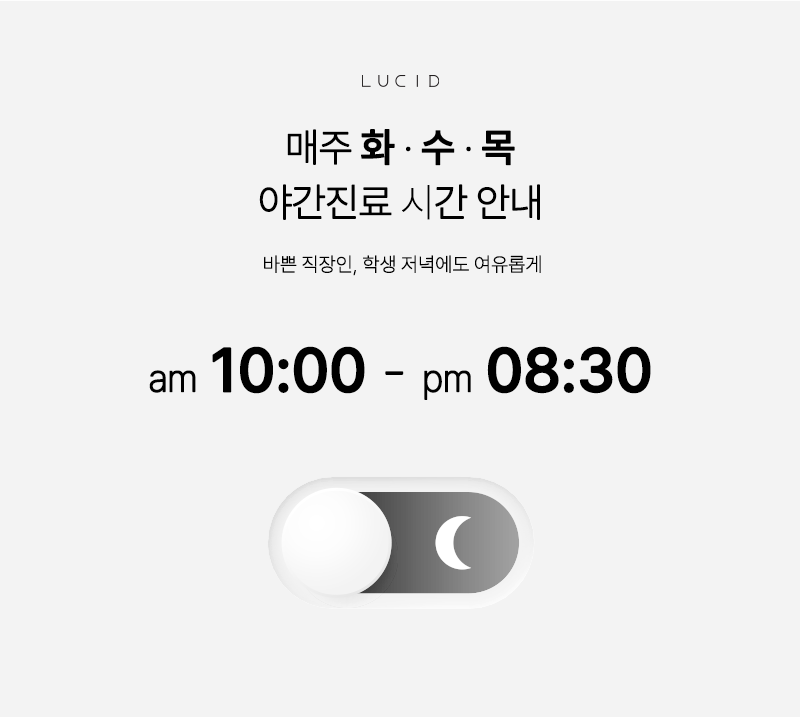
Lucid Dental Clinic
3rd–4th Floors, Coway Building, 606 Nonhyeon-ro, Gangnam-gu, Seoul