Hello, this is Lucid Dental Clinic.
Cavities are a common oral disease that many people experience at least once. However, if left untreated, they can lead to serious problems that may even result in tooth loss, so early detection and treatment are important.
Among those who visit for cavity treatment in Nonhyeon-dong, many come because they notice a small black spot on a tooth or feel sensitivity when eating cold or hot foods.
Today, we will take a step-by-step look at how cavities form and progress, what kind of treatment is needed, and how to manage and prevent them after treatment at Lucid Dental Clinic.
What is a cavity?
A cavity begins when food debris combines with bacteria in the mouth to create acid, and this acid damages the enamel, the hard outer layer of the tooth.
Once the enamel is destroyed, the inner dentin is also damaged, and from that point, sensitivity begins to appear.
A cavity starts as a small hole, but as it deepens, it can eventually reach the nerve. This is why cavity treatment in Nonhyeon-dong is important.
When a cavity is still in its early stage, it can be treated relatively easily, but if it is delayed, the scope of treatment becomes wider and the recovery process takes longer.
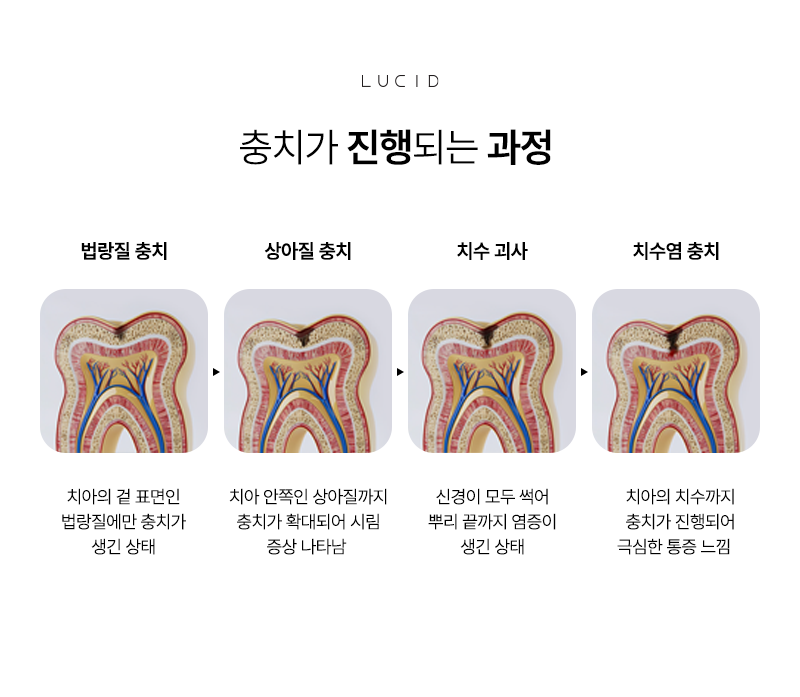
Stages of cavity progression
A cavity is not simply a matter of 'a tooth has decayed.'
Symptoms and treatment methods differ depending on the stage of progression.
-
Enamel cavity: An early cavity that has formed only in the enamel on the tooth surface. There is almost no pain, and it may appear only as a small visible black spot.
-
Dentin cavity: When the cavity spreads inside the tooth and reaches the dentin, sensitivity and intermittent pain may occur.
-
Pulp cavity: If inflammation spreads to the nerve tissue, severe pain appears, and root canal treatment may be needed.
-
Root inflammation: If nerve damage is limited and inflammation spreads to the root tip, gum swelling, bad breath, and severe pain may accompany it.
Because cavities become more complex as time passes, it is advisable to proceed with cavity treatment in Nonhyeon-dong as early as possible.
Cavity treatment methods
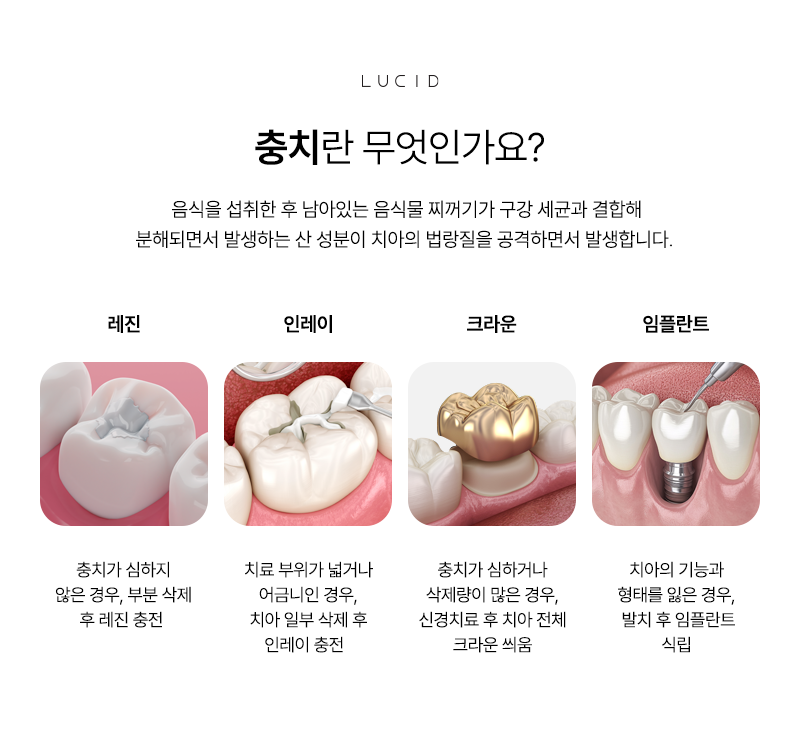
The cavity treatments performed at Lucid Dental Clinic include several methods depending on the extent of the damage.
▪️Resin treatment
Applied to early cavities. After removing the decayed area, it is filled with a resin material similar in color to the tooth to restore a natural appearance.
▪️Inlay treatment
Mainly used when the cavity area is wide or in molars that endure strong chewing force. A custom-made prosthetic is inserted after part of the tooth is removed.
▪️Crown treatment
Used when the cavity is severe and most of the tooth has been damaged. After root canal treatment, a crown is placed to protect the remaining tooth.
▪️Implant
If the cavity has progressed too far to save the tooth, implant treatment may be needed after extraction to place an artificial root.
In other words, cavity treatment cannot be definitively said to have 'the best' method; it varies depending on the patient's condition and the depth of the cavity.
When receiving cavity treatment in Nonhyeon-dong, it is important to find the method that is right for you through sufficient consultation with a specialist.
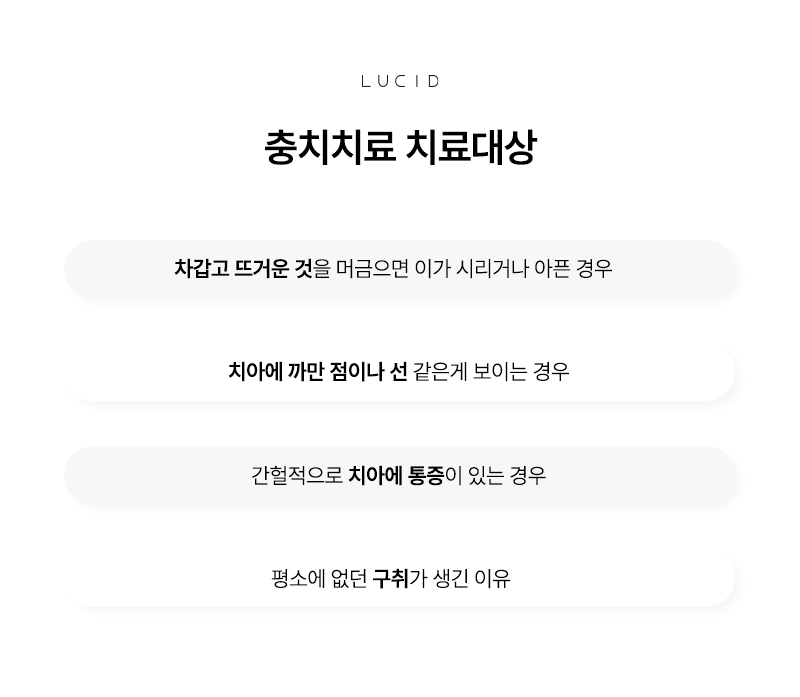
When cavity treatment is needed
If you have the following symptoms, you may suspect a cavity.
▪️Sensitivity in the teeth when eating cold or hot foods
▪️Black spots or lines visible on the tooth surface
▪️Bad breath that was not present before
▪️Intermittent tooth pain
If you notice these symptoms, it is a good idea to visit Lucid Dental Clinic early for an examination.
In particular, among patients seeking cavity treatment in Nonhyeon-dong, many delay treatment thinking, 'It should be fine because there is almost no pain,' only to later need more extensive treatment.
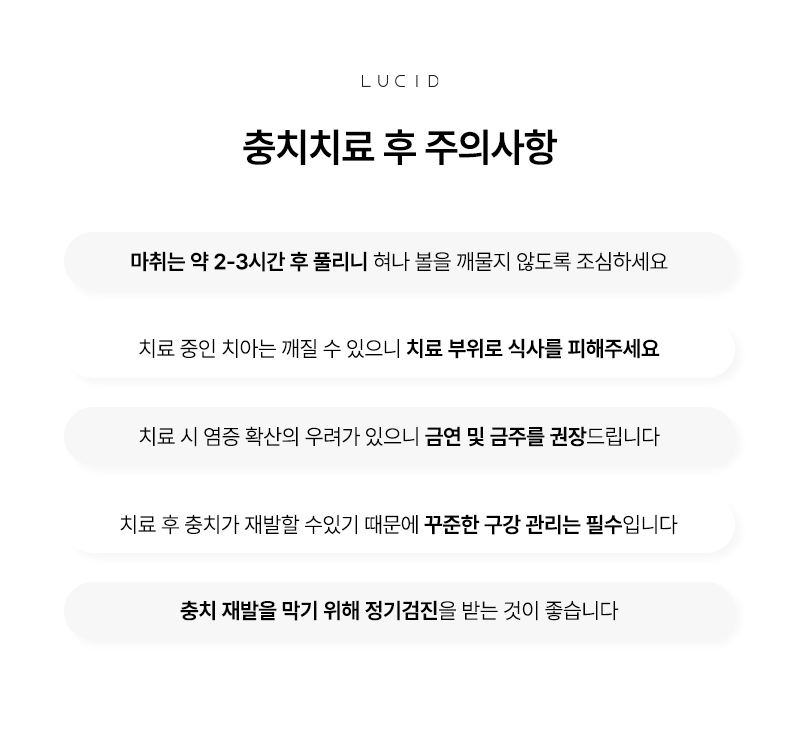
Precautions after cavity treatment
Treatment being finished does not mean all care is over. After cavity treatment, you should keep the following in mind.
▪️Anesthesia usually wears off after 2 to 3 hours, so be careful not to bite your tongue or cheek during this time.
▪️The treated tooth may be temporarily weak, so it is better to avoid hard foods.
▪️Smoking and drinking can interfere with recovery, so they should be avoided as much as possible.
▪️Because cavities can recur, consistent oral care and regular checkups are necessary.
Frequently asked questions
Q. Can I eat right after cavity treatment?
A. It is better to avoid eating until the anesthesia wears off. While numb, you may bite your cheek or tongue because sensation is reduced.
Q. My tooth feels sensitive after treatment—is that okay?
A. Temporary sensitivity may occur immediately after treatment. It usually improves over time, but if the symptoms persist for a long time, a return visit is recommended.
Q. Can cavities happen again?
A. New cavities can form even in areas that were not previously treated. Therefore, proper brushing and regular checkups are essential after treatment.
Prevention is always simpler and less expensive than treatment.
▪️Brush properly three times a day and use dental floss / interdental brushes
▪️Reduce intake of sweets and carbonated drinks
▪️Manage tartar through regular scaling
▪️Detect cavities early through regular checkups at Lucid Dental Clinic
The most important thing to avoid cavity treatment is your daily habits. Small differences in habits are the secret to protecting your dental health for a long time.
Cavities are common, but they are by no means something to take lightly.
If you feel even a small amount of discomfort, the safest option is to visit Lucid Dental Clinic and get it checked. If treated at an early stage, it can be managed simply, but if left untreated, it can lead to crown treatment or even implants.
Lucid Dental Clinic develops appropriate treatment plans by comprehensively considering each patient's oral condition and lifestyle habits.
Cavity treatment is not simply a process of filling a decayed tooth; it can be the starting point for protecting your future oral health.
Cavity treatment in Nonhyeon-dong is centered on early diagnosis and consistent care. If you pay a little attention to your daily habits, you will be able to protect healthy teeth and a bright smile for a long time.
Lucid Dental Clinic
3rd and 4th floors, Coway Building, 606 Nonhyeon-ro, Gangnam-gu, Seoul