
Hello. This is Lucid Dental Clinic.
Many patients who visit the dental clinic ask questions such as:
"Do I really need to get scaling?"
"Is it bad for my teeth if I do it too often?"
Scaling is one of the most basic and important forms of care for protecting the health of your teeth and gums,
but without accurate information, people often end up worrying unnecessarily.
Today, at our Nonhyeon-dong dental clinic, we will go over the need for scaling,
its frequency, and the reactions that may appear after the procedure.
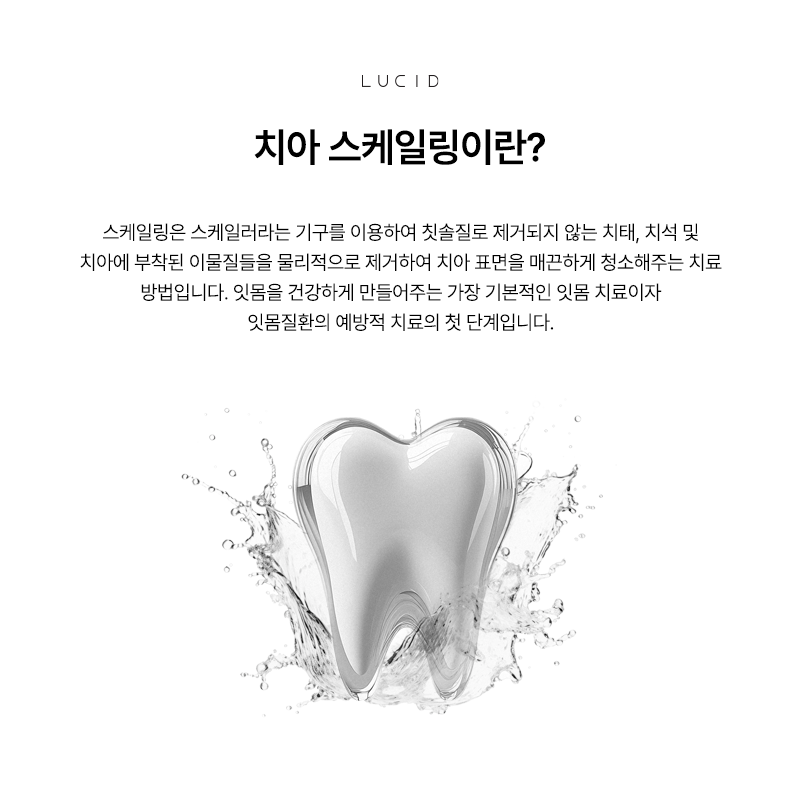
What is scaling?
Scaling is a preventive treatment that helps maintain oral health by removing tartar and bacterial film
that have built up on the tooth surface and around the gums.
Tartar that cannot be completely removed with brushing or flossing becomes harder over time,
and this can lead to gum disease.
Scaling is the process of physically removing this tartar,
helping keep the gums in a healthy state.

Reasons to get scaling
- To preserve natural teeth for as long as possible
Teeth are difficult to restore to their original condition once they have been damaged.
The most important goal we value in Nonhyeon-dong dental treatment
is to preserve natural teeth for as long as possible.
However, when tartar builds up, the gums swell, and even the bone
that supports the teeth can be affected. By removing tartar and
bacterial film through scaling, the gums can remain stable without inflammation,
and the teeth can be held firmly down to the roots.
➡️ In the end, scaling is not a treatment that directly makes
teeth "stronger," but it plays an important role in preserving natural teeth
because it is the most basic care for maintaining healthy gums and bone
around the teeth.
- Improving bad breath
Bad breath is not simply caused by insufficient brushing.
When bacteria remain, they break down proteins and produce volatile
substances, which become that distinctive unpleasant odor.
In particular, tartar and food debris stuck between teeth are often
sources of this smell. When scaling is done, debris and tartar hidden around
the teeth and along the gum line are removed, reducing bacteria that cause odor.
➡️ However, not all bad breath can be solved by scaling alone.
Bad breath can also be caused by other factors such as stomach issues,
tonsil problems, or nasal conditions, so it is important to identify the cause accurately.
- Expectation of reduced tooth staining
Highly pigmented drinks such as coffee▪️black tea▪️cola▪️and wine,
as well as smoking habits, can cause staining on the tooth surface.
Because tartar has a rough surface, these pigments adhere more easily,
and over time they appear as dark spots. Scaling removes this tartar
and smooths the tooth surface, so visible staining may be reduced to some extent.
➡️ However, one thing to note is that scaling is not a whitening treatment
that changes the natural color of the teeth. Discoloration that develops inside
the tooth cannot be improved with scaling alone.
- Preventing periodontal disease
Periodontal disease begins with simple gum swelling and, over time,
can destroy even the jawbone, causing teeth to loosen or fall out.
The starting point is tartar. Tartar serves as a foundation for bacteria to grow,
keeping inflammation going for a long time. If tartar is removed in time through regular
scaling, early symptoms such as swollen or bleeding gums can be prevented from worsening,
and the progression to periodontitis can be slowed.
➡️ If the jawbone has already been significantly damaged,
scaling alone may not be enough and additional periodontal treatment may be necessary.
That is why it is most important to keep up with
"preventive scaling" consistently.
Scaling performed at Lucid Dental Clinic in Nonhyeon-dong does not
change the teeth themselves; rather, it helps maintain health by organizing
the environment around the teeth.
When you want to keep your natural teeth for a long time, when you are worried about bad breath,
when staining bothers you, and when you want to prevent gum disease,
the basic care is 'scaling.'


Scaling: Frequently asked questions
Q. Doesn't getting scaling often damage the teeth?
A. Many people have the misconception that 'scaling wears down the teeth.'
However, scaling does not remove the tooth itself; it removes only the tartar
attached to the tooth surface. Because ultrasonic vibration is used,
it does not damage natural teeth.
Q. Why do my teeth feel sensitive after scaling?
A. After tartar is removed, the root area of the tooth that had been hidden
may be exposed, and a sensitive feeling may appear.
This is usually a temporary symptom that improves within a few days
and does not mean the teeth have been damaged.
Q. It feels like the gaps between my teeth have become wider. Is that okay?
A. After scaling, you may feel as if the spaces between your teeth have widened.
In reality, the teeth have not moved apart; it is simply that the original spaces have become visible as the tartar disappears.
Rather, this can be seen as a sign that the teeth have become healthier.
Q. Can I eat spicy or irritating foods after scaling?
A. Right after scaling, the gums may become sensitive and may be irritated by cold,
hot, or spicy foods. It is usually helpful to avoid these foods for about 2 to 3 days
and eat soft, non-irritating foods during recovery.
Q. What about alcohol and smoking?
A. Alcohol and smoking can interfere with gum recovery.
In particular, smoking can hinder blood flow to the gums and slow healing.
If possible, it is best to avoid them for at least one week.
Q. How should I brush my teeth?
A. There may be some bleeding after scaling, but stopping brushing can allow bacteria to multiply more easily.
Therefore, it is best to gently brush the gums and teeth using a soft-bristled toothbrush.
Do not scrub too hard, and carefully clean along the boundary between the teeth and gums.
Q. Can I use floss or interdental brushes?
A. Right after scaling, the spaces between teeth may feel sensitive,
but floss and interdental brushes can actually help gum recovery.
However, during the first few days, use them lightly if there is no pain,
and if the discomfort is severe, it is okay to start after things have settled down a bit.
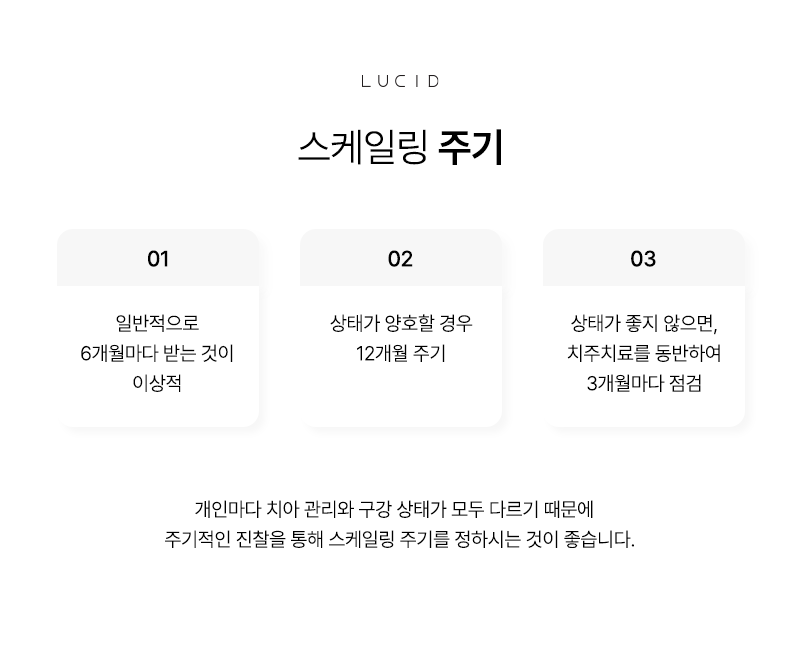
Scaling frequency summary
General case: once every 6 months
Under the health insurance standard, scaling is usually covered once a year,
and for oral care, a 6-month interval is often the most appropriate.
A 6-month period is also related to the time it takes for tartar to build up again
and affect the gums. Managing it at this interval allows plaque and tartar
to be removed preventively before they accumulate significantly.
If your condition is good: once every 12 months
People who usually have good brushing habits and use auxiliary tools such as
floss▪️interdental brushes well may not have major problems with just one visit per year.
In particular, if there are no symptoms such as gum bleeding or swelling,
and no abnormal findings are seen during regular checkups, once every 12 months
is often acceptable. However, even in these cases, regular checkups should be done alongside it.
If gum health is poor: check every 3 months
Those whose gums swell or bleed frequently, those with early signs of periodontitis,
and those with implants or prosthetic restorations may need more frequent care.
If checked every 3 months, action can be taken quickly before inflammation worsens,
which helps reduce the risk of losing teeth. In particular, if there are systemic factors
such as diabetes or smoking, gum recovery may be slower, so shorter intervals are recommended.

At Lucid Dental Clinic in Nonhyeon-dong,
we have introduced Airflow powder scaling equipment to help with delicate care
of the tooth surface and around the gums. Because it is an equipment that cleans tartar
through a fine spraying method, it can be comfortably applied even to patients
undergoing orthodontic treatment or those with prosthetic restorations.
Scaling is not a treatment that grinds down the teeth,
but one of the essential basic forms of care needed to keep the teeth and gums healthy.
If you make a habit of getting it regularly, you can slow the progression of gum disease
and build a foundation for using your natural teeth for a long time.
Lucid Dental Clinic carefully checks each patient's oral condition
and recommends scaling at a time appropriate to each individual situation.
Since teeth and gums are difficult to restore to their original condition once damaged,
managing them in advance through a Nonhyeon-dong dental clinic is the wisest choice.
Small acts of care accumulate and become a force that protects long-term oral health,
so we recommend continuing scaling as part of your routine along with regular checkups.
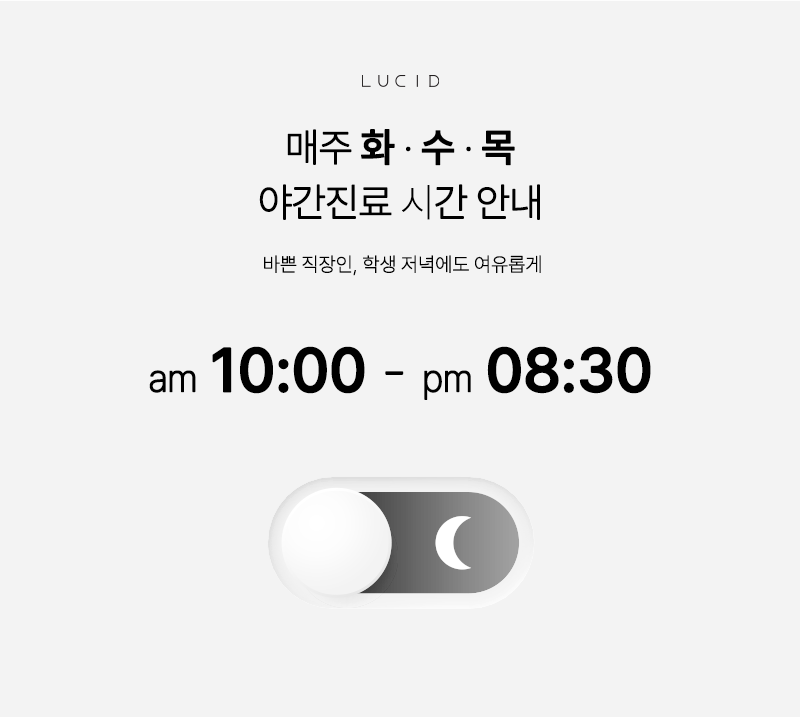
Lucid Dental Clinic
3rd–4th Floors, Coway Building, 606 Nonhyeon-ro, Gangnam-gu, Seoul