Hello. This is Lucid Dental Clinic.
Everyone has probably experienced discomfort caused by a tooth at least once.
When drinking a cold beverage, a sudden stabbing pain may appear, or when lying down at night, you may be kept awake by throbbing pain for no clear reason.
If you brush it off thinking, “It will get better after a while,” it may eventually become painful enough to make everyday life difficult.
If you carelessly ignore these signals from your teeth, you may end up needing more extensive treatment at a Nonhyeon Station dentist.
A representative example is root canal treatment.
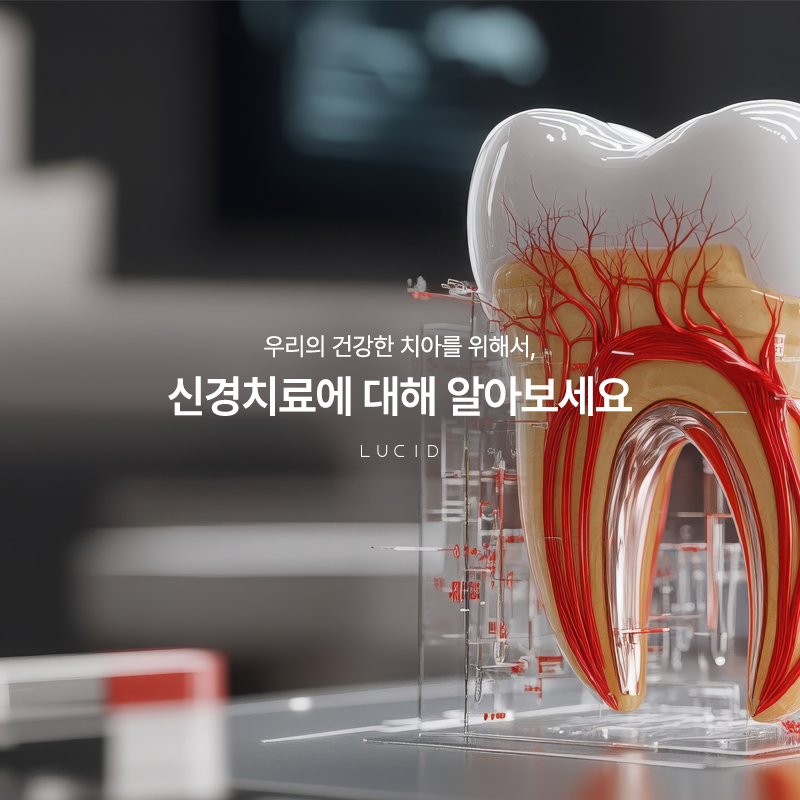
Root canal treatment is not simply for reducing pain, but is an important treatment method for preserving a damaged tooth as much as possible. So let’s take a step-by-step look at what root canal treatment involves, when it is needed, and how to care for the tooth afterward.
What is root canal treatment?
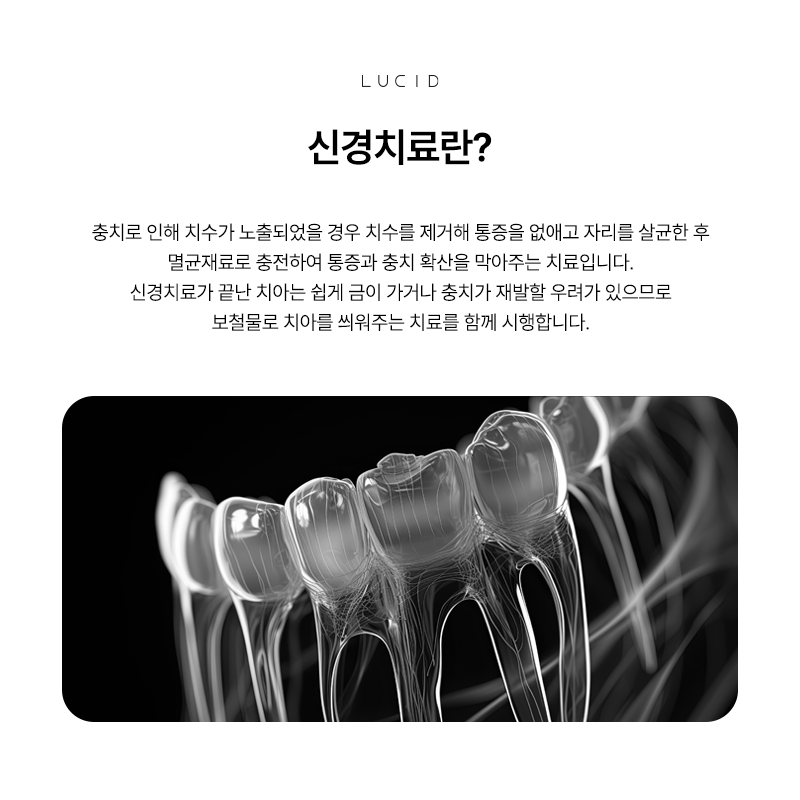
Root canal treatment is performed when the nerve (pulp) inside a tooth is damaged or inflamed.
Although a tooth looks hard on the outside, nerves and blood vessels are located inside it.
If this area becomes infected due to cavities or external impact, it can cause severe pain and, in serious cases, lead to the loss of the entire tooth.
Root canal treatment is the process of removing this damaged nerve tissue, thoroughly disinfecting the internal space, and then filling it with a special material to save the tooth.
It is commonly called “tooth root treatment,” and by preserving the root, it helps you use your natural tooth for as long as possible.
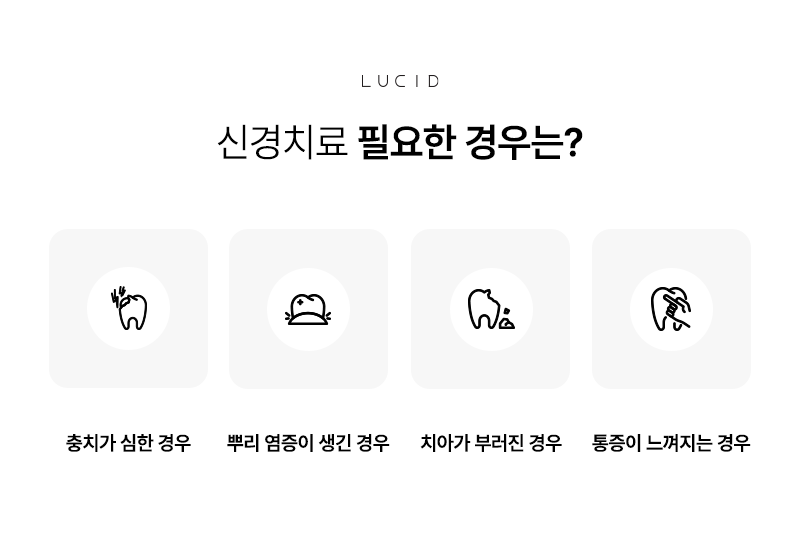
When root canal treatment is needed
Root canal treatment is not necessary for simple early-stage cavities.
However, it may be needed in the following situations.
▪️When a cavity has progressed deeply and reached the nerve area
▪️When a tooth has cracked or broken due to external impact, exposing the nerve
▪️When bacteria invade through gaps in an old filling or prosthetic restoration, causing internal inflammation
▪️When severe pain occurs with cold or hot foods and lasts for a long time
▪️When a tooth throbs without any special reason, or a pus pocket forms near the gums
In this sense, root canal treatment can be considered a “conservative method to save a tooth.” It is meaningful because it offers a way to keep the tooth instead of extracting it.
How can you tell when root canal treatment is needed?
When the condition has progressed to the point that root canal treatment is necessary, the signals from the tooth are usually clear.
At first, it may only react sensitively to cold or sweet foods, but gradually the pain becomes worse even with hot foods, and in severe cases, the pain continues without any stimulus at all.
In addition, the gums may swell or pus may build up, causing pain when pressed. In such cases, simple scaling or cavity treatment alone will not solve the problem, and the internal infection needs to be addressed through root canal treatment at a Nonhyeon Station dentist.
Therefore, if even minor symptoms keep recurring, it is best not to endure them and to have the condition checked.
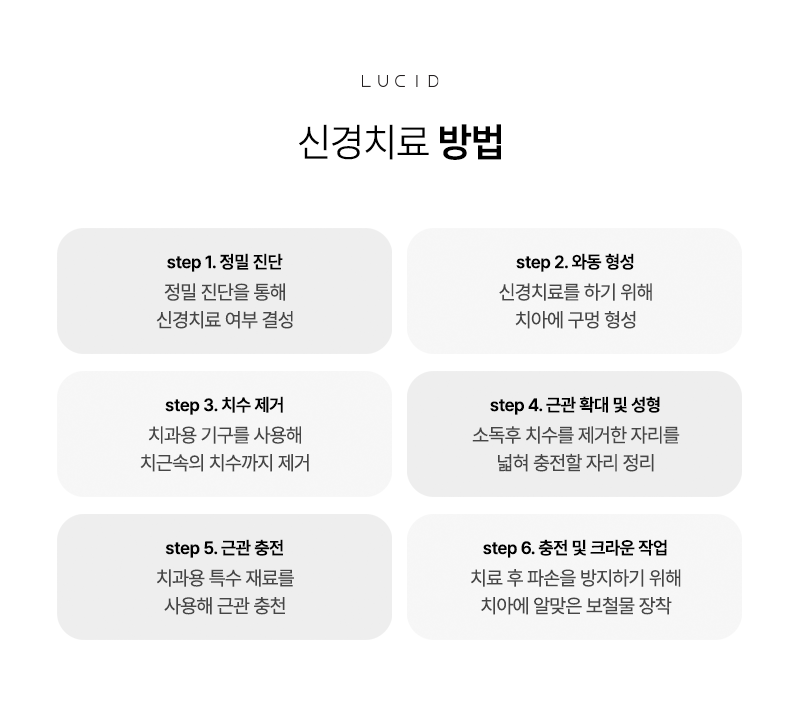
How is root canal treatment performed?
Root canal treatment at a Nonhyeon Station dentist is usually carried out in several stages.
-
Precise diagnosis
A detailed diagnosis is used to determine whether root canal treatment is needed.
-
Removal of infected tissue after anesthesia
After reducing pain with local anesthesia, the damaged nerve and inflamed tissue inside the tooth are removed.
-
Disinfection and filling
The inside is carefully disinfected to remove bacteria, then filled with a special material and sealed.
-
Prosthetic restoration
Although the inside has been filled, the tooth itself is in a weakened state, so it is covered with a prosthetic restoration to protect the tooth and restore function.
The importance of a prosthetic restoration after root canal treatment
Even after root canal treatment at a Nonhyeon Station dentist is finished, the entire process is not completely over.
A tooth from which the nerve has been removed can break more easily, so it must be protected with a prosthetic restoration.
A prosthetic restoration does not simply cover the tooth; it surrounds the tooth to increase strength and evenly distribute biting force, helping restore function.
It can also add aesthetic satisfaction because its color and shape are similar to those of a natural tooth.
Therefore, the prosthetic restoration stage after root canal treatment is an essential step for using the tooth for a long time.
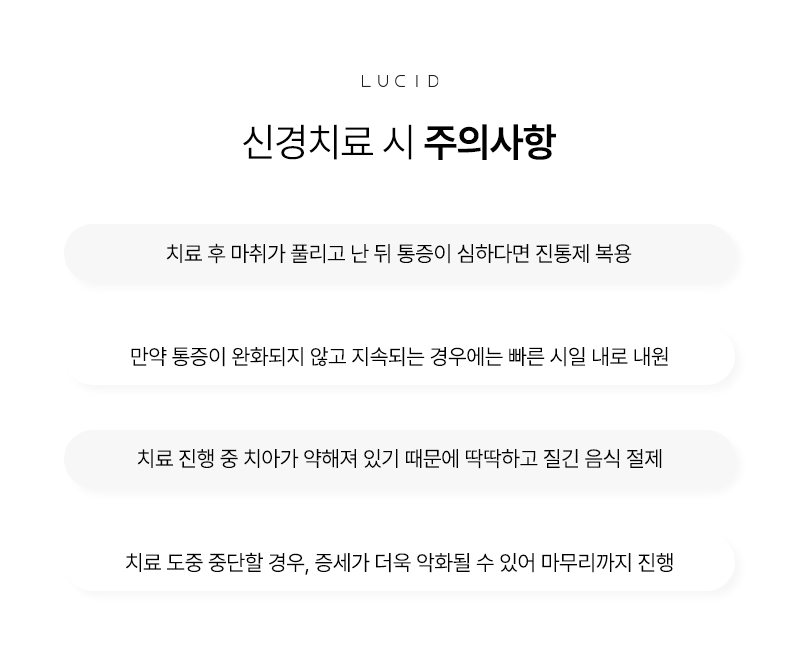
Precautions during root canal treatment
Root canal treatment at a Nonhyeon Station dentist is a procedure for preserving teeth, but there are also many things the patient must take care of.
▪️Do not chew hard foods with the treated tooth until the treatment is finished
▪️Pay extra attention to cleanliness while temporary material is in place
▪️Receive regular checkups after treatment to monitor the condition
▪️Avoid teeth grinding, clenching, and one-sided chewing
If lifestyle habits are not managed, the tooth can still be easily damaged even after root canal treatment, so proper oral care is important in daily life.
Teeth play such an important role that even being without one for a day can feel very inconvenient.
That is why preserving your natural teeth for as long as possible is the best option.
Root canal treatment can be considered the final stage of treatment that can save a tooth without extracting it.
Rather than simply enduring the pain or letting it pass as a temporary measure, it is wise to check the exact condition and receive the necessary treatment. Small attention and early care are the surest way to protect lifelong dental health.
Lucid Dental Clinic
3rd–4th Floors, Coway Building, 606 Nonhyeon-ro, Gangnam-gu, Seoul
Lucid Dental Clinic
Lucid Dental Clinic, bringing you happiness.
pf.kakao.com
Lucid Dental Clinic - LUCID DENTAL CLINIC(@lucid_dental_clinic) • Instagram Photos and Videos
11K followers, 25 following, 483 posts - View Lucid Dental Clinic - LUCID DENTAL CLINIC(@lucid_dental_clinic)’s Instagram photos and videos
www.instagram.com