Hello. This is Lucid Dental Clinic.
Among people who speak a lot throughout the day, or who are often exposed to air conditioning or heater air,
many say, “Lately, my mouth feels especially dry and sticky.”
Especially if drinking water does not easily relieve it,
and your mouth feels very dry even while sleeping, it may be due to more than just
lack of hydration or fatigue.
These symptoms are part of a condition called “dry mouth syndrome,”
in which not enough saliva is secreted, causing dryness in the mouth,
and bacteria can multiply more easily, sometimes accompanied by oral discomfort or pain.
At first, it may seem minor,
but dry mouth syndrome can lead to cavities, gum disease, bad breath, and reduced taste,
so it is important to identify the cause early and manage it.
 What Is Dry Mouth Syndrome?
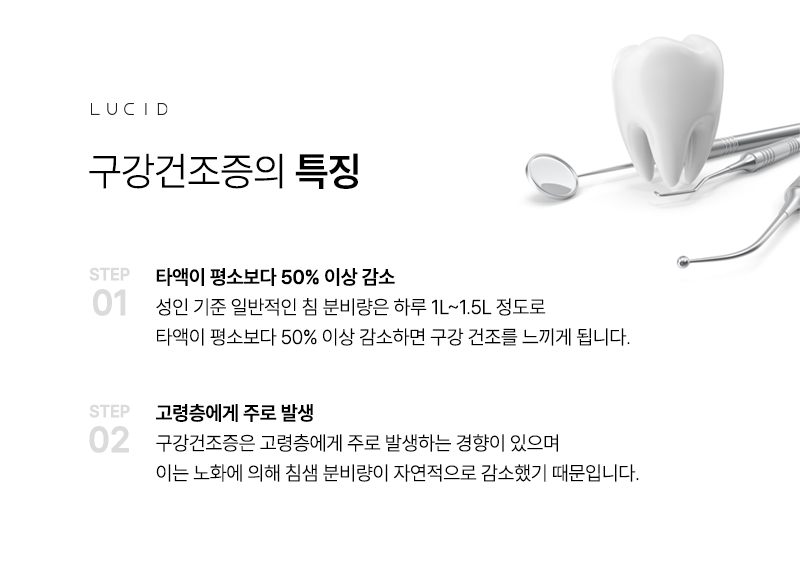
There are more than 1,000 tiny salivary glands in our mouths,
What Is Dry Mouth Syndrome?
There are more than 1,000 tiny salivary glands in our mouths,
and they secrete an average of 1 to 1.5 liters of saliva per day. This saliva does more than simply moisten the mouth;
it is essential for keeping the mouth healthy by helping digest food, suppress bacteria, and remineralize teeth
(the process of restoring damaged tooth surfaces on its own).
However, when salivary gland function declines,
or the body loses water, saliva is not secreted normally and the mouth becomes dry.
If this condition continues, the mouth may feel sticky,
the tongue may crack,
and bad breath may worsen, leading to various forms of discomfort.
In severe cases, it can become difficult to swallow food or speak,
which can lower quality of life.
 Main Causes of Dry Mouth Syndrome
Dry mouth syndrome does not usually have just one cause;
Main Causes of Dry Mouth Syndrome
Dry mouth syndrome does not usually have just one cause;
it appears when several factors act together.
- Reduced salivary gland function due to aging
As people get older, overall bodily function weakens,
and saliva production also decreases.
In particular, after the age of 50, the proportion of people complaining of dry mouth increases noticeably.
- Medication use
Blood pressure medications, antidepressants, cold medicine, and allergy medications may contain ingredients
that suppress salivary gland function.
With long-term use, dry mouth may appear as a side effect.
- Mouth-breathing habits
Nasal congestion, rhinitis, or sleeping with your mouth open while asleep can cause moisture in the mouth to evaporate quickly,
making your mouth feel dry every morning.
- Caffeine, alcohol, and smoking
Caffeine and alcohol can draw water out of the body through their diuretic effects,
and smoking weakens salivary gland function by irritating the mucous membranes.
- Stress and accumulated fatigue
When the sympathetic nervous system becomes overactive, saliva secretion is suppressed,
so mouth dryness can occur when you are tense or anxious.
 Problems That Dry Mouth Syndrome Can Cause
It does not simply end at “my mouth feels a little dry”;
Problems That Dry Mouth Syndrome Can Cause
It does not simply end at “my mouth feels a little dry”;
over time, the oral environment itself can deteriorate.
Increased cavities
When there is less saliva, food debris and acids are not properly neutralized,
making cavities more likely.
Gum disease
If saliva cannot wash away bacteria, inflammation is more likely to develop in the gums.
Bad breath
When saliva decreases, bacteria break down proteins and create odor,
which makes bad breath worse.
Changes in taste
When the surface of the tongue becomes dry, it becomes harder to properly taste food.
Mouth pain and mucosal damage
The tongue or the inside of the cheeks may become dry and develop sores.
 Habits to Help Relieve Dry Mouth Syndrome
When your mouth feels dry,
Habits to Help Relieve Dry Mouth Syndrome
When your mouth feels dry,
you may wonder, “Will drinking lots of water alone solve it?”
But beyond simply increasing fluid intake,
it is important to manage it consistently in daily life.
Drink water frequently
Rather than drinking a large amount at once,
it is more effective to drink small amounts often.
Reduce caffeine/alcohol
Coffee, green tea, energy drinks, wine, and similar beverages can suppress saliva production,
so reduce your intake.
Maintain indoor humidity
Using a humidifier or a wet towel to keep humidity at an appropriate level can help relieve both respiratory and oral dryness.
Use sugar-free gum or xylitol products
Chewing itself stimulates the salivary glands and helps saliva production.
Improve mouth-breathing habits
Practice breathing through your nose, and if you have rhinitis or nasal congestion,
please see a doctor.
Maintain oral hygiene thoroughly
In addition to brushing, use dental floss and interdental brushes,
and use a non-irritating mouthwash to help reduce bacterial growth.
If dry mouth syndrome is severe,
please check with Lucid Dental Clinic.
If symptoms do not improve easily even after changing your lifestyle,
or if your mouth feels so dry and irritated that eating or speaking becomes difficult,
professional evaluation may be necessary.
At Lucid Dental Clinic, we do not look only at the simple phenomenon of “having a dry mouth.”
We comprehensively examine salivary gland function, the condition of the oral mucosa,
teeth and gum health, and the degree of bad breath.
Then, depending on the cause of each patient’s symptoms, we provide guidance in the following directions:
▪️If gum disease is present > oral care focused on reducing inflammation, scaling, and gum care
▪️If prosthetics/dentures are causing irritation > adjustment of the uncomfortable area and relief of mucosal irritation
▪️If dry mouth occurs after orthodontic treatment > oral protection gel, moisturizers, and lifestyle guidance
In this way, Lucid Dental Clinic provides care tailored to each patient through the necessary approach based on the cause,
rather than unnecessary procedures.
A dry mouth is not simply a problem of “dryness.”
A decrease in saliva, which acts as a protective barrier in our mouth,
means an environment has been created where cavities and gum disease can more easily develop.
Therefore, it is basic to stay well hydrated in daily life,
and maintain healthy habits that do not irritate the mouth.
Even so, if discomfort continues,
an accurate diagnosis and consistent management are essential.
Lucid Dental Clinic provides treatment that also takes each patient’s lifestyle habits into account,
so that discomfort caused by dry mouth syndrome can be reduced and a healthier oral environment can be restored.
If your mouth feels dry often, and you also notice bad breath or pain,
it may be more than simple dryness — it may be a “signal.”
If you have ongoing dry mouth symptoms,
please seek a dry mouth syndrome consultation at Lucid Dental Clinic.
Identifying the exact cause and managing it systematically will help protect your healthy smile for a long time.
Lucid Dental Clinic
3rd–4th Floors, Coway Building, 606 Nonhyeon-ro, Gangnam-gu, Seoul
Lucid Dental Clinic
This is Lucid Dental Clinic, bringing you happiness.
pf.kakao.com
Lucid Dental Clinic - LUCID DENTAL CLINIC(@lucid_dental_clinic) • Instagram Photos and Videos
12K followers, 25 following, 503 posts - View Instagram photos and videos from Lucid Dental Clinic - LUCID DENTAL CLINIC(@lucid_dental_clinic)
www.instagram.com