Hello. This is Lucid Dental Clinic.
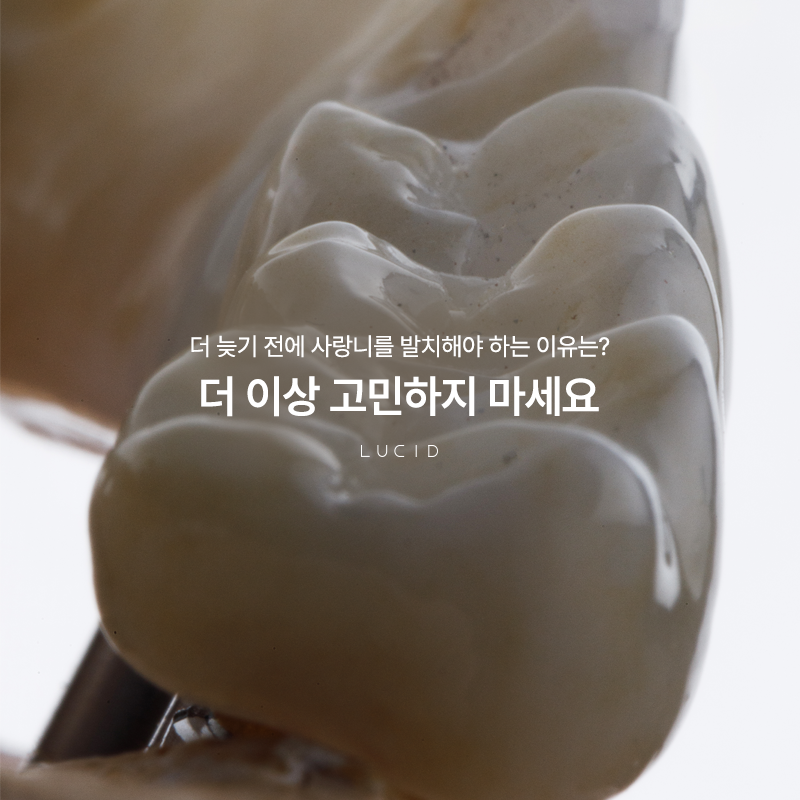
"I think my wisdom tooth is coming in" is one of the phrases
we hear often at the dental clinic.
When you look in the mirror, it may seem like something is
coming up behind your molars, or your gums may feel slightly
swollen when brushing, or food may keep getting stuck and
bother you.
Some people say it is fine to leave it alone,
while others say it absolutely must be removed.
So based on what criteria should
Yeoksam-dong wisdom tooth extraction be decided?
Today, for those who have such questions,
we will go over the role and structure of wisdom teeth,
cases where Yeoksam-dong wisdom tooth extraction is needed,
and how to care for them, step by step.
Why do wisdom teeth appear?
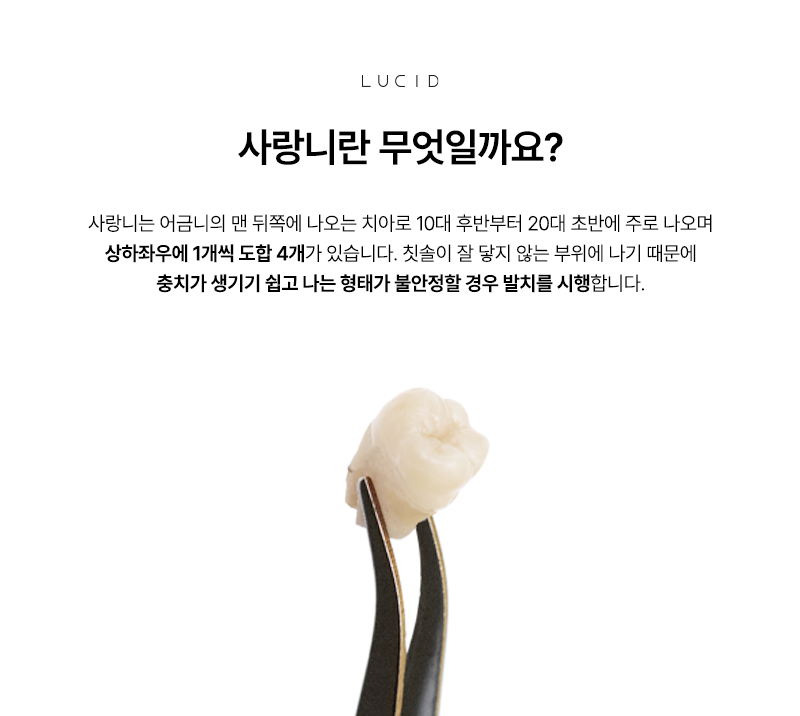
Wisdom teeth are the third molars and are teeth that have
become increasingly unnecessary over the course of human
evolution. In the past, jaws were wider and there were more teeth
to chew coarse food, but now that food has become softer,
the jaw has become smaller and there is not enough space
for teeth to fit in.
As a result, wisdom teeth that grow in the very back often
remain in a state where they grow crooked due to lack of space
or are buried under the gums (impacted).
Why wisdom teeth become a problem
Because wisdom teeth are located the deepest in the mouth,
they are difficult to see with the eye. Brushing often does not
reach them well enough, so food debris can build up and bacteria
can multiply easily.
As a result, the following discomfort may occur.
Gum inflammation
Swelling or pain in the gums around the wisdom tooth
Cavities
Risk of cavities spreading to adjacent molars
Jaw pain and headaches
Occurs when a wisdom tooth pushes the tooth next to it and affects the bite
Bad breath
Caused by bacterial growth and resulting in bad breath
In particular, impacted wisdom teeth are not visible on the surface,
so they can be difficult to notice until inflammation or cysts develop.
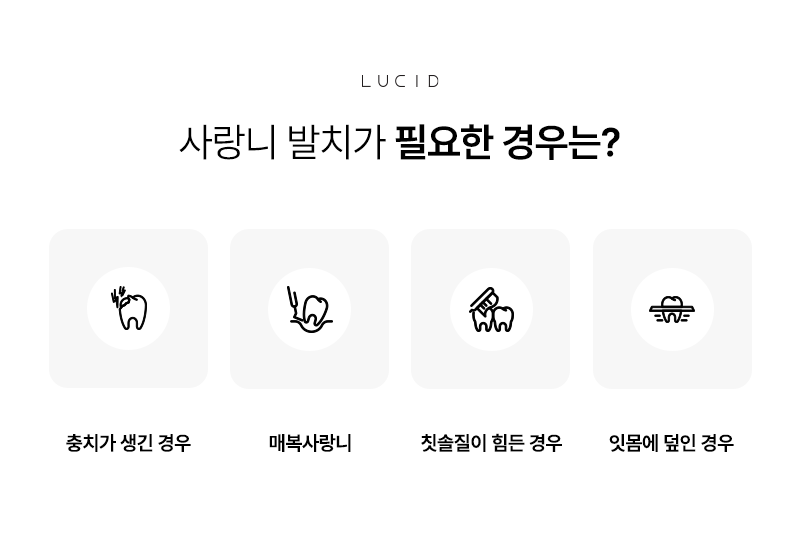
Wisdom teeth do not always have to be removed
Yeoksam-dong wisdom tooth extraction is not always necessary.
Because everyone has different jawbone structures, tooth alignment,
and eruption directions, a decision should be made based on the
individual condition.
Yeoksam-dong wisdom tooth extraction is recommended in the following cases.
-
When pain occurs because the tooth is pushing or pressing on the adjacent tooth
-
When it grows in an abnormal direction or only partly erupts
-
When it is buried under the gums and there is a possibility of inflammation or cysts
-
When food frequently gets stuck and gum swelling or odor keeps recurring
-
When only one side has a wisdom tooth while the opposite side does not, causing an unbalanced bite
On the other hand, if a wisdom tooth has grown straight,
there are no problems with chewing function,
and it is being well managed, it can be kept.
The safest approach is to receive a professional assessment
through regular checkups.
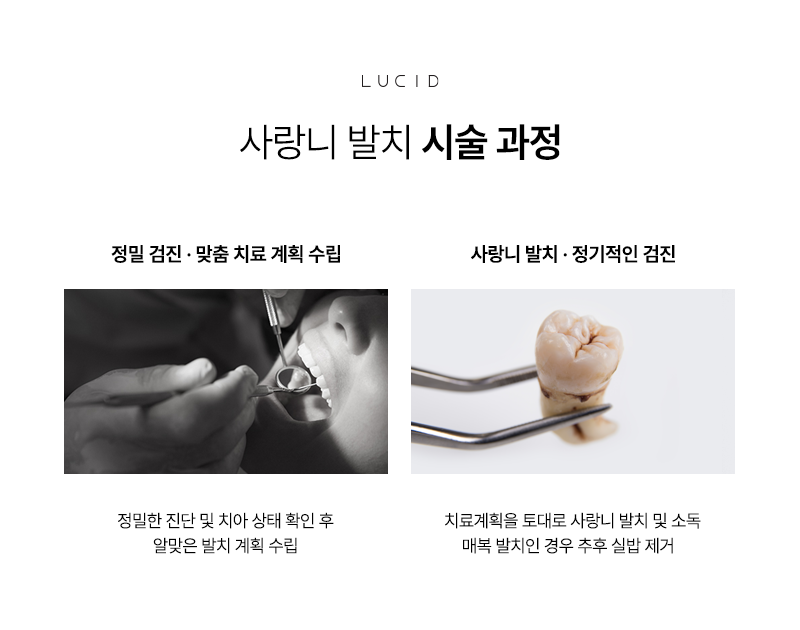
Wisdom tooth extraction process
Because the direction and position of wisdom teeth vary from person to person,
it is difficult to simply describe the procedure as "pulling it out."
In general, the process proceeds as follows.
-
Detailed diagnosis and imaging
X-rays or 3D CT scans are used to check the wisdom tooth's location,
its distance from the nerves, and root shape.
-
Extraction plan established
After understanding the alveolar bone structure and degree of impaction,
the extraction direction and method are planned.
-
Wisdom tooth extraction procedure
Depending on the condition, it is either removed simply
or extracted after incision of the gum and sectioning of the tooth.
-
Disinfection and recovery care
Disinfection is performed to stop bleeding and prevent infection.
Afterward, you will be guided on how to care for it.
Why care after extraction is important
After Yeoksam-dong wisdom tooth extraction, care for the next few days is important.
▪️Keep the hemostatic gauze in place for about 2 to 3 hours to prevent bleeding.
▪️Cold compresses help reduce swelling within 24 hours.
▪️Avoid using straws, spitting, and rinsing, as these can interfere with clotting.
▪️Eat mostly soft, lukewarm foods.
▪️Alcohol and smoking can delay recovery, so it is best to avoid them for at least 3 days.
During this period, lifestyle habits that help recovery are
much more important than pain itself.
Common questions after wisdom tooth extraction
Q. How painful is it?
A. It varies depending on the individual's sensitivity to pain,
but in general, discomfort lasts about 2 to 3 days and then gradually eases.
Q. When does the swelling go down?
A. It is usually at its worst within 48 hours and naturally decreases
around one week later.
Q. When can I brush my teeth?
A. On the first day, avoid the wound area, and from the next day,
it is best to brush gently.
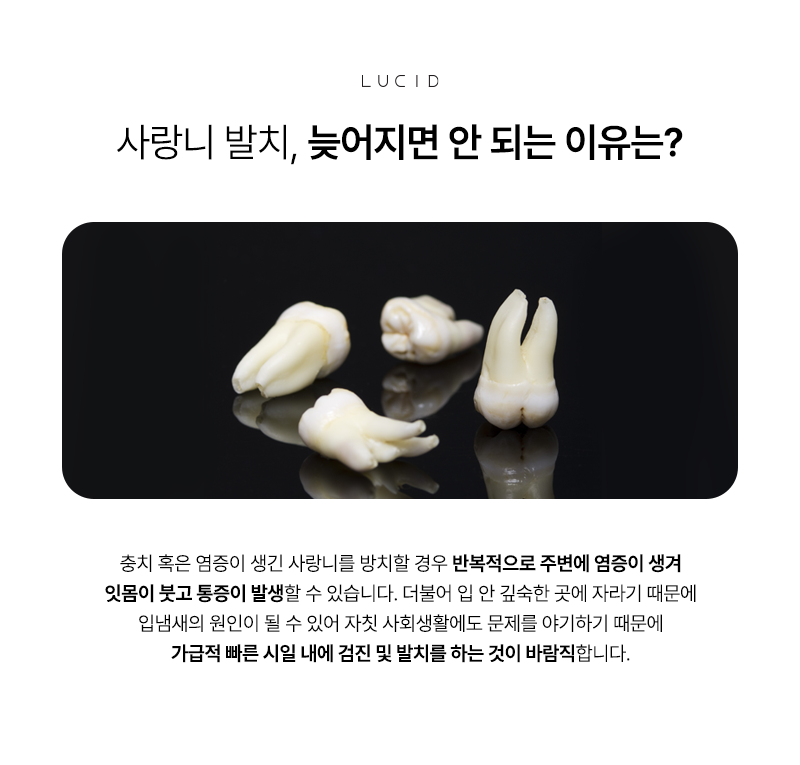
Problems that can occur if wisdom teeth are left as they are
If wisdom teeth are neglected, small discomfort can lead to bigger problems.
Cavities in nearby teeth
If a wisdom tooth is lying sideways, food can get stuck between it
and the adjacent tooth, making cavities easy to develop.
Repeated gum inflammation
If inflammation keeps recurring, the gums become weaker,
and the surrounding bone can also be damaged.
Changes in tooth alignment
Pressure from the wisdom tooth can push the teeth forward
and distort the alignment.
Cyst formation
If a cyst develops under the gums, it can damage the surrounding bone
and teeth.
Therefore, even if there is no pain, it is important to check the condition
through regular examinations.
When is the best time to remove wisdom teeth?
In general, extraction is faster when done at a younger age,
before the wisdom tooth roots are fully established.
In particular, it may be inconvenient during the school term or while working,
so it is better to plan it during vacation or holiday periods.
Why is professional diagnosis important for wisdom tooth care?
Because wisdom teeth are located very close to the nerves,
it is difficult to accurately determine their condition by visual inspection alone.
Therefore, it is safest to check the structure at a dental clinic equipped with
advanced diagnostic equipment before deciding whether extraction is necessary.
Also, even if extraction is not needed, you can receive guidance on how to manage it
and when to schedule regular checkups.
Prevent with regular checkups
It is possible to predict the position of wisdom teeth before they erupt.
If you check the direction in advance through imaging during regular checkups,
you can help prevent inflammation and cavities. Early diagnosis has the advantage
of reducing unnecessary pain and, if extraction is needed, allowing the timing to be adjusted.
Wisdom teeth can appear in anyone,
but they do not all grow in the same way.
Some people live their whole lives without discomfort,
while others experience pain and inflammation that interfere with daily life.
What matters more than when to remove them is
how to manage and judge the situation.
Lucid Dental Clinic carefully analyzes each person's oral structure
and proposes a reasonable treatment direction to reduce unnecessary extractions.
If you are experiencing discomfort because of a wisdom tooth,
don't 고민 alone—please check your condition with a specialist.
Lucid Dental Clinic
3rd–4th Floors, Coway Building, 606 Nonhyeon-ro, Gangnam-gu, Seoul
Lucid Dental Clinic
This is Lucid Dental Clinic, where we bring happiness.
pf.kakao.com
Lucid Dental Clinic - LUCID DENTAL CLINIC(@lucid_dental_clinic) • Instagram photos and videos
12K followers, 25 following, 506 posts - View Instagram photos and videos from Lucid Dental Clinic - LUCID DENTAL CLINIC(@lucid_dental_clinic)
www.instagram.com