Hello. This is Lucid Dental Clinic.
Among oral diseases that almost everyone has experienced at least once,
one of the most representative is a cavity.
At first, it may only seem like a sensitive feeling or a darkened area,
but the longer it is left untreated, the worse the pain becomes and the
larger the treatment area gets, which is why early detection is so important.
In this post, we will look step by step at why cavities occur,
as well as treatment and prevention methods.
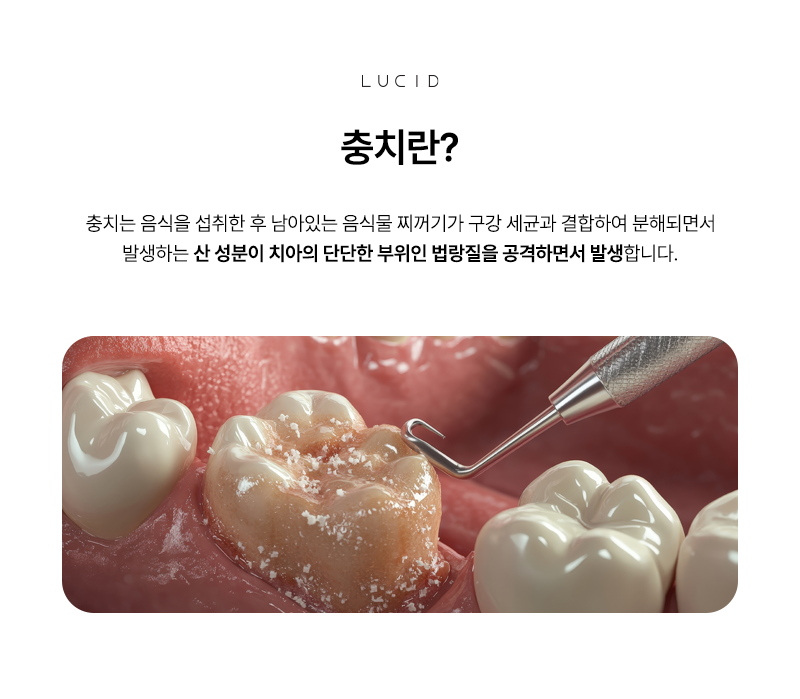
What is a cavity?
A cavity is a disease that occurs when acids produced as bacteria
break down sugars in food left in the mouth dissolve the tooth surface enamel.
The outer part of the tooth is covered with hard enamel,
but repeated exposure to acid weakens and damages it little by little.
If this process continues, it progresses to the inner dentin and can
ultimately worsen to the stage of causing inflammation in the nerve.
A cavity is not simply a disease that is caused by “sweet foods.”
Various factors work together, including brushing habits,
the amount of saliva, eating habits, and the types of bacteria.
In particular, people who often eat late-night snacks or skip brushing frequently
are at higher risk of cavities.
Main causes of cavities
- Inadequate brushing
Even if you brush three times a day, food debris left between the teeth
and along the boundary between the gums and teeth can become food for cavity-causing bacteria.
- Eating habits with high sugar intake
Frequently consuming sweets or carbonated drinks keeps the acidic environment
in the mouth for a long time, making teeth more easily damaged.
- Reduced saliva secretion
Saliva protects teeth and neutralizes acid.
When saliva production decreases due to stress, medication, dehydration, and so on,
cavities develop more easily.
- Problems with tooth alignment
If teeth overlap or are crooked, food and bacteria can get trapped more easily,
increasing the likelihood of cavities.

Stages of cavity progression
A cavity is not a disease that worsens quickly;
it progresses step by step. However, because early detection is difficult,
by the time pain is felt, it has often already progressed.
- Early stage
This is the stage where white spots appear on the tooth surface and demineralization begins.
There is almost no pain.
- Middle stage
The tooth becomes noticeably dark or bluish, and food tends to get stuck easily.
Sensitivity or pain with cold foods may also occur.
- Late stage
As bacteria invade the nerve, the pain becomes severe.
It throbs at night, and sensitivity occurs not only to cold foods but also to hot foods.
At this stage, root canal treatment may be necessary.
Self-check points for cavities
You can suspect a cavity to some extent at home as well.
▪️You feel sensitivity when drinking cold water or eating sweets.
▪️The tooth surface feels rough, or black/brown areas are visible
▪️A specific area aches or hurts when chewing food
▪️There is an odor near the gums
If you have these symptoms, it is better not to dismiss them as simple sensitivity
and to get a professional examination.
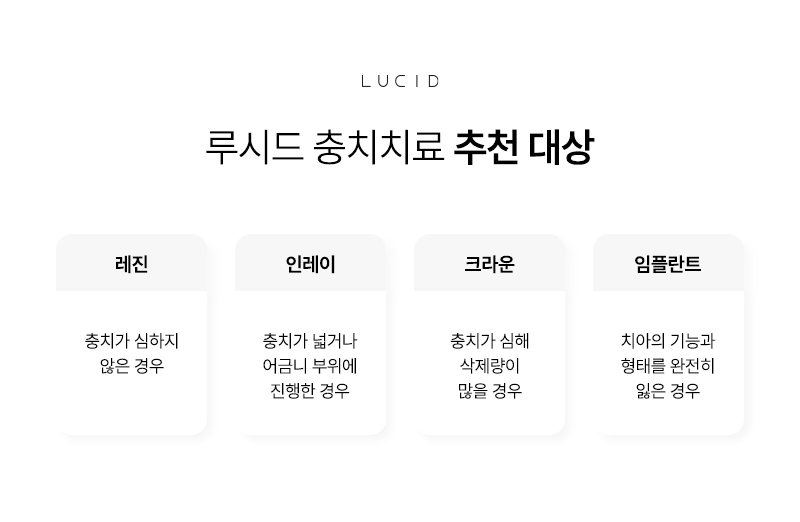
How is cavity treatment performed?
The Gangnam cavity treatment method differs depending on the degree of progression.
If detected early, it can be completed with a simple filling,
but if left untreated and the nerve is damaged, root canal treatment or prosthetic treatment may be needed.
- Early stage - resin treatment
In the early cavity stage, where the cavity is limited to the enamel or the surface of the dentin,
the damaged area is removed and then filled with a tooth-colored resin material to restore the tooth shape.
This method is characterized by minimal removal of tooth structure and completion within a relatively short time.
The color is also similar to natural teeth, so aesthetic satisfaction tends to be high.
However, if the cavity is deep or spread widely, other treatment may be needed.
- Middle stage - inlay treatment
In the middle stage, where the cavity has progressed deeply into the dentin,
it is difficult to simply fill the damaged area with resin, so after partially shaping the tooth,
a custom prosthesis is attached. The prosthesis is made from various materials,
such as ceramic, gold, and resin, and plays a role in restoring the tooth’s shape and function.
Before Gangnam cavity treatment, a precise diagnosis is needed to consult on which material is appropriate.
- Late stage - root canal treatment and crown
In the late cavity stage, when the cavity has reached the pulp (nerve), inflammation and pain caused by bacterial infection can occur.
In this case, root canal treatment is necessary: the damaged nerve is removed,
and the inside is thoroughly cleaned and filled to prevent infection.
After that, a crown is placed to protect the weakened tooth and improve functional stability.
If the condition has progressed to this stage, the treatment period may become longer,
so it is better to prevent it through regular checkups before pain appears.
Problems that can occur if a cavity is left untreated
Damage to the tooth nerve
If the cavity spreads to the nerve, inflammation and pain become severe,
and eventually the tooth may no longer be salvageable.
Infection of adjacent teeth
The cavity area can become a breeding ground for bacteria,
allowing the infection to spread to nearby teeth.
Severe bad breath and gum disease
A decayed tooth can cause odor, and if bacteria affect the gums,
it can lead to periodontal disease.
Overall worsening of oral health
Chewing food can become difficult, and it can also lead to an unbalanced nutritional intake.
Daily cavity prevention methods
Cavities are difficult to avoid completely,
but they can be sufficiently prevented with proper care.
Here are some simple methods that can be practiced in daily life.
- Brushing within 3 minutes after meals
It is best to brush right after eating so food does not remain on the teeth for too long.
- Use dental floss and interdental brushes
These help remove foreign substances between teeth that are difficult to eliminate with a toothbrush alone, reducing the occurrence of cavities.
- Reduce sweets and carbonated drinks
In particular, avoid sugar intake before bedtime, and after consuming it,
it is best to rinse with water.
- Use fluoride toothpaste
Fluoride strengthens enamel and increases resistance to acid attacks from bacteria.
- Regular Gangnam dental checkups
It is best to visit the dentist and get a checkup at least once every 6 months to a year.
This is because there are many early cavities that may not be visible to the eye but can only be confirmed through X-ray examination.
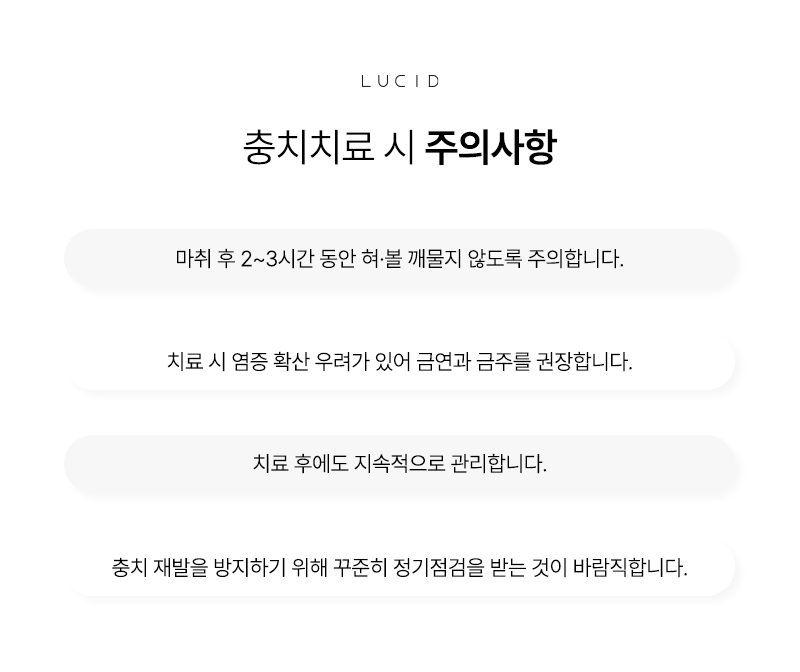
Precautions after cavity treatment
After Gangnam cavity treatment, please keep the following in mind.
▪️On the day of treatment, it is best to avoid very hard or sticky foods.
▪️If anesthesia is still in effect, be careful not to bite your tongue or lips.
▪️Do not use the treated area for a long time; temporarily chewing on the opposite side helps you recover steadily.
▪️Do not use the treated area for a long time; temporarily chewing on the opposite side helps you recover steadily.
▪️You may feel sensitivity for a while, but it usually goes away within a few days.
Prevention is more important than treatment when it comes to cavities.
With consistent oral care and regular checkups, you can keep your teeth healthy for a long time.
Rather than assuming everything is fine because there is no pain,
checking your current condition is the first step in reducing future treatment burden.
Lucid Dental Clinic carefully reviews the patient’s tooth condition and lifestyle habits as a whole to help maintain healthy teeth for a long time.
If your teeth are often sensitive, food gets stuck frequently, or you suspect a cavity, get checked early and manage it before it grows into a bigger problem.
Lucid Dental Clinic
3rd–4th Floors, Coway Building, 606 Nonhyeon-ro, Gangnam-gu, Seoul
Lucid Dental Clinic
This is Lucid Dental Clinic, which brings you happiness.
pf.kakao.com
Lucid Dental Clinic - LUCID DENTAL CLINIC(@lucid_dental_clinic) • Instagram Photos and Videos
12K followers, 25 following, 522 posts - View Instagram photos and videos of Lucid Dental Clinic - LUCID DENTAL CLINIC(@lucid_dental_clinic)
www.instagram.com