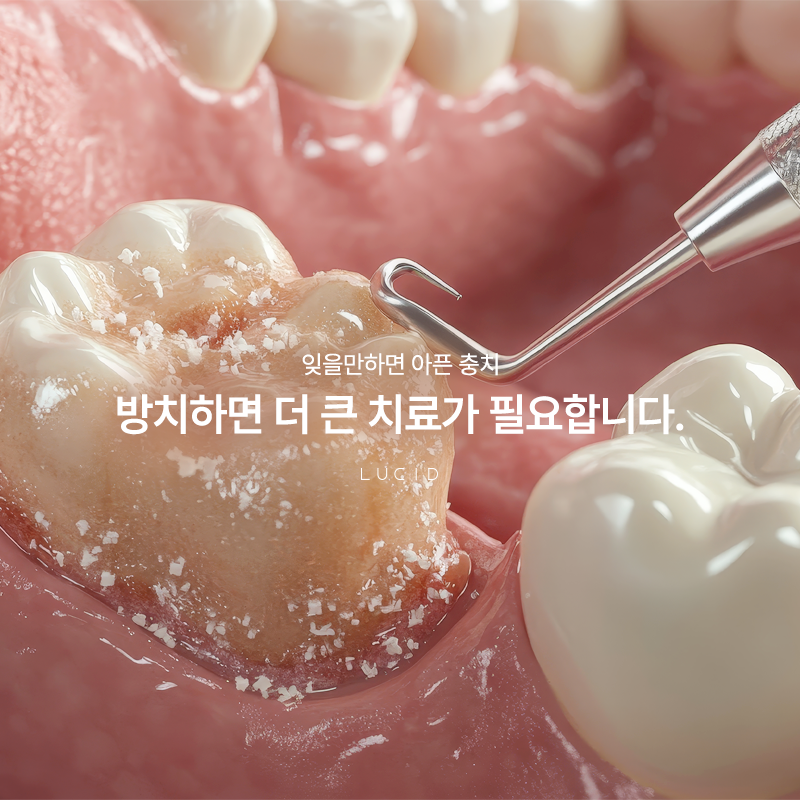
Hello. This is Lucid Dental Clinic.
Teeth do not naturally recover once they are damaged.
In particular, cavities cause almost no pain in the early stages,
so it is easy to think, "I should get it treated a little later."
However, cavities do not stop, and they progress faster than you might think.
Today, we will talk in detail about why cavity treatment is urgent,
what the treatment process is like, and the part many people are
curious about: pain.
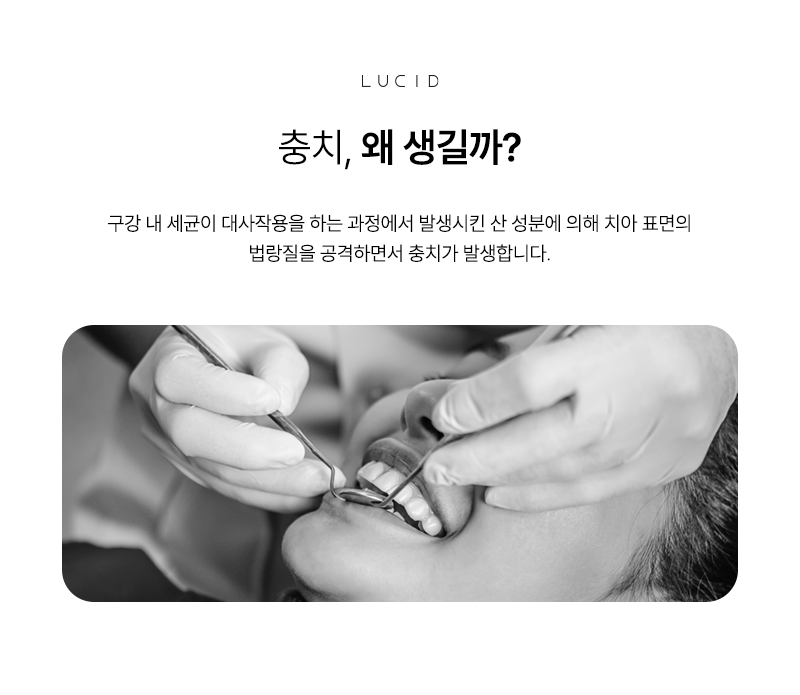
Why do cavities occur?
Cavities are a disease in which teeth are gradually dissolved by acid produced when bacteria in the mouth break down
sugars in food debris.
Even with careful brushing, it is difficult to completely remove bacteria from between teeth, the deep grooves of molars,
and areas near the gums with brushing alone. Bacteria multiply in these areas and produce acid, weakening the enamel
of the tooth and gradually invading the dentin underneath, causing the cavity to deepen.
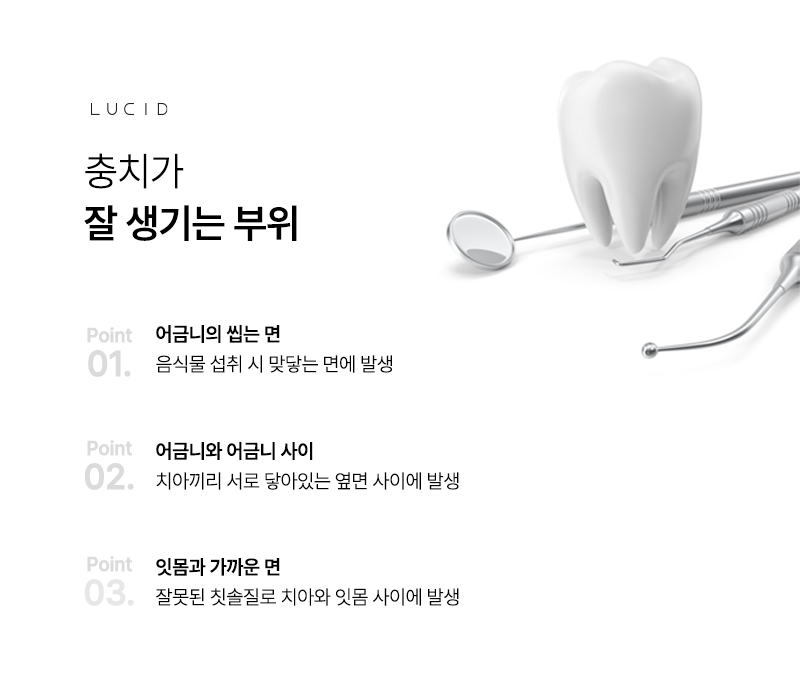
Cavities are especially likely to develop in the following cases.
▪️When you eat sweets frequently or do not brush right after meals
▪️When the spaces between teeth are tight or the teeth are misaligned, causing food to get stuck often
▪️When your mouth is often dry and you have little saliva
▪️When the area around old prosthetic restorations has become loose
Why should cavities be treated quickly?
Cavities do not heal on their own.
If you leave them alone thinking, "I can get treatment a little later," the small hole gradually gets deeper and eventually
reaches the nerve.
At first, you may only feel sensitivity, but in the middle stage, even cold water, sweets, or even air can cause pain.
In the late stage, it develops into severe throbbing pain or pain that wakes you up at night.
At that point, it may not be resolved with a simple filling,
and root canal treatment or a crown may be necessary.
In other words, if a cavity is treated early, it can end with a simple resin treatment,
but if left untreated, the treatment period, pain, and cost all increase.
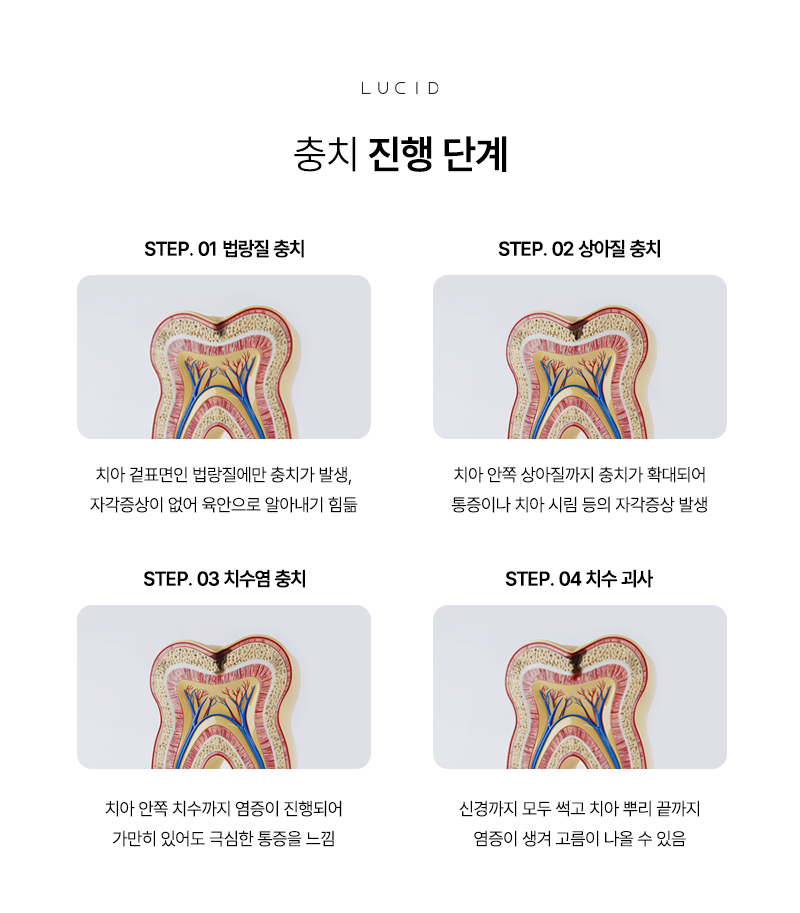
How is cavity treatment carried out?
- Enamel cavity
Early cavities that occur only in the enamel are difficult to detect because there are no noticeable symptoms,
but they can be found through regular checkups.
Pain stage: No noticeable symptoms or pain
Cavity stage: Cavity progresses only to the outer layer of the tooth, the enamel
Treatment method: Regular checkups ▪️ Resin
- Dentin cavity
This is the stage where the cavity has progressed to the dentin inside the tooth, causing pain,
sensitivity, bad breath, and increased sensitivity to cold.
Pain stage: You may feel irritation when exposed to cold or when eating sweets
Cavity stage: Cavity progresses to the dentin layer
Treatment method: Inlay ▪️ Crown
- Pulp (nerve) inflammation cavity
The cavity has progressed to the pulp, causing severe pain even when you are at rest.
As treatment is delayed, the pain gets worse, so prompt treatment is necessary.
Pain stage: Pain when exposed to hot things, or pain felt even at rest
Cavity stage: Progresses through the dentin to the pulp (nerve)
Treatment method: Crown
- Pulp necrosis
This is the stage where the cavity has progressed to the nerve and the root of the tooth,
and pus may form. Root canal treatment is necessary, and in severe cases, extraction followed by an implant may be needed.
Pain stage: There may or may not be pain
Cavity stage: Late-stage cavity where the pulp has necrotized,
and inflammation has progressed to the root tip; in severe cases, inflammation of the alveolar bone may occur, causing tooth mobility
Treatment method: Extraction followed by implant ▪️ Bridge
Does cavity treatment hurt?
This is one of the most frequently asked questions.
To get straight to the point, it does not hurt as much as it used to.
During treatment, local anesthesia is used, so most patients feel almost no pain.
If the cavity is not deep, treatment is often possible without anesthesia,
and even in deep cavities, discomfort during treatment can be minimized.
In addition, thanks to digital equipment and minimally invasive treatment techniques,
only the necessary areas are removed to perform delicate treatment,
reducing pain while increasing treatment precision.
However, after the anesthesia wears off, slight soreness or sensitivity may occur,
but this is temporary and usually disappears naturally within a few days.
What problems can arise if treatment is delayed
If cavities are left untreated, it is not just the tooth that hurts.
▪️In some cases, the nerve is damaged and the tooth cannot be saved
▪️Inflammation spreads to the jawbone, developing into apical periodontitis or an abscess
▪️Bad breath, discomfort when chewing, and in severe cases, the need for extraction
If you develop the habit of chewing on only one side, it can strain the temporomandibular joint,
and if neighboring teeth shift, your bite can collapse. In the end, do not forget that one cavity can disturb the balance
of your entire dentition.

If this applies to you, be sure to get a cavity checkup
▪️People who still feel an odd sensation or odor after brushing
▪️People who often feel a sudden sensitivity when drinking cold water or eating sweets
▪️People whose old prosthetic restorations have become discolored or developed gaps
▪️People who have no pain but have black discoloration on the surface of a molar
▪️People who have chipped or fractured teeth
Even if a cavity looks fine on the surface,
the inside is often already decayed.
Early detection through regular oral checkups is the most important thing.
How to care after cavity treatment
Continued care is needed even after treatment.
▪️Brush within 3 minutes after meals, and make a habit of using dental floss and interdental brushes, especially
▪️Reduce foods high in sugar and frequent snacking
▪️Detect early cavities through regular checkups every 6 months to 1 year
▪️Carefully manage the areas around resin and inlay restorations
At Lucid Dental Clinic, we regularly check your condition even after treatment
and also guide you on how to care for the area around restorations and on lifestyle habits.
A cavity is not a condition that ends with "it hurts a little."
If you miss the early stage, the scope of treatment becomes larger,
and it may lead to root canal treatment or prosthetic treatment.
These days, the burden of pain is reduced and treatment time is much shorter,
so delaying out of fear is actually a loss.
If you feel even a small discomfort, getting an accurate diagnosis early is the wisest choice.
At Lucid Dental Clinic, depending on the patient's condition,
we provide cavity treatment that minimally treats only the necessary areas
while also considering natural color and functional recovery.
Even if you do not have pain right now, if you suspect a cavity,
don't put it off and get professional advice.
The earlier you act, the simpler the treatment,
and the longer you can protect your teeth.

Lucid Dental Clinic
3rd–4th Floors, Coway Building, 606 Nonhyeon-ro, Gangnam-gu, Seoul
Naver Reservation :: Lucid Dental Clinic
Hello, we are Lucid, a Gangnam dental clinic loved by former [ entertainers ] [ influencers ] [ idols ] [ beauty pageant winners ] :) Our clinic strives to provide dental care that considers both aesthetics and function. We understand very well that every patient has thought deeply before coming to our clinic. Therefore, at Lucid, we do our best to provide maximum satisfaction and results with minimal treatment. The best treatment is to interfere with the teeth and gums as little as possible. We prioritize methods that preserve natural teeth, and even during treatment, we aim to minimize damage to natural teeth...
m.booking.naver.com
Lucid Dental Clinic
This is Lucid Dental Clinic, bringing you happiness.
pf.kakao.com