Hello. This is Lucid Dental Clinic.
Wisdom teeth may look quiet on the outside,
but once a problem occurs, they can cause
greater inconvenience in daily life than you might expect.
In particular, many people ask questions such as:
“Do I really need to have it removed if it doesn’t hurt right now?”
“How uncomfortable will it be after extraction?”
“What condition is my wisdom tooth in?”
Today, for those considering wisdom tooth extraction,
we would like to provide a more realistic and detailed guide
focused on the information people ask about most
and actually need.
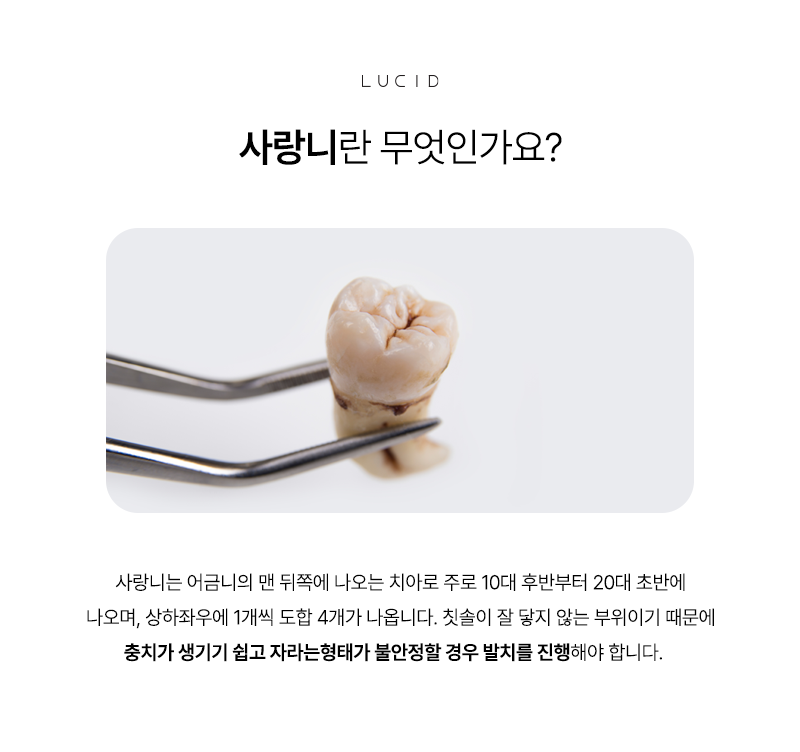
Why should wisdom teeth be managed in advance
even if they don’t hurt?
Wisdom teeth often gradually develop problems
even without any special symptoms. The reason is simple.
Most wisdom teeth quietly create problems in places you can’t see.
Why wisdom teeth quietly cause problems
▪️Their position is almost unreachable by a toothbrush > food debris and bacteria easily accumulate
▪️Their direction is often twisted > they gradually press on the molars in front
▪️They may grow lying down in the bone > inflammation can develop inside without external symptoms
▪️The surrounding gums can easily become weak > swelling may recur when you are tired or run down
Wisdom tooth pain is usually not a sudden, intense pain.
Instead, it tends to follow a repeating cycle: swelling and pain only when you are not feeling well > it gets better > then hurts again.
The more this pattern repeats,
▪️Extraction becomes more difficult
▪️Recovery takes longer
▪️The risk of damage to nearby teeth increases
Because of issues like these, it is important to check the tooth with Lucid Dental Clinic before it becomes fully painful.
What condition is my wisdom tooth in?
You cannot tell just by looking inside the mouth.
When viewed through an X-ray or CT scan, it usually falls into one of the four categories below.
- A normally positioned tooth that is coming in straight
> If there is no problem, it can be monitored without extraction
- Partially erupted, with part of it still impacted
> Food often gets trapped in the gum-covered area, causing repeated inflammation
- Completely hidden, impacted
> It grows within the bone and may press on the root of the front tooth or form a surrounding cyst
- Horizontally impacted, growing on its side
> It continuously presses on the molar in front, increasing the risk of cavities and pain
In particular, impacted and horizontal wisdom teeth often appear fine from the outside,
but changes may be progressing slowly on the inside.
Among people who say, “Mine doesn’t hurt,”
a fair number actually already have problems building up on X-rays.
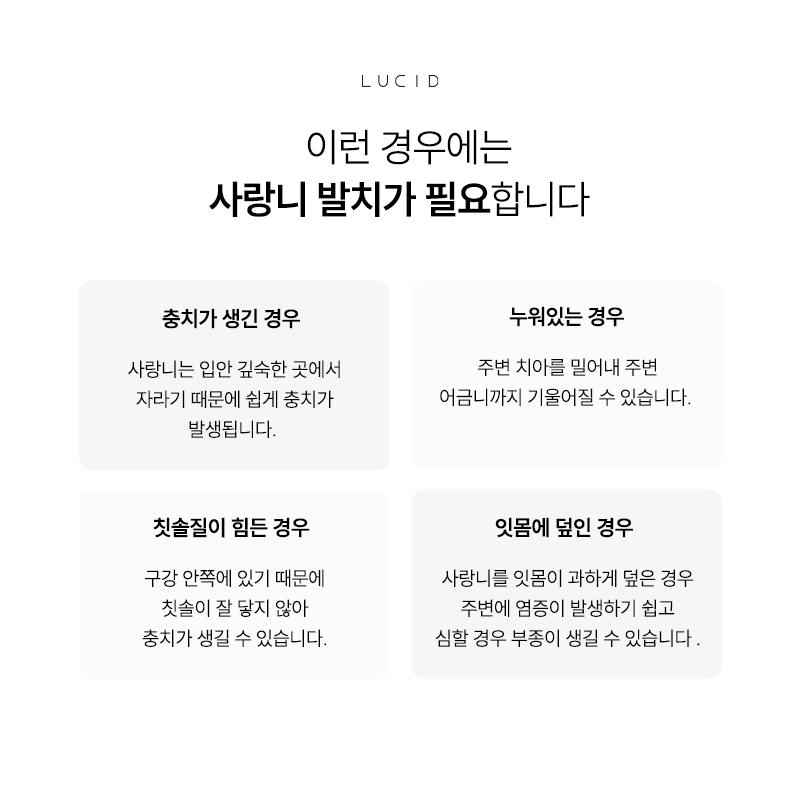
Realistic situations in which wisdom tooth extraction becomes necessary
From a medical standpoint, there are various criteria,
but the situations in which patients actually decide to have the tooth removed are a little more practical.
- When the gums swell and opening the mouth becomes uncomfortable when you are tired
This is a common symptom of pericoronitis seen in a partially impacted state.
- When cavities begin to form between the front molar and the wisdom tooth
The space between the wisdom tooth and the molar is barely reached by brushing, so cavities progress quickly.
- When you often bite the inside of your cheek while chewing
This pattern repeats when the angle of the wisdom tooth faces outward.
- When you are undergoing orthodontic treatment, or plan to start soon
It can interfere with tooth movement or make realignment difficult.
- When you occasionally feel a dull pain spreading toward the chin, below the ear, or the neck
This is a typical pattern seen when there is repeated inflammation around the wisdom tooth.
As such, wisdom teeth should not be underestimated as “almost fine,”
because they can suddenly become a major problem one day.
That is why it is important not to overlook the small signals you feel in daily life.
The wisdom tooth extraction process is simpler than you might think,
but it varies depending on the situation
Not every wisdom tooth is removed in the same way.
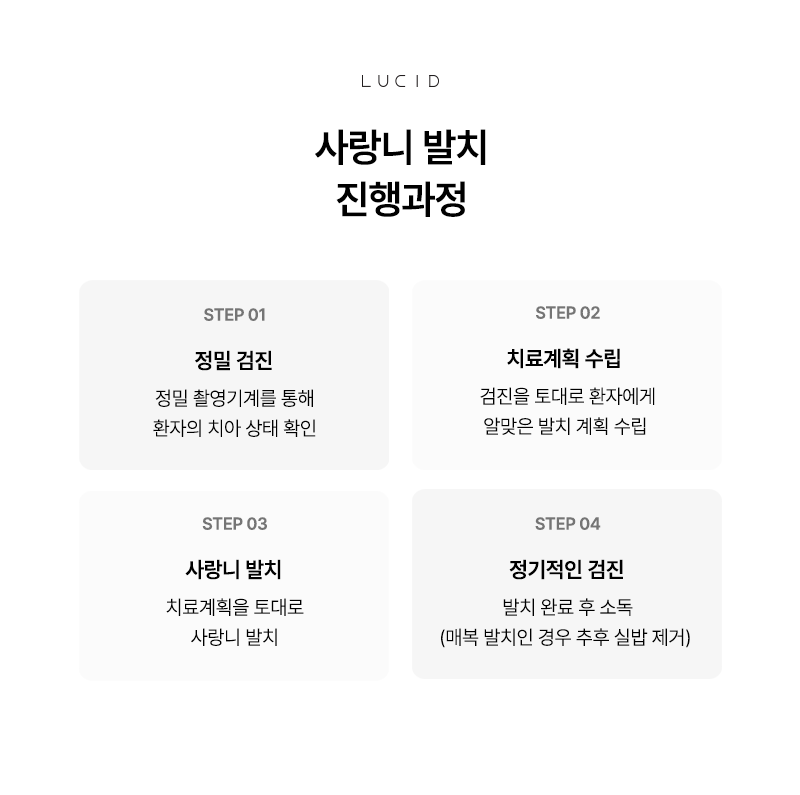
The basic process is as follows.
-
Imaging
-
Local anesthesia
-
Gum incision (if needed)
-
Tooth sectioning and removal
-
Bleeding control and suturing
However, the difficulty of extraction and the time required differ according to
the type of impaction, bone density, shape, and distance from the nerve.
Even for the same person, the difficulty of the left and right wisdom teeth can be completely different.
In other words, comparing it by saying, “My friend said theirs was over quickly, so mine should be fine,” is actually almost meaningless.
Everyone’s condition is different.
The real recovery process after wisdom tooth extraction
- Changes in pain
▪️Day 1: stiffness, mild pain
▪️Days 2–3: swelling and pain are at their strongest
▪️After day 4: swelling gradually decreases
▪️Days 7–10: daily inconvenience almost disappears
In particular, lower wisdom teeth often have a longer pain period than upper ones because the bone is harder.
- Swelling
Swelling is not inflammation; it is a recovery response.
It is a natural process in which the body protects the wound after surgery.
▪️Use an ice pack for up to 48 hours
▪️After that, a warm compress is more helpful
- A blood taste / reddish saliva
This is normal at first.
However, persistent bleeding needs to be checked.
- Stitches are usually removed in about 7 days
The timing of removal may vary depending on the degree of impaction.
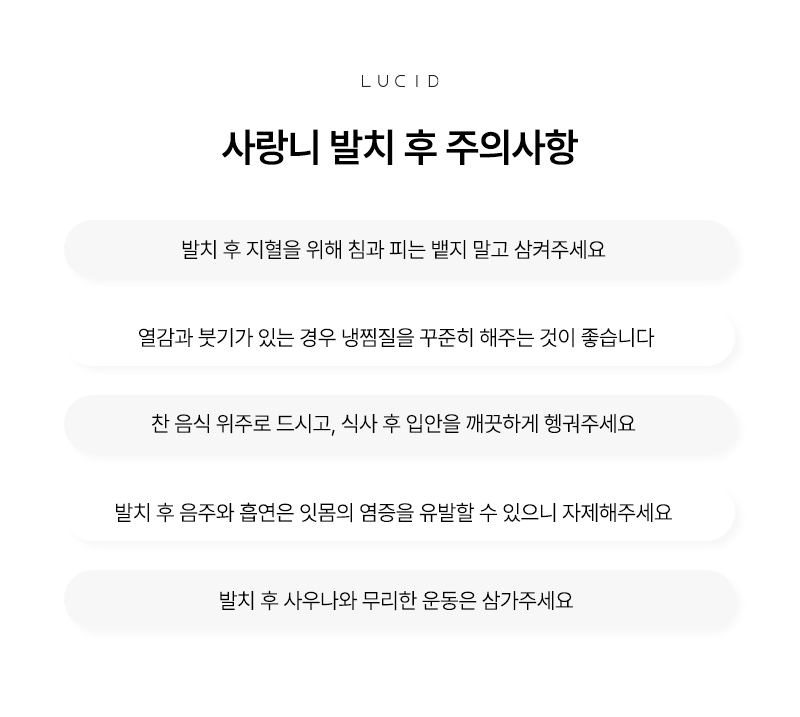
6 things you must absolutely avoid after extraction
Many people overlook this part,
but these are very important factors in determining recovery speed.
- Drinking through a straw
The negative pressure can dislodge the blood clot
- Using mouthwash
It can interfere with hemostasis, so do not use it on the first day.
- Hot food
May worsen swelling
- Smoking
Delays recovery and increases the risk of inflammation
- Vigorous exercise
Raises blood pressure and increases the risk of bleeding
- Touching the extraction site with your tongue or fingers
Interferes with healing + increases infection risk
Just following these six points makes recovery much more stable.
Why delaying wisdom tooth removal can make extraction more difficult
Many people say, “I’ll hold out a little longer... I’ll do it when I have time later...”
but in fact, as time passes, the root shape of the wisdom tooth becomes more complex
and it becomes more firmly attached to the bone.
In particular:
▪️Early 20s > often lower difficulty
▪️Late 20s to 30s > roots mature > extraction difficulty increases
▪️After repeated inflammation > surrounding tissue is damaged and recovery takes longer
In other words, even if symptoms are not severe right now,
a wisdom tooth that repeatedly causes problems may become more burdensome if left alone for too long.
A wisdom tooth is not simply “just one extra molar.”
It is a factor that can affect the overall health of your mouth.
Even if it does not hurt right now, if inflammation keeps recurring
or if it is confirmed to be in a poor direction,
it is best to consult a specialist and adjust the timing appropriately.
At Lucid Dental Clinic, after accurately checking each wisdom tooth’s position, shape,
and relationship to the nerves,
we provide thorough guidance on whether extraction is needed,
the expected process, precautions, and more, tailored to each individual’s situation.
If your wisdom tooth continues to cause discomfort or you are considering extraction,
please feel free to visit us for a consultation.
Lucid Dental Clinic
3rd–4th Floors, Coway Building, 606 Nonhyeon-ro, Gangnam-gu, Seoul
Naver Reservation :: Lucid Dental Clinic
Hello, this is Lucid, a Gangnam dental clinic loved by people with backgrounds as [celebrities] [influencers] [idols] [beauty pageant winners] :) Our Lucid Dental Clinic strives to provide dental care that considers both aesthetics and function. We understand very well that patients have gone through many concerns before coming to our clinic. Therefore, Lucid works to deliver maximum satisfaction and results with minimal treatment. The best treatment method is to preserve the teeth and gums as much as possible. We prioritize methods that can be done while preserving natural teeth, and even during treatment, we avoid damaging natural teeth as much as possible...
m.booking.naver.com
Lucid Dental Clinic
This is Lucid Dental Clinic, bringing you happiness.
pf.kakao.com