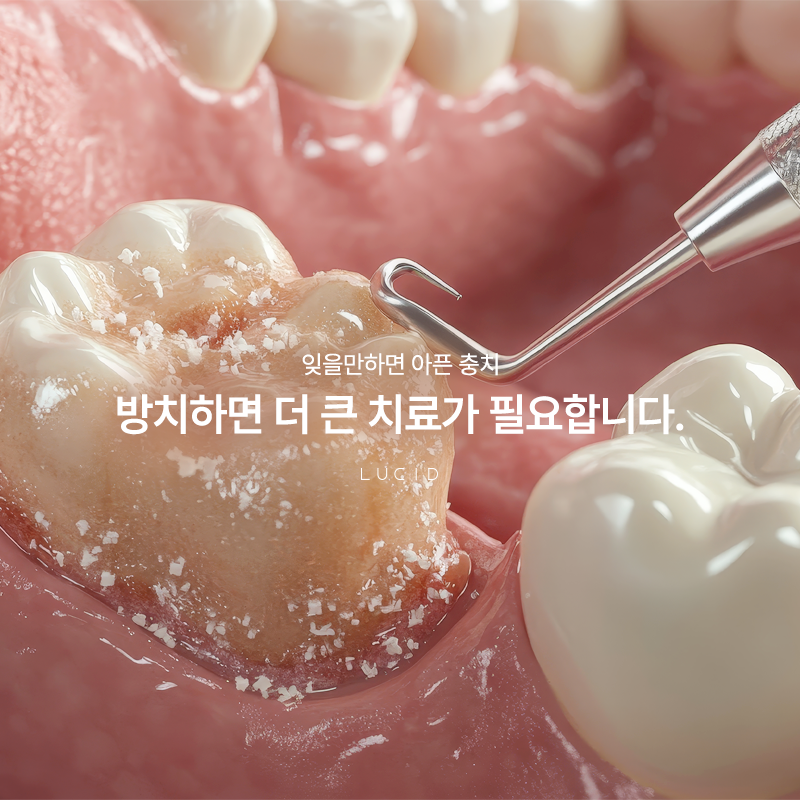
Hello. This is Lucid Dental Clinic.
Even if you think you brush your teeth well, there are times when your teeth suddenly feel sensitive or it feels like food keeps getting stuck.
Or, even without any particular pain, some people are surprised to hear during an exam that they have a cavity.
A cavity is one of the most common dental conditions many people experience. In particular, it is easy to miss the right time for treatment because, in the early stages, it is hard to see and there is little to no pain.
However, since cavities gradually deepen over time, it is important to detect them early and receive appropriate treatment.
If you keep putting it off, thinking, “It only feels a little sensitive, so it should be fine,” or “I’ll go when I have time later,” the scope of treatment may become larger. That is why it is important to understand cavities accurately and know when to visit a Gangnam dental clinic.
In this post, we will take a detailed look at cavities.
What Is a Cavity?
A cavity refers to a condition in which the surface of a tooth is damaged by bacteria.
When we eat, food debris remains in the mouth, and bacteria multiply on it and produce acids. This acid gradually dissolves the outer layer of the tooth, the enamel, and that is how a cavity begins.
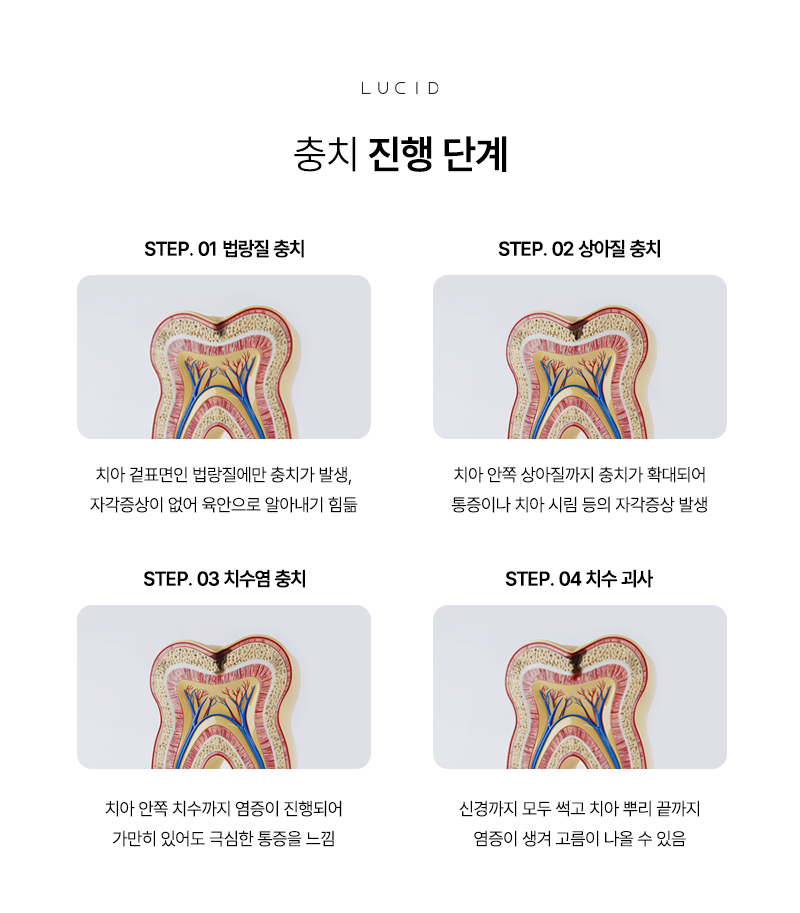
A cavity does not form overnight; it progresses gradually over time. In general, cavities develop through the following stages.
The outermost layer of the tooth has been damaged. At this stage, there is often no particular pain, so it is frequently discovered through regular checkups.
The cavity has progressed into the dentin, the inner part of the tooth. From this point on, you may feel sensitivity to cold foods, become sensitive to sweets, or notice that food gets stuck often.
If the cavity progresses to the tooth nerve, severe pain may occur. At this stage, root canal treatment may be needed rather than simple cavity treatment.
Self-Check Test for Cavities
If you have the following symptoms, you may want to suspect a cavity.
-
Your teeth feel sensitive when drinking cold foods or beverages
-
A specific tooth is sensitive when you eat sweets
-
Food feels like it gets stuck often in a specific tooth
-
You can see black or brown spots on the tooth surface
-
Your breath still feels bad even after brushing
-
A specific tooth feels uncomfortable when chewing
-
The tooth surface feels rough
-
The space between your teeth feels wider than before
If 2 to 3 or more of the above apply, getting an exam at a Gangnam dental clinic may be helpful.
Because cavities often progress in places that are not visible, it is important to confirm the exact condition through a dental examination.
Who Is More Likely to Develop Cavities?
Cavities can happen to anyone, but the likelihood may increase in the following cases.
- When you often eat sweets
Foods high in sugar, such as chocolate, carbonated drinks, and desserts, can stimulate bacterial activity.
- When you do not brush after late-night snacks
At night, saliva production decreases, which can make bacterial activity more active.
- When care between teeth is insufficient
It is difficult to clean between teeth perfectly with a toothbrush alone, so using dental floss or interdental brushes may help.
- When you do not receive regular checkups
Early cavities are often difficult to notice on your own and are frequently found through regular examinations.
How Is Cavity Treatment Carried Out?
Cavity treatment may differ depending on how far the cavity has progressed.
Step 1: Remove the cavity
First, the tooth tissue damaged by the cavity is removed. During this process, healthy tooth tissue is preserved as much as possible while only the decayed area is cleaned out.
Step 2: Restore the tooth shape
After removing the cavity, the empty area is filled with a restorative material to restore the tooth’s shape. Common materials include resin, inlay, and onlay, and the treatment method may vary depending on the location and extent of the cavity.
Step 3: Root canal treatment if needed
If the cavity has progressed to the nerve, root canal treatment followed by prosthetic treatment may be necessary.
Does Cavity Treatment Hurt a Lot?
One of the biggest reasons people delay dental treatment is concern about pain.
However, with the recent use of various anesthesia methods and equipment, discomfort during treatment has been greatly reduced.
In particular, the earlier a cavity is treated, the smaller the treatment area and the shorter the treatment time may be.
On the other hand, if a cavity is left untreated for a long time, the treatment process may become longer, root canal treatment may be needed, and the treatment area may become larger.
So if you notice any warning signs in your teeth, it may be helpful to check them as quickly as possible.
How Is the Cost of Cavity Treatment Determined?
The cost of cavity treatment may vary depending on the following factors.
For example, a small cavity may be treated relatively simply, but a deep cavity may require prosthetic treatment or root canal treatment.
Therefore, it is best to receive an accurate treatment plan and cost estimate through consultation after an examination.

Problems That Can Occur If a Cavity Is Left Untreated
A cavity does not naturally go away.
It may start as a small spot in the early stage, but over time it can gradually deepen.
If a cavity is left untreated, the tooth can be significantly damaged, root canal treatment may be necessary, and in severe cases, it can even lead to tooth extraction.
That is why it is important to detect and treat even a small cavity early.
Why Choosing a Gangnam Dental Clinic Matters for Cavity Treatment
Cavity treatment is not just about removing decay; it is also a process of restoring tooth function and managing the tooth so it can be used for a long time.
When choosing a dental clinic, it may be helpful to check whether enough consultation is provided, whether the current condition of the teeth is explained in detail, and whether the treatment plan is presented in an easy-to-understand way.
Features of Cavity Treatment at Lucid Dental Clinic
Because each patient has a different dental condition, a personalized treatment plan is important for cavity treatment.
At Lucid Dental Clinic, we carefully review the patient’s dental condition through sufficient consultation before treatment and guide them toward a treatment plan suited to their current condition.
In addition, through precise oral examinations, a systematic treatment process, and consultations that help patients understand their condition, we strive to make treatment as comfortable as possible.
Cavities can happen to anyone, but if they are detected and managed early, they may help maintain dental health for a long time.
Teeth are tissues that do not naturally recover once damaged. That is why, rather than leaving even a small cavity untreated, it is important to check and manage it at the proper time.
If you often feel tooth sensitivity or feel like food gets stuck frequently, it may be helpful to get a dental checkup. We hope you can maintain healthy teeth for a long time through regular care and appropriate treatment.
If you suspect a cavity or want to know about your dental condition, consulting a Gangnam dental clinic can be a good way to check your current condition.
Q&A
Q. Can cavities get better on their own?
A. Cavities are not a condition that recovers naturally.
In the early stage, there may be almost no symptoms, but they gradually progress over time.
Once the outermost layer of the tooth, the enamel, is damaged, that area does not regenerate on its own, so it is important to check the condition through a dental examination at the right time and receive the necessary treatment.
If detected early, treatment may be relatively simple, but if left untreated for a long time, the treatment scope may become larger.
Q. Can I have a cavity without pain?
A. Yes, absolutely.
Many people think a cavity must hurt to exist, but in reality, cavities that progress without pain are very common.
In particular, early cavities may have no particular pain, may only cause slight sensitivity, or may have no symptoms at all.
That is why it is important to check through regular dental examinations even if you do not have any special discomfort in your teeth.
Q. How long does cavity treatment usually take?
A. The treatment period may vary depending on the extent of the cavity and the treatment method.
For example, a small cavity > treatment may be completed in a relatively short time. A larger cavity > additional treatment or a prosthetic process may be needed.
The exact treatment period may vary depending on the condition of the tooth, so it is best to receive guidance through consultation after the examination.
Q. Once I get a cavity, will I keep getting them?
A. Treating a cavity does not mean you will never get another one. Cavities can be influenced by various factors such as diet, oral care habits, and tooth structure. That is why, even after treatment, it is important to manage your teeth with proper brushing habits, flossing, and regular checkups.
Q. How should I care for my teeth to prevent cavities?
A. To prevent cavities, daily oral care is important.
-
Proper brushing habits 2 to 3 times a day
-
Use dental floss or interdental brushes
-
Oral care after eating foods high in sugar
-
Regular dental checkups
These may be helpful. In particular, since cavities have almost no symptoms in the early stage, checking through regular examinations can help with prevention and management.

Lucid Dental Clinic
3rd–4th Floors, Coway Building, 606 Nonhyeon-ro, Gangnam-gu, Seoul
Naver Reservation :: Lucid Dental Clinic
[LUCID DENTAL CLINIC Lucid Dental Clinic] Lucid aims for dental care that designs both aesthetics and function, not just a place that simply treats teeth. We understand well that visiting a dentist requires a lot of 고민 and determination. That is why Lucid follows the principle of treating only as much as necessary, rather than treating as much as possible. Preserving teeth and gums as much as possible is the best treatment. We prioritize ways to protect natural teeth and, even when treatment is needed, provide precise care in a way that minimizes damage. [LUCINATE Premium Laminate] Lucid...
m.booking.naver.com
Lucid Dental Clinic
This is Lucid Dental Clinic, bringing you happiness.
pf.kakao.com