Hello, this is Lucid Dental Clinic.
You may be brushing diligently for the sake of your teeth, but have you ever experienced a moment when the surface of your teeth feels rough or your gums bleed? Many people wonder, “I brush well, so why do these symptoms happen?”
One reason is tartar.
Tartar is a substance that is difficult to remove completely even if we brush every day, and over time it hardens and settles between the teeth and gums. The representative dental treatment used to remove tartar is scaling.
However, many people still worry about scaling at a Hakdong Station dental clinic, asking, “Will it hurt?”, “Will it weaken my teeth?”, or “Do I really need it?”
Today, let’s take a closer look at what scaling is, when it is needed, and why regular scaling is important.
What Is Scaling?
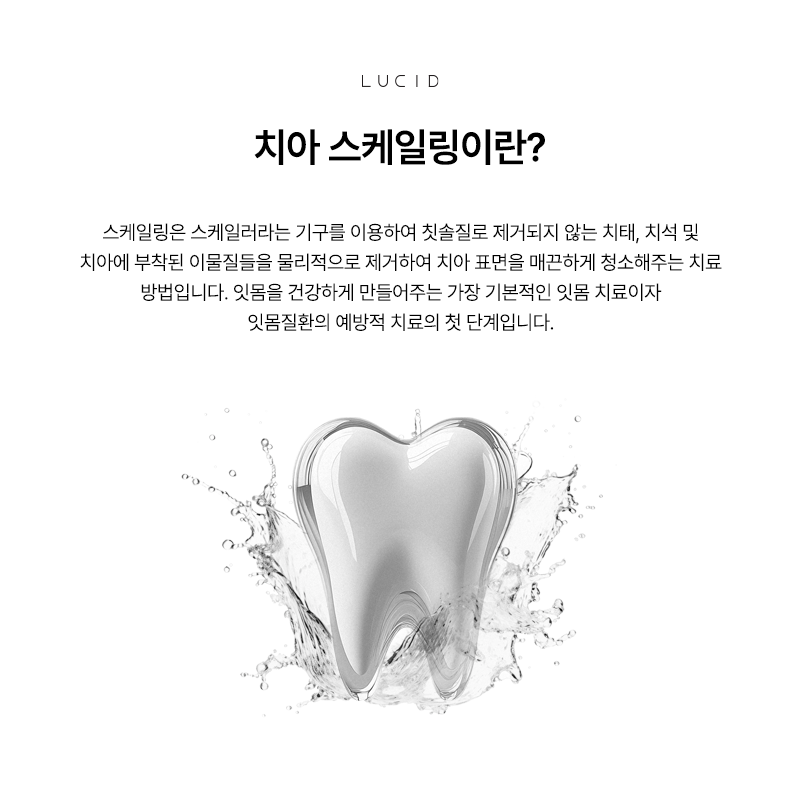
Scaling is a treatment that removes tartar and plaque accumulated on the surface of the teeth and around the gums.
When we eat, various bacteria are present in the mouth, and together with food debris, they form plaque on the tooth surface.
Because plaque is relatively soft, it can be removed to some extent by brushing. But if plaque is not properly removed and remains in place, over time it combines with mineral components, hardens, and turns into tartar.
When tartar forms, the following problems can occur:
In particular, because tartar attaches between the teeth and gums and creates an environment where bacteria can easily multiply, it can affect gum health over the long term.
Scaling can be seen as a treatment that helps manage the oral environment more cleanly by removing this tartar.

Why Does Tartar Form?
Tartar can form in anyone. No matter how diligently you brush, there are areas in the structure of the teeth that are hard for a toothbrush to reach.
In particular, tartar tends to form easily in the following areas:
In addition, the following lifestyle habits can also affect tartar formation:
For these reasons, scaling along with regular dental checkups is known as one of the basic ways to maintain oral health.
How Often Should You Get Scaling?
One of the most common questions people ask is about the scaling interval.
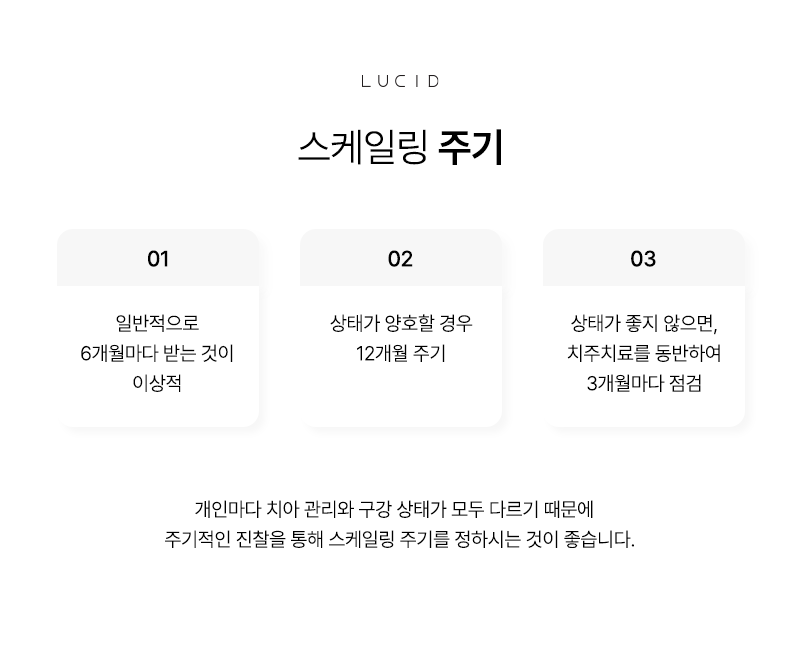
In general, many people receive regular scaling at a Hakdong Station dental clinic about once every 6 months to 1 year. However, this interval can vary depending on the individual’s oral condition.
For example, more frequent care may be needed in the following cases:
-
When tartar forms easily
-
When gum inflammation occurs frequently
-
When there is a history of periodontal disease
-
When wearing orthodontic appliances
On the other hand, if oral care is well maintained and the gums are stable, the care interval can be adjusted through checkups.
What matters is consistent monitoring and care of your oral condition rather than a fixed number of visits.

Is Scaling a Painful Treatment?
For people receiving scaling at a Hakdong Station dental clinic for the first time, pain is often the biggest concern.
In most cases, scaling is considered a relatively low-burden treatment, but depending on the condition of the gums, you may feel the following:
-
Mild discomfort when there is a lot of tartar
-
Temporary pain when there is gum inflammation
-
A sensitive feeling when the teeth are sensitive
However, these sensations are usually temporary and occur during the process of removing tartar, and in many cases they gradually ease over time after treatment.
Recently, ultrasonic scaling equipment and similar devices have made it possible to remove tartar more efficiently, reducing the burden of the treatment process compared with before.
If You Have These Symptoms, Scaling May Be Needed
If you have the following symptoms, it may be worth considering scaling at a Hakdong Station dental clinic.
-
Gums bleeding when brushing
-
The tooth surface feels rough
-
Bad breath is bothersome
-
The spaces between teeth look yellow
-
The gums are swollen or have turned red
Because these symptoms may be related to gum inflammation or tartar buildup, it may be helpful to check your oral condition through a dental examination.
Problems That Can Occur If Scaling Is Delayed
If tartar is not removed for a long time, it can lead from simple gum inflammation to periodontal disease.
As periodontal disease progresses, the following problems can occur:
In particular, because there is almost no pain in the early stages, the problem can progress without being recognized.
Therefore, regular scaling is not just routine care, but preventive care to help keep teeth healthy for a long time.

Scaling Care at Lucid Dental Clinic
Scaling at a Hakdong Station dental clinic may seem relatively simple, but a careful treatment process that takes into account the patient’s gum condition and tartar distribution is important.
At Lucid Dental Clinic, we check the oral condition before performing scaling and provide guidance so that treatment can be carried out while considering the patient’s gum health and tartar condition.
In addition, after scaling, we provide guidance on proper brushing methods, how to use dental floss, improving oral care habits, and the need for regular checkups so that long-term oral health management can be supported.
Dental health is not maintained by one treatment alone; it can be maintained for longer when consistent care and prevention are carried out together.
Because teeth are difficult to recover naturally once damaged, preventive care is very important. Scaling is not simply a process of cleaning the teeth, but one of the basic dental care methods that can help maintain gum health and prevent periodontal disease.
If you have gum bleeding when brushing, visible tartar, or it has been a long time since your last dental visit, it may be a good idea to check your oral condition.
At Lucid Dental Clinic, we carefully check patients’ oral conditions and help provide treatment for healthy dental care.
Start with a small habit for healthy teeth: regular scaling.

Scaling Q&A
Q. How often should scaling be done?
A. In general, many people receive scaling regularly about once every 6 months to 1 year. However, since the speed at which tartar builds up varies depending on a person’s oral condition and lifestyle habits, the care interval may differ. For example, more consistent care may be needed in the following cases.
-
When gum inflammation occurs frequently
-
When tartar forms easily
-
When wearing orthodontic appliances
-
When periodontal disease management is needed
It is a good idea to confirm the care interval that suits your oral condition through regular dental checkups.
Q. Why do teeth feel sensitive after scaling?
A. Some people may feel sensitivity after scaling. This can happen because the tooth surface that had been covered by tartar becomes exposed after the tartar is removed. In most cases, this gradually eases over time, and if the sensitivity persists, it may be helpful to consult a dentist and check your oral condition.
Q. Can scaling help with bad breath?
A. One of the causes of bad breath is tartar and bacteria accumulated around the teeth. As tartar builds up, an environment that allows bacteria to multiply easily can form, so removing tartar through regular scaling can help manage the oral environment. However, the causes of bad breath can vary, so if discomfort continues, it is a good idea to find the cause through a Lucid Dental Clinic examination.
Q. Are there any precautions after scaling?
A. After scaling, teeth may temporarily feel sensitive, so the following points may be helpful.
-
Avoid very hot or very cold foods for a while
-
Reduce intake of刺激ive foods
-
Maintain proper brushing habits
-
Use dental floss to care for the spaces between teeth
Above all, the most important thing is to maintain regular oral care habits.

Lucid Dental Clinic
3rd and 4th Floors, Coway Building, 606 Nonhyeon-ro, Gangnam-gu, Seoul
Naver Reservation :: Lucid Dental Clinic
[LUCID DENTAL CLINIC Lucid Dental Clinic] Lucid aims for dental care that designs aesthetics and function together, not just a place to treat teeth. We understand that visiting a dental clinic requires a lot of 고민 and determination. That is why Lucid’s principle is to treat only as much as is needed, rather than treating a lot. It is best to preserve teeth and gums as much as possible. We prioritize methods that preserve natural teeth, and even when treatment is needed, we provide precise care in a way that minimizes damage. [LUCINATE Premium Laminate] Lucid...
m.booking.naver.com
Lucid Dental Clinic
This is Lucid Dental Clinic, bringing happiness.
pf.kakao.com