Hello. This is Lucid Dental Clinic.
Today, we will take a more detailed look at the Q&A about wisdom teeth that many people are curious about.
Wisdom teeth are the last teeth to erupt as you become an adult, and they usually appear in the late teens to early 20s.
However, they do not appear in the same form at the same time for everyone. In some cases, they do not erupt at all, and in others, they remain impacted within the gums.
Because of this variety, wisdom teeth are seen as teeth that require management and judgment rather than simply ordinary teeth.
In particular, wisdom teeth are located at the very back of the mouth, which makes them difficult to care for, and they have structural characteristics that make problems more likely to occur.
That is why many people have questions about whether they should be removed, when to remove them, pain, and how to care for them.
Today, we will go through the questions that are often asked during wisdom tooth consultations at Yeoksam Dental Clinic.
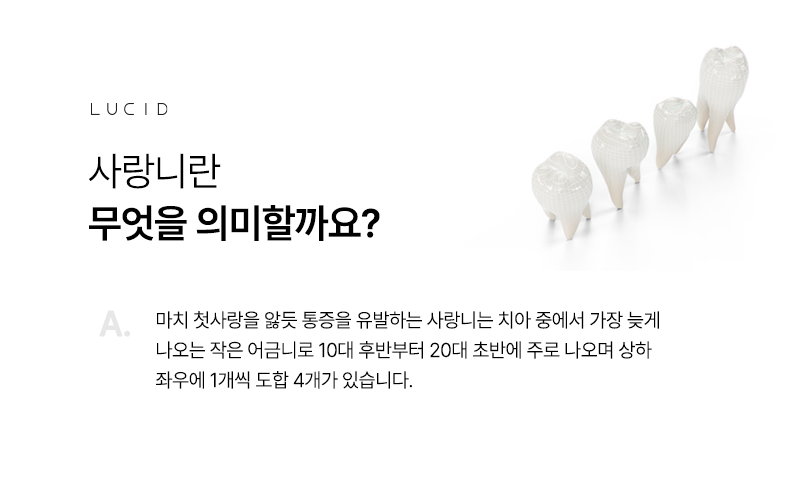
Q. Do wisdom teeth always need to be extracted?
A. Wisdom teeth are not teeth that must always be removed.
If they grow straight in a normal way, harmonize with the surrounding teeth, and can be kept clean, it is possible to leave them in place.
However, in reality, extraction is considered in the following cases.
-
When the wisdom tooth pushes against the adjacent tooth and causes pain
-
When only part of the gum covers it and food frequently gets stuck
-
When inflammation or swelling occurs repeatedly
-
When decay develops in the wisdom tooth itself or in nearby teeth
In particular, wisdom teeth are structurally located where a toothbrush does not easily reach, so plaque and food debris can accumulate easily.
Because this environment increases the likelihood of cavities or gum disease, it is important to consider not only the current condition but also whether it will be manageable in the future when making a decision.
Q. If a wisdom tooth does not hurt, can I just leave it alone?
A. The absence of pain does not mean there is no problem. Wisdom teeth are teeth that can gradually cause problems even without symptoms.
For example, in the case of an impacted wisdom tooth buried in the gums, there may appear to be nothing wrong on the outside, but inflammation may be progressing inside, or the tooth may be pressing on the root of a nearby tooth.
Also, if food gets stuck and decay develops, there may be little to no pain in the early stages, so discovery can be delayed.
To prevent these hidden problems, it is important to check the current condition through regular examinations.
Rather than waiting until pain develops, checking in advance before problems arise can lead to easier management.
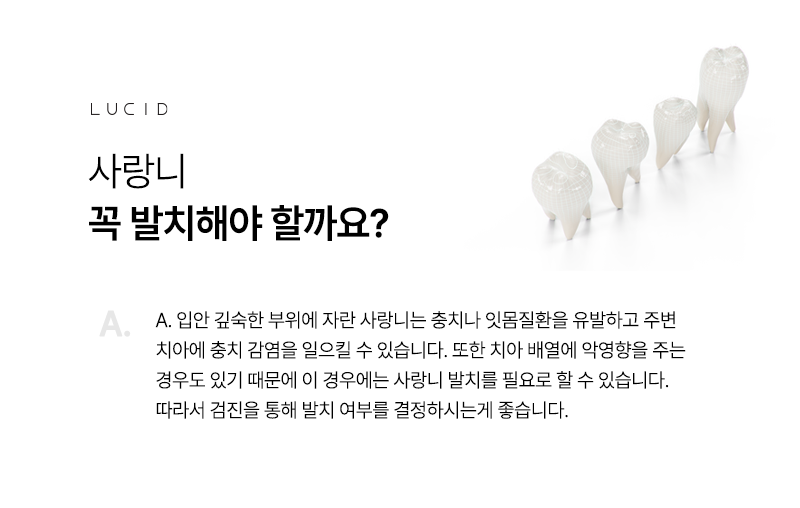
Q. When is the best time to remove wisdom teeth?
A. The timing for wisdom tooth extraction depends on each person's oral condition. Rather than there being a fixed time, extraction is considered in situations such as the following.
-
When inflammation such as pain or swelling recurs
-
When decay is progressing around the wisdom tooth
-
When orthodontic treatment is planned
-
When gum disease has occurred or is likely to progress
Also, in general, extraction may be considered during a period when recovery is relatively good.
However, rather than setting the timing in advance without exception, it is more important to make the decision after accurately checking the current condition of the teeth.
Q. Is wisdom tooth extraction very painful?
A. This is one of the biggest concerns people have about wisdom tooth extraction. Often, the concern is less about the extraction itself and more about the pain and recovery process afterward.
In reality, it varies depending on the person's dental condition, the degree of impaction, and the difficulty of extraction, and swelling or discomfort may occur for a certain period after extraction.
-
Swelling or soreness may last for about 2–3 days after extraction.
-
There may be some discomfort when eating.
-
In some cases, opening the mouth wide may feel uncomfortable.
However, if you follow the precautions you are given and get enough rest, the condition will gradually stabilize.
Q. What should I be careful about after wisdom tooth extraction?
A. Post-extraction care has an important effect on recovery. It is good to be careful about the following.
-
Avoid using straws or spitting forcefully
-
Avoid very hot or irritating foods for a certain period
-
Refrain from drinking alcohol or smoking, as these can affect recovery
-
Do not frequently touch the extraction site with your tongue or hands
-
Take the prescribed medication as directed
In particular, the extraction site needs a natural healing process, so minimizing irritation is important.
Even a small habit can affect the speed of recovery, so careful management is needed.
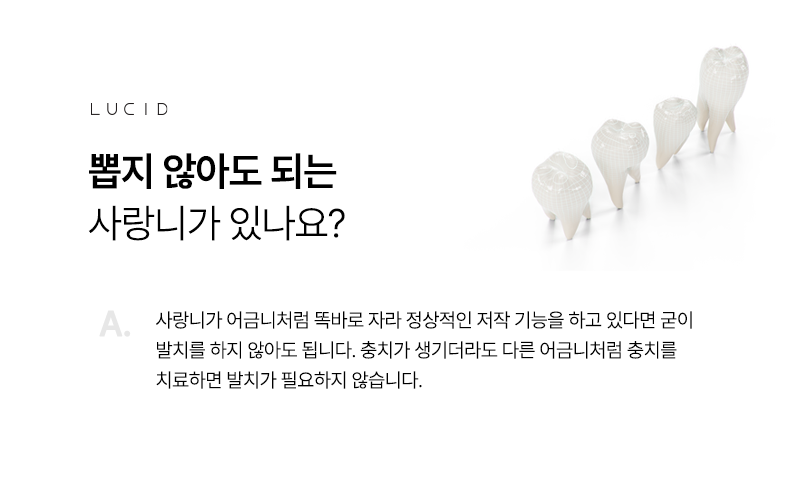
Q. What problems can occur if I do not remove a wisdom tooth?
A. There are various problems that can occur if Yeoksam Dental Clinic leaves wisdom teeth in place.
-
It may cause cavities in adjacent teeth
-
Gum inflammation and swelling may recur
-
Food trapped around it may cause bad breath
-
It may affect the alignment of the teeth and cause imbalance
In particular, because the space between the wisdom tooth and the tooth in front is difficult to care for, cavities may develop in both at the same time, so caution is needed.
Q. Do impacted wisdom teeth always need to be extracted?
Impacted wisdom teeth refer to teeth that are completely or partially buried within the gums. In this case, depending on their position and direction, they may affect the surrounding teeth or gums, so a more careful examination is needed.
Not all impacted wisdom teeth are candidates for extraction, but extraction may be considered in the following cases.
-
When there is a possibility of pushing against or damaging the adjacent tooth
-
When inflammation occurs repeatedly
-
When the possibility of future problems is judged to be high
Therefore, it is important to make a diagnosis accurately and consider both the current condition and the possible future course.
Wisdom teeth are not teeth that should be judged simply as 'present or absent'; rather, their current condition and how they may affect future oral health should be considered together.
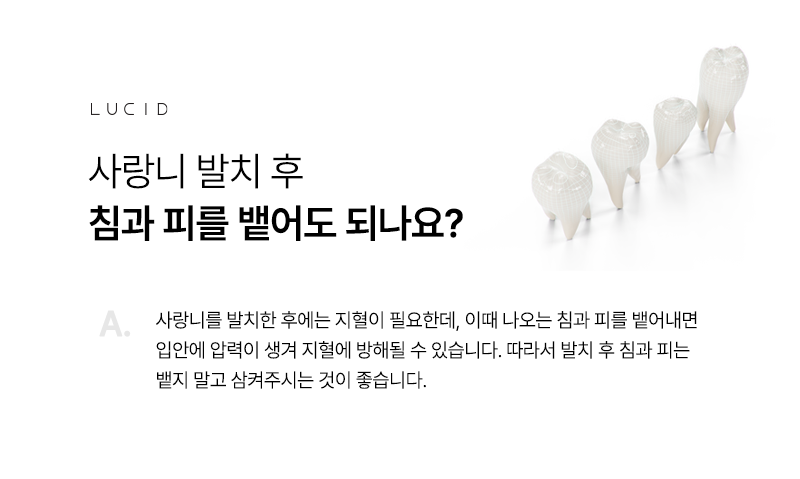
Wisdom teeth: accurate diagnosis and planning are important.
Wisdom teeth are not teeth that should be judged simply as 'present or absent'; rather, their current condition and how they may affect future oral health should be considered together.
Because each person's wisdom tooth position, direction, and level of care are different, the approach can vary even in similar situations. That is why it is important to establish a personalized plan based on an accurate diagnosis.
We recommend that not only people who are uncomfortable because of wisdom teeth, but also those who do not have any special symptoms yet but are curious about their condition, check in advance through regular examinations.
A little attention and care can help maintain a more comfortable oral condition.
If you have questions, contact Naver TalkTalk!
Lucid Dental Clinic
3rd–4th Floors, Coway Building, 606 Nonhyeon-ro, Gangnam-gu, Seoul
Naver Reservation :: Lucid Dental Clinic
[LUCID DENTAL CLINIC 루시드치과] Lucid aims to provide dental care that designs both aesthetics and function, not simply a place that treats teeth. We understand well that it takes a lot of 고민 and determination to visit a dental clinic. That is why Lucid follows the principle of treating only as much as necessary rather than treating a lot. Preserving teeth and gums as much as possible is the best treatment. We prioritize ways to protect natural teeth and provide precise treatment in a way that minimizes damage even when treatment is needed. [LUCINATE 루시네이트 프리미엄 라미네이트] Lucid...
m.booking.naver.com
Lucid Dental Clinic
This is Lucid Dental Clinic, which brings happiness.
pf.kakao.com